electrocd

Blog

267 results
  • 1
  • 2
  • 3
  • 4
  • 5
  • 6
  • 7
  • 8
  • 9
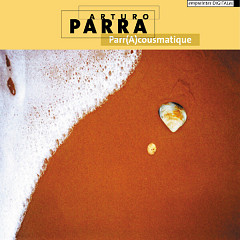
  • Parr(A)cousmatique, Arturo Parra in Sonoloco Record Reviews

    “Review”, Ingvar Loco Nordin, Sonoloco Record Reviews, November 25, 2002
    Monday, November 25, 2002 Press

    Arturo Parra (1958), born in Colombia, has been living in Canada since 1989. For the last ten years he has been busy composing and performing contemporary pieces, often with the guitar in different contexts. He is interested in sonic exploration, as well as development of new playing techniques and the stretching of the possibilities for the guitar in modern art music. Parra has also been active in the spoken word idiom.

    This CD has an interesting background. It all stems from Arturo Parra’s idea back in 1997 to commission works for electroacoustics from several well-known composers. They were Francis Dhomont, Gilles Gobeil, Robert Normandeau and Stéphane Roy; all very successful in their fields. The commission was for pure electroacoustic works, which Parra then would use to compose other works for guitar and electroacoustics. In 1998 both versions of each of the then four works were heard in concert in Canada. Another peculiarity of this project was that the financing was a shared commitment by The Canada Council for the Arts and The Colombian Ministry of Culture.

    This CD contains the final mixed results, i.e. the versions that Arturo Parra achieved with the compositions delivered by the four composers mentioned above plus an extra entry managed in the same way, electroacoustically composed by Colombian composer Mauricio Bejarano.

    The guitar parts were played by Arturo Parra without the use of any manipulative means, recorded in realtime on an instrument built by Manuel Contreras in Madrid, Spain in 1984.

    La basilique fantôme (The Phantom Basilica) begins the selection. Its electroacoustic part is composed by Stéphane Roy. The atmosphere here is that of a remembrance of the souls that have prayed in the basilica, and one has the feeling of centuries of shadowy figures out of the past coming to life once more. A dark breath of air comes at you at the very beginning, but the guitar fingers swiftly along a gallant figure, which gets rhythmic and even very melodious, tenderly touching upon a simple melody, however darkly mirrored and shadowed in the electroacoustics. The rustling movements of long skirts or gowns in an electroacoustic string section sounds like the silent voices of a sea of people, swaying back and forth in time, receding back in the ages and emerging out of the darkness of death; a pale, shy battalion of ghastly shapes, conjured up out of their beyond by intruding visitors. The fabric of this cumbersome piece is dark, with a somber hue, almost not visible in the dusky corners of the basilica, and soon everything will pass, the forlorn shapes unable to retain the energy that keeps them visible or semi-visible for this short duration.

    D’or et de lumière (Gold and Light) is composed – its electroacoustic layer – by Mauricio Bejarano. The vision of the composer was a dense forest with a lake, into which a man dives, offering himself up to the God or perhaps the gods. Around the lake – still in the composer’s vision – thousands of bodies (he say “bodies”, not “people”) are lost in a trance dance. The music is grainy at first, fragments of audio shimmering like grains of sand in the sun and between teeth. It strikes me that this project as such is a strange bird at empreintes DIGITALes. The mixed form – especially with the tightly curbed prerequisites of this set — is very hard to do something very good with, as it oftentimes comes out superficial or forced. This release is not totally free of this malice, but I do declare that the result is unusually successful anyway, with this little remark in mind. The electroacoustics of track 2 are delicate, minuscule, tempting, and the guitar remains much a lone elf in this gleaming electroacoustic environment. I wouldn’t mind hearing a developed version of the electroacoustic of this piece by itself.

    Sol y sombra… L’espace des spectres (Sun and Shadow… Ghosts Over the Ring), was composed in its acousmatic part by Seigneur Francis Dhomont. In this composition Parra has had the bullring in mind, having the guitar and the tape part confront each other like the matador and the bull. Parra even mentions Manuel de Falla in his introductory text. Without a doubt, this entry is the most exciting so far on the CD, with a richness of sounding material, more equal with the guitar than in the former pieces, in a web of ingenious sounds in which the guitar just adds a peculiar glance, a certain flair, from the so-called real, analog, realtime (explain that word to Einstein!), daily life. This hint at everyday strife is however delivered by Dhomont in a dreamy, mirrored kind of way, and he even uses, figuratively speaking, brass mirrors of The Old Testament, which do not deliver sharp-edged reflections, but hazy approximations of life, and the string theorists of today would say that this is more to the point, since nothing, no matter, no energy, is absolutely certain, but rather a little elusive, floating, evasive… no matter how practical and empiric we believe that we are… These almost twelve minutes of Dhomont-Parra turns out to be a masterpiece, and with Francis Dhomont involved – a man with only masterworks in his catalog – this is no surprise… but it makes me happy anyway, as I was just losing some hope for the mixed form.

    Soledad (Solitude) is Gilles Gobeil’s go at this project. Parra says that he aimed the guitar at the expressions of solitude, separating each of the guitar sounds from each other, stripping the instrument of its harmonic properties. A slow atmosphere, a murmur deep down, a long sigh, followed by yet another sigh, spaced far apart, opens a transparency, an openness beneath bridges, at zero-points, in areas with lots of cargo in harbors when no one is at work, a Sunday afternoon at the docks, occasional ants passing over cracks in the cement, cranes resting with bowed necks along the wharf. This is another masterpiece, slightly contoured around a thin-aired space with lots of empty time, lots of un-sounding sounds, a wide gesture over vast areas, water trickling like in a movie by Andrei Tarkovsky; Stalker… and we’re in the Zone, treading it in rubber boots and gas masks, just to make sure… These eerie illusions are skillfully instigated by Gilles Gobeil, and Arturo Parra has followed suite and managed a perfect match. Nothing here feels “mixed”. This is a coherent audio poem in subdued, withheld post-war shreds of darkness, flying up like silent ravens around are hopes…

    L’envers du temps (The Other Side of Time) closes the album. Robert Normandeau is the electroacoustician. Parra’s text on the piece takes us into the timelessness beyond time, into a state of mind which is, in fact, in my view, much more true than the daily, frantic dealings with time, because in a universal aspect everything is happening simultaneously, or rather without the hindrance of linear time. Everything that has happened is in the same state, in the same place, as is everything that has not yet happened – and try to define a NOW! Impossible. It’s just a theoretical interface of past and future. Alas, like I like to say: All times are now; all places are here! The initial sounds are like fenders rubbing against the quay-edge as a gentle swell rolls in, from died-down storms far below the horizon. I also get the feeling of crickets measuring time in a hypnotic beating of very short durations, so short and close that they turn into a pitch, a cicada pitch of illusionary time, producing gravity as it curves, having us rest like plummets through the space-time continuum. The music is very gentle, the fender sounds of the guitar mingling with pianistic guitar sounds, in a simmering, vibrating atmosphere which grows denser only to thin out, in a breathing motion, myriads of cockroaches and silver-fish welling up out of planetary cracks in the moonlight outside a coastline steelworks on the Baltic Sea… but in this vision the guitar provides a prayer bead of tones to hold on to in a consoling message from benign spirits in the timelessness…

    liberum arbitrium, morceaux_de_machines in Sonoloco Record Reviews

    “Review”, Ingvar Loco Nordin, Sonoloco Record Reviews, November 25, 2002
    Monday, November 25, 2002 Press

    These laptop goblins make sure nothing is really sure anymore, as they bring the fuzzy principles of quantum mechanics and string theory into the world of binary sonics, played backwards in time, it seems, to the beat of sprawling chronometer meltdowns, clocks and spiders crawling away across cracks in the cement, time bent in on itself, curving ever deeper into spirit and matter, ever closer to the core of the NOW, as the minute, minuscule slices of time with their minute – but densely packed – fragments of lives are mangled through a wormhole in space-time with a Gargantuan might that distorts everything recognizable and well-known into pointillist approximations of an echo of the solid, bohemian safety of A Prairie Home Companion… individual remains of human lingual morphemes floating up into conscience in flaky dandruff residue – and I’m talking about music, don’t you forget, music right above the surface of dirty blue jeans and shimmering Macintosh interfaces, out of frantic, warm circuits in a mystery machine right out of The Hitchhiker’s Guide to the Galaxy – but DON’T PANIC!!!

    The Quebec City radio show Napalm Jazz on CKIA–FM back in the mid 1990s constitutes the beginnings of the duo work of Aimé Dontigny and Érick d’Orion. The concept of the show was a wild mix of avant-garde, hip-hop, free jazz, electronics, found sounds and musics, which lays down the direction of the subversive workings of these guys up until this today, obviously providing enough creative force to keep them staggering down this wildman path!

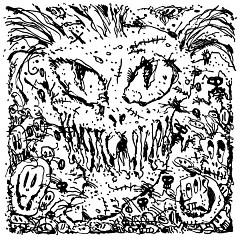
    The packaging is something extra here. It is made like regular empreintes DIGITALes covers, with a contraption of fold-out, hard, high-quality paper, but the art is overflowing and really compelling here, with demonic drawings by cartoonist Guy Boutin and wonderful water colors by Sophie Dowse. The whole impression of this package is one of bursting, overflowing, overpowering creativity. Flow with it or bend out of the way and hide, until it sweeps by!

    In track 2 I actually find a more overarching, modal structure, in a bubbling frenzy which the mind glues together into a bead, a line, a melody of sorts, if only from a distance, as fractions of voices add a human touch, and the static of telephone lines through minus 40 Lapland wastelands wheeze and crackle through the human predicament with needy messages for a hungry ear beyond the weather…

    There is nowhere to hide from this army of lightning rods inside your head, emerging from the core of Self, cutting away at your stray thoughts like a battalion of paper shredders in an office high-rise. Piano bar melodies are smeared all over the walls, as something gets back at something for something. We slide up against the back wall, easing sideways past the most awesome of goings-on, as the fish jump in frenzied electrocution in their center room aquarium, seconds before impact, as the avenger comes flying in, bent on avenging the 2nd, 3rd and 4th world, as he recognizes “the disgusting thing that causes desolation standing in a holy place” [Daniel 12:11 & Matthew 24:15], and Armageddon is on…

    Track 3 brings hallucinatory voices into a woman’s warmth and shelter (Twas in another lifetime, one of toil and blood, when blackness was a virtue and the road was full of mud, I came in from the wilderness, a creature void of form; ‘Come in,’ she said, ‘I’ll give you shelter from the storm’ [Bob Dylan]) as skin peels descend like soot-flakes from an arson epidemic all across the parking lot as you run and keep on running, away, away, away…

    I get the idea that these sounds may be what alien civilizations on forlorn worlds out of thinkable reach may one day find as the electromagnetic remains of our moment in time on Earth, the distorted transmissions from a died-down culture, a faded-away species, soar past their receivers scanning their cold skies for traces of spiritual spurs down the galaxy clusters and beyond…

    morceaux_de_machines is a virtual dream machine, injecting the listener with such a wild array of visions that peyote and mescaline becomes futile accessories. Aimé Dontigny and Érick d’Orion have found a modern, high-tech backdoor into age-old shaman rites and magic otherworldly experiences – which goes to show that each time in history has it’s on way of boring into the layers of consciousness, towards pre-intellectual domains of bliss and wonder. When genuine and authentic medicine men of contemporeana (for example lap top wizards) take on this feat as seriously as morceaux_de_machines, the means are there, installed, up and running, for anyone with a clear ear to utilize – and I do, with the pleasure of a whooopeee mind rider!

    morceaux_de_machines is a virtual dream machine, injecting the listener with such a wild array of visions that peyote and mescaline becomes futile accessories.

    Traces in Array Online

    “Review”, Tae Hong Park, Array Online, November 18, 2002
    Monday, November 18, 2002 Press

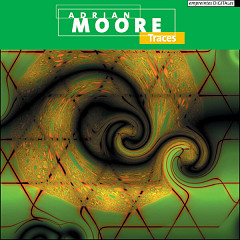
    Adrian Moore’s CD Traces (2000) showcases five electroacoustic music works from 1994 to 1997. All five pieces on the CD are acousmatic, i.e. they involve no intervention of ‘performed materials.’ Mr. Moore’s fluency and eloquence in manipulating and shaping sound objects such as recorded tinfoil, a marker pen, and balloons is of the highest craftsmanship. While listening to the tracks one can imagine him steering his magic mouse from pixel to pixel, and conjuring up sound images that often reveal no clear traces of their origins or roots. At the same time, as in the last piece Sieve for example, the composer does use recognizable and familiar sound sources but puts the listener in a new listening environment through strategic juxtaposition of those sound materials: “Normally one would listen to cars when approaching an intersection and listen to the birds or the wind in the trees as one walks along the sidewalk. If this was reversed and we listened to the cars as we walked along the sidewalk and the birds at the intersection, our relationships to the environment would be changed.”

    Sieve also deals vividly and directly with the notion of space in music. In one section of the piece the listener is washed out from an interior sound space to an exterior one space a la ‘Ono Fluxus flush’. In another moment you’re inside a room that has a deafening silent feel of an anechoic chamber, listening to the ringing of a small carriage clock and the next moment you suddenly find yourself in the courtyard of a cathedral with its overwhelming ambience. The transportation occurs rapidly, yet in a consistently streamed projection achieved through the use of the timbral boolean product between the clock’s chimes and large bells from the church. Constant bizarre juxtapositions of sound objects that morph from the known to the unknown and unknown to the known appear throughout the piece and in some cases, sounds such as the church bells return transformed to a degree of ‘ambiguous certainty’, most notable towards the end of the recording. The listener is often induced to seek out residual traces of original sound sources that seem to be temporally and spectrally altered. However, one is in most cases given one second and one timbral feature too little to overcome one’s ‘uncertainty of certainty’ regarding the identity of the timbre.

    The first track Junky (1996), according to Mr. Moore is ‘electroacoustic ambient’ music. One can quite easily hear both the ‘electroacoustic’ and ‘ambient’ elements in the piece although the heredity of the sounds themselves is digitally smeared via sonic treatment to render unrecognizable sound objects. The form however, is a more familiar one and follows an A, B, A+B, and a coda design with various ‘cadential’ points. In fact, traditional musical idioms such as melody, harmony, and rhythm appear in various parts in the piece. A slowly moving harmony, which strongly makes up the ambient part of Mr. Moore’s ‘electroacoustic ambiance’, mainly hovers around a steady C# major tonality omnipresent throughout the piece. However, the ambient moments are not something that would be regarded as ‘music for airports’: the smooth ambient clouds are constantly tagged with insect-like gestures that oscillate unpredictably between the foreground and background soundscapes. The idea of ‘electroacoustic ambient’ music further extends itself to the second track Dreamarena also composed in 1996. However, the ambient sound qualities soon become fainter and more aggressive gestural characteristics begin to color the piece. Insect-like sounds that resemble bits and pieces heard in the first track crawl all over the sonic terrain in Dreamarena and the compositional manipulations what seems like granular synthesis, accentuates the behavior of the tiny digital night-bugs.

    Unlike the first two pieces, Study in Ink (1997) and Foil-Counterfoil (1997) use close-miking techniques to capture recognizable real-life sounds as a means to an end — to bring out concealed sonic layers of the recordings. The main starting sound in Foil-Counterfoil is not surprisingly tin foil. Mr. Moore uses the idea of ‘re-hearing’ the tin foil through the investigations of sonic features from other sources such as glasses, balloons, and bottles. In other words, the ‘counterfoil objects’ or the tin foil’s ‘opponents’ (bottles, glasses, etc.) serve as a means to reveal hidden sonic features of the tin foil itself. The low-level timbral feature extraction exercises in deconstructing the multidimensional make-up of the tin foil through seemingly unconnected sound objects and the highlighting of sonic intersections between the tin foil and unrelated sounds exemplifies Foil-Counterfoil. The listener is invited to hear and trace common sonic nodes, intersecting junctions, and acoustic overlaps between distantly related sound objects that he or she would not normally even try to link together. Study in Ink is similar to Foil-Counterfoil in that it deals with exposing different sound layers — comparing, relating, referencing, and incorporating it to other unrelated sound objects. However, in Study in Ink the composer uses the recording of a single marker pen only and transforms it into a variety of new sounds. Compositions based on single sound sources are of course not new — one of the earliest pieces being Pierre Henry’s Variations pour une porte et un soupir (1963). However, Adrian Moore takes the idea to a much higher dimension and sculpts the simple yet idiosyncratic sound object into a plethora of surprising, humorous, and musical objects. One is constantly surprised at the local sonic stops that are made until the piece reaches its final destination after 10 minutes and 22 seconds. For example, at one point the marker pen transforms into various types of quasi-birds, sheep, and insects. At another point in the piece the composer further stretches the spectral and temporal boundaries of the pen and places the listener in a virtual jungle with all its sonic and spatial intricacies. Yet in another moment, perhaps as homage to Pierre Henry, a door creaking gesture is made and at approximately 2’33” into the piece a quasi-human voice sighs out of the blue — somewhat reminiscent of Edgar Varèse’s sudden injection of a sighing female voice in Poème électronique (1958). But the vague similarity with Varèse’s piece only lasts for a very short moment as the quasi-human voice morphs into what seems to resemble a howling beast in the mountains of Transylvania?

    Without a doubt Traces features an abundance of densely-populated aural soundscapes that bring about countless savoring moments of musicality, humor, surprise, and strategic placement of sound objects in time, keeping the listener extremely busy until the very last sound byte is spun out by the CD player. The meticulously placed sounds in space are also one of the highlights present in all five pieces on Traces. Perhaps his experience with the BEAST (Birmingham Electro Acoustic Sound Theatre) system inclined him to give particular importance to the spatial aspect of composition in this CD. Of all the interesting moments in the pieces however, possibly due to the unexpected contrast, one of the most beautiful moments on this whole CD is a dry and fleeting silent sector at the beginning of the last track.

  • 1
  • 2
  • 3
  • 4
  • 5
  • 6
  • 7
  • 8
  • 9