electrocd

Blog

267 results
  • 36
  • 37
  • 38
  • 39
  • 40
  • 41
  • 42
  • 43
  • 44
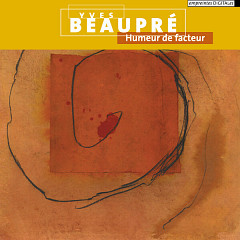
  • Humeur de facteur in The WholeNote

    “Review”, Den Ciul, The WholeNote, no. 7:5, February 1, 2002
    Friday, February 1, 2002 Press
    This recording could not have fallen on more sympathetic ears. I share a profession with M. Beaupré (harpsichord building) and also a life-long interest in electroacoushc music (and my son, Michael, is a composer in this genre).

    The sounds that provide the raw material for these works were recorded in M. Beaupré’s harpsichord shop — the bumps, thumps, whirs, tappings, clickings, pluckings of harpsichords as work in progress. Some of the samples are musical, some are just sounds. The structure follows the form of a Suite (“Ordre”) of pieces by Francois Couperin, one of the brightest lights in the harpsichord world.

    This is a very interesting genre as it draws composers from many musical styles, from rock to classical. The realization here is well crafted and it is evident that there is structure and development of the material. Six hours of recordings were made of the daily workings of the harpsichord shop and these sounds were processed and manipulated as computer samples. It is not music in the conventional sense, performed from a score on musical instruments by musicians. It does have thematic material and a kind of polyphony. There is exposition and development following classical forms. M. Beaupré speaks of working and assembling the parts into a whole, as he works the components for his harpsichords from carefully selected materials into the finished instrument. Here we have the transmogrification of the physical workshop into an electronic one.

    The title Humeur de facteur (The Maker’s Humour) is perhaps a pun on several levels, and an indication that this work is not to be taken too seriously. This is certainly not to everyone’s taste, but it is worth a hearing. It is clever, charming, and humourous.

    It is clever, charming, and humourous.

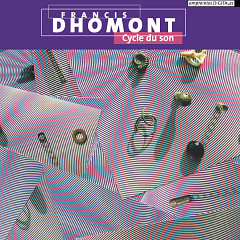
    Cycle du son in The WholeNote

    “Review”, Randall Smith, The WholeNote, no. 7:5, February 1, 2002
    Friday, February 1, 2002 Press

    Recollecting a sonic spirit that has evolved over 50 years of imagining, visioning and sensing, Francis Dhomont’s new CD Cycle du son takes us back to the roots of an unusual art form and returns us to the here and now, intact and enlightened. We are summoned by the jolt, forced to hear the distinctive characteristics of musique concrète of old before being led confidently into the present. After all, the first composition Objets retrouvés is a memorial to one of the inventors of the medium, Pierre Schaeffer.

    Collectively the four compositions included here provide a sonic history of acousmatic art. The classic sounds are intertwined and juxtaposed with new inventions providing a palette of rich colours and dynamic tones.

    Francis Dhomont, who divides his time between his native France and Canada, delicately weaves a kaleidoscope of sound objects, evolving fluidly and freely through a maze of juxtapositions and contrasts. From the waves of an ocean to the ripple created by a single drop of water he dramatically takes the listener through an experience that is both terrifying and serene. Dhomont’s skillful resources do not end with capturing the sound abjects themselves, however; even with such complex and dynamic sound material his attention to pitch relation and form leaves one firmly convinced of his mastery.

    If I were asked to recommend a single CD to introduce one’s ear to the world of musique concrète, I would say Cycle du son. What Pierre Schaeffer revolutionized in France, Francis Dhomont continues to explore to new heights and this is a CD about which I can say without reserve, everything works.

    If I were asked to recommend a single CD to introduce one’s ear to the world of musique concrète, I would say Cycle du son.

    Ohmix in The Wire

    “Soundcheck Review”, Julian Cowley, The Wire, no. 216, February 1, 2002
    Friday, February 1, 2002 Press
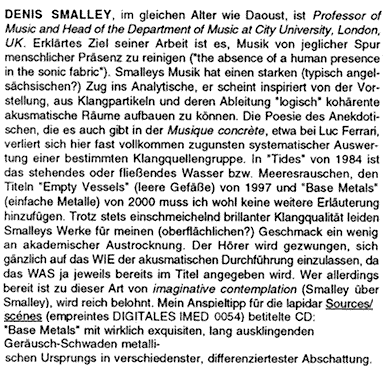
    For Ohmix the Quebec based Avatar Foundation invited eight composers to plunder the back catalogue of its OHM Éditions imprint and produce new work through their remixes and transformations. German recyclist Ralf Wehowsky, of P16.D4, kicks things off with a steadily building shimmer that peaks in a flurry of samples followed by a gentle, pulsing decline. Montréal turntablist Martin Tetreault’s brief contribution collapses muitiple sources into a jittery flux, music and voice sped up and whisked into an agitated state. French composer Christian Calon produces a tense dystopian piece in which an impoverished and seemingly distressed human voice is hemmed in by shadowy electroacoustic forms. Terre Thaemlitz contributes Transit(ional Edit) a clicking gridlock of synthetic horn sounds, an angry and terminally immobile jam. There are two pieces from arch plunderer John Oswald. Ohmigone (re)constructs a radio phone conversation, empty words drifting amongst inhuman sounds in a communication vacuum. Ridge builds from ripples to waves to a breaker of lush piano music. Spikier piano runs through an animated piece by Diane Labrosse, who has played with the groups Wondeur Brass and Justine. Tinkling bells, organ chords and reedy blasts, cartoon squeaks and distorted human voices are among the other elements in this soundtrack to some enigmatic narrative. Ambient technician David Kristian spins out an enigma of another kind. His Ohmite gradually intensifies from pinpoint to full glare without ever revealing the source of its luminous throb. Finally Alexandre St-Onge, an improvising associate of Kristian, drains the remaining air from the Ohmix atmosphere, mimicking the micro rhythms of a puncture or a gas cylinder with an open valve. A long, measured breath out. The OHM policy of taking risks often results in albums that include arresting episodes yet are uneven overall. A more selective project, Ohmix is consistently worthwhile.
    Ohmix is consistently worthwhile.
  • 36
  • 37
  • 38
  • 39
  • 40
  • 41
  • 42
  • 43
  • 44