electrocd

Blog

366 results
  • 1
  • 2
  • 3
  • 4
  • 5
  • 6
  • 7
  • 8
  • 9
  • Rumors of War in Splendid E-Zine

    “Review”, George Zahora, Splendid E-Zine, December 3, 2003
    Wednesday, December 3, 2003 Press

    Admit it: you’ve thought about war more in the last twelve months than you ever have before. Most of us have. We’ve discussed it, sometimes heatedly, with friends and co-workers, read and responded to polls and surveys, and perhaps even attended a rally or two. But how many of us have undertaken an existential examination of modern-day war?

    Italian duo Metaxu (Filippo Paolini and Maurizio Martusciello) have engaged in just such an exploration. They present their thoughts in Rumors of War’s twelve pieces, each of which is named for a significant conflict or human-engineered disaster. The album begins with the event that set the ball rolling for World War I — the assassination of Archduke Franz Ferdinand on June 28th, 1914 — and takes us through (what else?) September 11th, 2001. Metaxu have even included the fateful dates in their track titles, just in case you want to grab an encyclopedia.

    These aren’t songs in a conventional sense (thank God — can you imagine the lyrics?). At best they’re abstract, conceptual collages punctuated by moments of musicality, some of which are startlingly lovely; at worst, they are aural reconstructions, full of metaphors writ large and loud. 06091945 Hiroshima is a cyclical accumulation of elements from the IDM palette — pops, clicks, clacks, bleeps and burbles — with voices half-audible in the background. Perhaps it’s meant to conjure the sterile stillness that follows a nuclear explosion. 07121941 Pearl Harbour ties more directly into reality, progressing from an ominously beautiful minor-key string sequence to an abrupt and ferocious attack, sounds and voices screaming from the sky like giant angry insects. 02051982 Falkland gradually layers an ominous, rumbling bass presence over a gentle pastoral atmosphere as if directing the full weight of the world’s attention at the titular islands.

    11092001 New York will be most listeners’ best bet for making a contextual connection with Metaxu’s muse. If you think you’re no longer haunted by the World Trade Center disaster, listen to this one on headphones and get ready to be disturbed. The hint of Arabic music deep in the collage may not get to you, but later in the tune, when the central, keening drone rises in volume and intensity, becoming the scream of a tortured jet engine pushed beyond its design tolerance, you’ll be well and truly creeped. Fortunately, Metaxu don’t linger over the actual crash; the end, when it comes, is as sudden and sharp and devoid of detail as the real thing must have been.

    Rumors of War is an unusual, intermittently powerful album, capable of leaving you disturbed (the aforementioned 11092001 New York) and frustrated (it’s mastered pretty low, so plan on being jolted out of your chair by a handful of quiet-to-loud transitions) in roughly equal measure. There’s no real dialogue between Metaxu and the listener, and no revelation beyond the fact that violence and war are sad, terrible things. Then again, that’s clearly a lesson we need to relearn every twenty years or so.

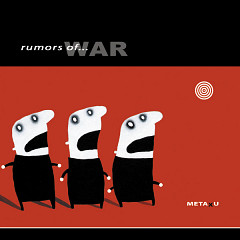
    … an unusual, intermittently powerful album, capable of leaving you disturbed…

    Sings the Blues in Splendid E-Zine

    “Review”, Walt Miller, Splendid E-Zine, December 3, 2003
    Wednesday, December 3, 2003 Press

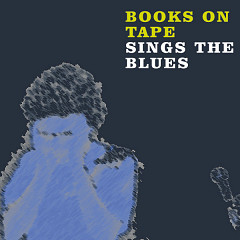
    If you judge a book by its cover (get it? Books on Tape? “book by its cover”?), LA resident Todd Drootin, the latest punker turned electronic miscreant whom you need to know, might seem more of a fit within the Tigerbeat6 clique than a Montréal highbrow label like No Type (which has jointly released this sophomore album in Europe and Canada). In Drootin’s world, everything is fair game. Electronica, hip hop, rock, jazz, breakbeats, theme pop: it’s all in there, as long as it can be used, abused and bent into compliance — albeit barely — with a shit-eating grin. Books on Tape’s mischievous core is exposed as a whimsical bright spot within IDM’s crowded field — much like a Kid606, to whom he’s often compared. However, with abstraction seeming to be the rule these days, Drootin represents a stark contrast to his laptop peers, as his sound is relatively unmolested by plug-in technique. Sings the Blues has its own methods of unearthing balls-to-the-wall stream of consciousness; here, the sonic freeflow that wants to be Zappa-electro-free jazz is kept in check by linear production and a high degree of organization. Where some artists rely on wayward mouse clicks to give their music a push, Drootin has a plan. Needless to say, it’s refreshing.

    Early on, Sings the Blues (which, if you haven’t figured out by now, has little do with the blues), hits you over the head with playful hooks and personality to match, gradually becoming less civilized as the raucous energy takes over. Tracks like Republic Of (a mix of Amon Tobin and Prefuse 73 hip-hop futurism) and See You In Tokyo (in which the Batman and Munsters themes collide in a Shibuya backyard alley) team with hip hop and rock sensibility — an alliance that Drootin won’t let you forget. Girls Up Front gives a taste of Drootin’s beat programming pedigree, a complex barrage of loop science in which our hero throws another rock bassline into the prickly chaos of the Squarepushin’ briar patch. The cartoonish Death In the Sex Shop continues the arc; its berserker onslaught could be likened to Naked City on a crack high after an all-night recording session with every product in the Sweetwater catalog.

    Toward the album’s end, Drootin lays in with a masterstroke of choppy techno-funk on Sidekick, a rare moment of obvious digital processing discipline. Otherwise, Books on Tape flaunts each meticulously programmed note, as well as each breakbeat loop notched carefully upon the next — in some ways, a throwback to the days when MIDI churned through Cakewalk and 16 note polyphony. Thankfully, Drootin doesn’t overthink things. His melodic leads — there are quite a few — are not fancy; it’s as if he hits record and taps in the next tuneful thing that pops into his head, and never mind the inspired skullduggery that surrounds it. Mike Paradinas perfected this trait, but Books on Tape takes it to a different plane altogether, where even a track like The Crucial, with its ironic Prodigy-style breakdown, can succeed with the help of thematic contortions. It would be a mistake to brand Books on Tape as less sophisticated based on Drootin’s apparent methods, but it’s worth mentioning this point because it sets him apart from his competitors.

    Books on Tape’s mischievous core is exposed as a whimsical bright spot within IDM’s crowded field…

    Face the Front

    Tuesday, December 2, 2003 General

    After a surprising performance in Montréal for the Rien à voir (14) concert series held October 2003, iconoclasts activists behind Front, Max Haiven (Halifax) and Jon Vaughn (Saskatoon), are now disseminating their irrevencial work across Canada. Contrarily to many contemporary works, Front is a 73-minute composition which cause nothing less than a confrontation between your perception of the world and the world itself! When is the last time you truly experienced art?

    December 9, 2003: Volt-AA (08) Concert, Montréal

    Monday, December 1, 2003 In concert

    The Volt-AA (08) concert sees the gathering of Jean-Pierre Gauthier, USA minimalist composer Richard Chartier in his long awaited first appearance in Montréal since Mutek 2000, Cal Crawford whose minimal works combine rigorous sound research as well as risk taking, and i8u, who makes a return to Volt-AA following a long period of sound research and exploration to present yet another fascinating journey into digital manipulation of field and studio recordings. The concert is held on December 9, 2003 at Montréal’s Société des arts technologiques (SAT).

    Bleak 1999 in Stylus Magazine

    “Review”, Deanna Radford, Stylus Magazine, December 1, 2003
    Monday, December 1, 2003 Press

    That’s right, produced in 1999, this 2003 release offers a good retrospective of Jirku’s earlier work. Perhaps the album title displays a hard-pressed attempt to describe what the sounds encapsulated within are like… ‘bleak’ really downplaying the kinds of interesting sonic junctures and consistencies that Jirku is so obviously capable of creating. It’s not to say that the overall grain of the album is not dark. Bleak 1999 certainly is a dark-sounding foray, with quiet beats and slowly peering sonic arcs and bows; it’s worthwhile to hear what kind of direction Jirku’s work has come from. Having said that, this album is for people who are interested in what Jirku’s musical palette has consisted of, and Bleak 1999 contains many smart and desirable sounds worthy of your attention, even four years after their original creation.

    … a dark-sounding foray, with quiet beats and slowly peering sonic arcs and bows…
  • 1
  • 2
  • 3
  • 4
  • 5
  • 6
  • 7
  • 8
  • 9