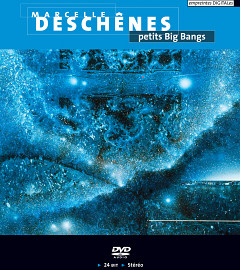
Not only does empreintes DIGITALes release the music of its core composers like Dhomont, Normandeau, Calon — all acknowledged first class acousmaticians — but it also has room for lesser known talents. Marcelle Deschênes is one of the latter group with a very crafty repertoire.
This disc presents work spanning the years 1976 to 2000. Six major works, two of which are thematically connected. Her sonic language is rich (as is the case with most of the ED composers), explosive, harmonic, and at times sensual. Although the music for the most part fits the acousmatic bill, with sounds in turmoil, audiotechnological machismo and abstract structure there are definitely bends and corners inside the compositions that reveal the touch of a woman.
Deschênes studied with Schaeffer himself and Guy Reibel during the late 60s. After that she returned to her home state Quebec and worked as a lecturer and was involved in many organisations there. She has connected her work to many multimedia and theatre productions and some of these are presented on this disk.
The disc starts off with Big Bang II. This is a work that was started in 1987 and has been reworked in 1995. It is a surprisingly versatile composition. It offers very nice and subtle granulated sounds, but also a female choir, short snippets of Tuvalian throat singing and typically sampled sounds. The structure of the piece is very well paced.
Indigo, second on this disc is the first part of a diptych called Griffes (Claws). Deschênes started this work in 2000 and considers this piece still unfinished. Indigo proceeds at a slow pace. Low drones superimposed by higher pitched covers set the atmosphere until at around 4 minutes a suddenly climax lets the work take a corner and new material is entered. Voices, together with electronic sounds, build up tension several times, each time going from rest into more restlessness.
Until the Le bruit des ailes (The Sound of Wings) starts with the same low drones acompanied by the sound of wings flapping. Quite a happy scenery. This continues until a huge disruption changes things dramatically. (I was really surprised to hear harsh distorted sounds (lots of loud block waves here), which is quite unusual within the ED context.) The sound of wings takes on different forms which are not at all very nice and sweet. The theme for this piece is from Hans Christian Andersen’s tale The Ugly Duckling, where the wings are stretched and mutilated and mixed with the sounds of ice storms, erupting volcanoes and the sounds of nuclear bombs exploding.
Lux, the fourth composition here, starts with a voice reciting the word ‘desire’ again and again. Deformed, crying out in a whispering voice, the atmosphere is immediately threatening. This piece is the audio part of a multimedia work that was constructed by Renée Bourassa, in 1985. A very strong work this is, with craftily pronounced text by Openheimer, Shaw, Kant, Rutherford and Bourassa. Interestingly the aural part of this worksounds a bit dated because of use of so typical digital instrumentation especially in the parts approximately from the 5th until the 10th minute and at multiple occasions later in the piece. Sampler, synclavier, however modern and high tech they were in 1985, they sound ancient in 2007. As a whole a very strong work, though. The piece feels a bit like Laurie Anderson who was popular at the time.
The next work is Moll, opéra lilliput pour six roches molles. This is the oldest work, dating from 1976. this is the only piece that also involves acoustic instruments (clarinets, trombones, percussion and toys). The work is versatile, exciting and a very good mixture of electronics and fantastic craftmanship on the instruments. The booklet tells us that “this suite of 17 miniatures is the result of long, obsessive hours spent looking at the ordinary gray pebbles on the Bas-Saint Laurent beaches”. That gives it lovely exotic touch (especially when I hear the small children’s voice singing a song, while typing) but the work itself is already good enough without any exotic liner notes. It’s brilliant and the world could have known as early as 1976 that Deschênes is a very fine composer.
Alright then, the final piece: Big Bang III: an hommage to Earth. 2 minutes 38 seconds, a soundscape to accompany a 3D film at the planetarium. And that’s all I have to say about it. Well done, but I would not have entered it in this collection. Ending with Moll would have blasted me away. This is sort of a disappointment, albeit a short/small one.

![Louis Dufort [Photo: Valérian Mazataud, Montréal (Québec), March 2018]](https://res.electrocd.com/image.php/image/d/dufort_lo.11980.jpg?width=n2&cropratio=1:1)
![Milliseconde topographie [Photo: Isabelle Gardner, Montréal (Québec), 2005]](https://res.electrocd.com/image.php/image/m/millisecondetopograp_.2.jpg?width=n2&cropratio=1:1)
![John Young [Photo: Cecilia Young, Leicester (England, UK), July 2023]](https://res.electrocd.com/image.php/image/y/young_jo_13447.jpg?width=n2&cropratio=1:1)
![Francis Dhomont [Lisbon (Portugal), November 30, 2018]](https://res.electrocd.com/image.php/image/d/dhomont_fr.9171.jpg?width=n2&cropratio=1:1)