electrocd

Blog

257 results
  • 8
  • 9
  • 10
  • 11
  • 12
  • 13
  • 14
  • 15
  • 16
  • Lieu-temps in Touching Extremes

    “Review”, Massimo Ricci, Touching Extremes, September 1, 2008
    Monday, September 1, 2008 Press

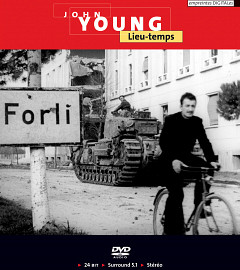
    As soon as the sign “Forlì” was spotted on the cover I got curious, as understanding the perpetual attraction of distant visitors for that socio-cultural quagmire called Italy — by far one of the most overrated countries in the globe in every sense, except perhaps the splendour of some of the landscapes and a few historic/artistic sites — keeps making a living as a perplexing matter in my mind. Still, this audio DVD is much more significant than that type of scrutiny, depicting how the shock of war (in this case, WWII) and the might of an everlasting reciprocal devotion often intertwine branches. John Young’s father Alex was in that city in 1944, a soldier in the New Zealand contingent of anti-German allies. Right there he met Tarcisia Fariselli — “love at first sight”, as Alex himself explains — who became his wife, following him after the end of the conflict. The crossroads of these destinies is movingly portrayed by a son who, admirably, devoted a huge endeavour to the circumstances during which his parents began to share a life. In Ricordiamo Forlì, Young utilized their voices, tapes of onsite reports from that era’s transmissions (from the archives of BBC and Radio New Zealand) and extraordinary field recordings of the city, the most frequent being the tolling bells of the churches, which the composer feels as “something permanent, yet alive” communicating a strong emotional message to a man who had listened to these recollections since he was a kid but only in 2002 was able, together with dad, to inhale the air of the place where it all happened. The set’s design, despite its intensely dramatic suggestions, sounds at times like an amazing fairy tale (also due to the essential presence of Franco Bianchini’s narrating voice) as Young magnificently delivers the blend of complementary sensations underlying the account through a vast range of breathtaking sonic structures, so striking that the great amount of spoken word segments never challenges our endurance; on the contrary, one’s impatient to know “what happens next”. The piece emerges as an intense acousmatic journey, utterly worthy of the 1st prize won at the Bourges International Festival in 2007. Another affecting composition for small orchestral group and electroacoustics, Arrivederci, closes the record with a touch of class by the Stroma ensemble, whose responsive reading of the score meshes with the ever-present sound of a bell — processed or less — closing a circle where grieving memories seem to claim the protagonist’s role, even when love is central in the unfolding story. Tangible mournfulness in a next-to-masterpiece oeuvre.

    Tangible mournfulness in a next-to-masterpiece oeuvre.

    Environs in Touching Extremes

    “Review”, Massimo Ricci, Touching Extremes, September 1, 2008
    Monday, September 1, 2008 Press

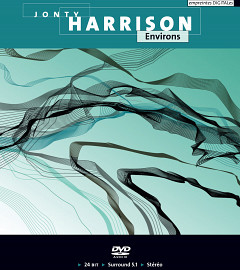
    In presence of records such as Jonty Harrison’s Environs one is tempted to leave the leaf totally bare, with the exception of a solitary word: listen. The English composer and director of Birmingham’s BEAST fully deserves to be put side by side with the Ferraris and the Parmegianis of the world, that’s for sure. Few recent acousmatic releases have succeeded in keeping my interest levels persistently high, a program length of circa 76 minutes notwithstanding. Yet it’s right there, on the long distance, that we’re in the condition of sizing up the diverse abilities of those who play in the electroacoustic ground. While most of them need to methodically slice, glue, juxtapose and reinvent their sonic clothes only to sound more or less musty at the end, Harrison focalizes his awareness on the purest elements of life, both from a biotic point of view and the perspective of personal experience. He constructs amazing pieces entirely based on aquatic constituents which, contrarily to many bathed-in-obviousness mélanges, appear psychologically overwhelming to the extent of making us literally feel like drowning (Undertow). Otherwise, he stitches together car engines and other means of transportation to engender a whole range of inner-city rhythms and patterns (Internal combustion). The last track Afterthoughts is built upon “sounds of a suburban garden in early summer”, yet it resembles an alarming sequence of snapshots of disheartening isolation, the human factor all but absent in favour of intimidating roars, sharp clangour and ominous crescendos of insurmountable metropolitan unease. The whole toughened by superlative skills in the assessment of timbral structure and a sense of architectural symmetry that not many names operating in this area can challenge.

    The whole toughened by superlative skills in the assessment of timbral structure and a sense of architectural symmetry that not many names operating in this area can challenge.

    Les arbres in Sonomu

    “Review”, Stephen Fruitman, Sonomu, August 28, 2008
    Thursday, August 28, 2008 Press

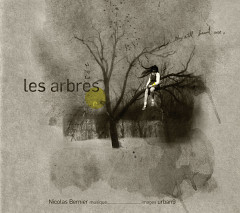
    A real coffee-table book of a package. Housed in its handsome slipcover are a slim CD case and six quality postcards, each featuring a montage by visual artist Urban9, with its title on the back.

    Each title naturally corresponds to a complementary track by composer Nicolas Bernier. The idea behind this project was to collaborate over disciplinary boundaries, allowing the images to inspire the music and the music aid in assembling the visuals. If I understand correctly, this give-and-take process went back and forth through to a final revision.

    The montages of Urban9 are composed on grey on grey backgrounds with patient balance and painful symmetry, which becomes all the more apparent the deeper you look into each image. At the centre of each but one stand photographs of children, removed from their original context in some family album from the Victorian age or the 1940s, to judge by their clothes. In some, faces shine brightly, even preternaturally, while in others they are partially or wholly obscured. Gazing deeper into the frame there are the eponymous trees, of course, featured in every piece. But the trees are uniformly denuded, bereft of leaves and possibly also of life. Gaze even deeper and you find ghost writing, flower X-rays, an owl, and other eggingly incongruous elements, all drawn together to form a very cohesive whole. If I had to pick a favourite, it would be the second image, // This Is a Portrait, with its young schoolboy cradling a lamb in his arms, unexpressive eyes fixed directly on the photographer’s lens, impatient to get this over with.

    I am also very attracted by the music for this piece, which features longtime Bernier collaborator Delphine Measroch on accordion and cello with Bernier on guitar and “audio transfiguration.” This piece is as truly murky and deep with layers as Urban9’s visuals.The strings and accordion even add a hint of French-Canadian folk music, if only by mere presence rather than express style.

    With his computerized hammer and chisel, Bernier has sculpted each piece out of sparse instrumentation — a guitar or two, some brass, piano, strings and the above-mentioned squeeze-box.

    At times his interpretations are much more literal — “sound-effect-y,” if I may coin an unwieldy term — than expected, or necessary. When this happens it appears that more restraint at the computer keyboard would have been preferred.

    However, most of the time his electronics complement his acoustics admirably, lending them just the righ patina. Les Arbres is gloomily enchanting, for example // Piano, where the thoughtful depression of a deep piano note is allowed to swell and subside before venturing a new one. // Bora, an “audio bricolage” according to the composer, is not my favourite track — too much of the sound-effectery mentioned before — but the foghorn rumble he has his sampled trombones emitting is almost physically seductive. The sentimenal violin of Pierre-Olivier Gaudreau on the closing track (perversly titled // Ouverture) is peppered with very unsentimental electronic debris but this sonic juxtaposition only works to enhance the feeling of oneness between the visual art with its layered depth and the musical art’s similarly stratified sonic geography.

    An exciting, possibly even profound work from a young composer, and an introduction to the work of one very interesting visual artist.

    A real coffee-table book of a package. Housed in its handsome slipcover are a slim CD case and six quality postcards…

    August 31 – September 4, 2008: Final Concert of M&R’s Workshops: Dhomont, Vande Gorne

    Saturday, August 23, 2008 In concert

    Musiques & Recherches summer worshops in Ohain (Belgium) will take place from August 31 to September 4, 2008. The final concert will notably propose the spatial diffusion on M&R’s “wide format” acousmonium of Espace / Escape by Francis Dhomont and Figures d’espace by Annette Vande Gorne. The concert will take place, on September 4, at the Grange of the Ferme du Biéreau in Louvain-la-Neuve.

    August 15 – 21, 2008: morceaux_de_machines is Back

    Thursday, August 14, 2008 In concert

    morceaux_de_machines, duo formed by A_dontigny and Érick d’Orion, will present its new audio works in Québec City and in Montréal:

    • August 15, 2008 (9 pm): with Maximus (Christian Messier), Saphir Martini (Fred Carrier, Catherine Lefrançois, Vincent Bélanger, Alexandre Lefrançois, Maxime Lefrançois, Luke Dawson) at 840 Saint-Joseph Est in Québec City.
    • August 21, 2008 (9 pm): with holzkopf (Jake Hardy), DJ Kutcorners at L’envers in Montréal.

  • 8
  • 9
  • 10
  • 11
  • 12
  • 13
  • 14
  • 15
  • 16