electrocd

Blog

107 results
  • 1
  • 2
  • 3
  • 4
  • 5
  • 6
  • 7
  • 8
  • 9
  • Topographies in Rif Raf

    “Love on the Bits”, Fabrice Vanoverberg, Rif Raf, no. 194, October 1, 2013
    Tuesday, October 1, 2013 Press

    Disciple de Robert Normandeau, et ça veut dire beaucoup au fan d’électroacoustique, Martin Bédard et ses Topographies (empreintes DIGITALes) explorent un sentier certes couru depuis Iannis Xenakis, mais qui a la bonne idée de s’éloigner de l’objectif initial. Hormis un début qui évoque d’un peu trop près le souvenir du compositeur franco-grec, l’artiste québécois rend sur ses cinq pièces honneur au titre de l’album. Oubliant toute forme de monotonie assommante, Bédard multiplie les contrastes et les contre-champs, quitte à donner le vertige au milieu de la tempête. Et si parfois, on ne sait plus trop si l’on préfère la pluie eu beau temps, on y trouve toujours de quoi satisfaire une curiosité sonore de tous les instants.

    … on y trouve toujours de quoi satisfaire une curiosité sonore de tous les instants.

    Topographies in Trebuchet

    “Music Review”, Alexei Monroe, Trebuchet, September 17, 2013
    Tuesday, September 17, 2013 Press

    While there’s a booming re-issue business for the work of historical electronic composers such as Xenakis, rarely does contemporary acousmatic and electroacoustic work make it beyond the specialist audiences of specialist labels, or the confines of university music departments.

    This is partly because sometimes in this scene there has been a deliberate attempt to deter or confuse outsiders and to keep work purely for the initiates. On this evidence, that’s a great shame, as Topographies is a very important release, deserving of the widest audience possible.

    … a vast sonic space mapped out by a thrilling, visceral flow of scurrying sounds…

    Martin Bédard is a French-Canadian teacher and composer. This is his first solo release but his work has been used in installations, theatre pieces and he has received several composition prizes. Topographies is actually a collection of 5 acousmatic works dating from 2005 to 2012, but successfully mastered in 2012-13 to give the impression that they could all have been composed at one time as a coherent album.

    Grand dehors opens with what may or may not be the sound of creaking door. It’s soon clear that this won’t be an arid, hyper–cerebral release. Angular blocks of sound sweep across a dense soundscape, occasionally reversing on themselves before sudden acclerations that break up slower, more pacific interludes. The sounds approach and recede at pace. One of the snaking sequences sounds like a distorted snatch of music garbled by shortwave interference.

    Listening on headphones the effect is equally stimulating and unnerving. After the drama comes a very elegant and precise fade out.

    Another dramatic start announces Topographie de la noirceur, but the mood soon shifts to a more uneasy ambience, populated by cold, shimmering tones and rattling sonic debris. At one point a beat kicks in briefly – perhaps a recording of a printing press or some other large machinery – but is never allowed to dominate.

    The epicentre of the album is the longest track, the 16-minute epic Push & Pull, a vast sonic space mapped out by a thrilling, visceral flow of scurrying sounds. These are interspersed with quieter passages of processed orchestral ambience but later become more threatening again.

    From around 11.24 the track briefly trails its own debris in its wake, later tiny digital shards lend a literally cutting-edge quality to it. Distant bells appear in the final minute but even then there are still further sonic strafings, then a clean, reverbed fade. This immense work alone is a masterpiece, the kind of work you feel privileged to have heard.

    Métal fatigue presents snaking, coiling metallic sounds cutting through and alternating with beautiful deep ambience. There are very tense interludes followed by what seem to be fleeting snatches of a horribly brutalised pop song limping by. Later there are quite affirmative distorted chords reminiscent of glitch electronica, followed by yet more various swooping sequences and indefinable bell-like smears.

    There’s an abrupt, noisy start to Champs de fouilles, but it’s actually the most atmospheric and delicate piece here, despite being cut through by a series of rapid mechanical sequences that might be the sound of a train, of a flock of geese, or of something else entirely. Icy, shimmering chords eventually prevail and the piece gradually fades to silence.

    When confronted by Topographies, listener, reviewer and composer are on shifting ground. These pieces are so rich in detail that their “meaning” is unstable – something heard on second listening can completely displace a previous interpretation and the meaning can shift second by second within a piece.

    It’s hard to identify or predict what just happened and what might happen next. Anyone seeking innovative and forward-thinking electronic music need look no further; the energy and imagination displayed in this collection puts many younger producers to shame.

    … the energy and imagination displayed in this collection puts many younger producers to shame.

    Greffes in The Sound Projector

    “Monique Jean: Hard Graft For Easy Listening”, Stuart Marshall, The Sound Projector, September 6, 2013
    Friday, September 6, 2013 Press

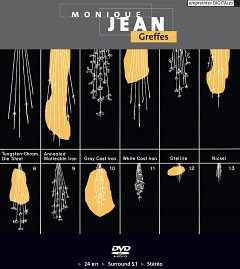
    In this tastefully packaged DVD-Audio recording, electroacoustic composer (and former Francis Dhomont protégé) Monique Jean (re)asserts her redoubtable talent in a field scarcely short of it. Her second release on the empreintes DIGITALes label – in 9 years to be precise – demonstrates a depth of realisation most likely achieved as a result of a patient, methodical work ethic. Unlikely is it that she’s been sat around thinking about lunch all these years: her list of works for live performance, radio, video and installations, since 1997, is Babylonian in stature. Regarding the work itself: in the words of a biographer, Jean ‘is interested in the tensions, ruptures and clashes of sonic matter that produce a transmutation of the real into the poetic.’ Which is as valid a summary of the contents of this DVD-Audio as one could possibly muster.

    The slightly sycophantic sleeve notes twice designate the composer a ‘siren’ (though not ‘a goddess’, phew); moving on to conceptually clarify the kinesthetics of solo instrumental performance qua source material for Jean, relating a methodology whereby ‘each performer’s gesture… is magnified and broken down to its energetic principles, which then become the theme of the piece.’ And where for some this might entail sampling and looping telling fragments of a recording for the sake of a tasty beat, for Jean it is an intuitive reckoning with the musician’s very élan vital, as she disembowels a series of intrepid improvisations and exposes the pulsating innards. While Iancu Dumitrescu isn’t likely to find himself on the dole any time soon, he would have every cause to approve of this assiduously assembled set of acousmatic meditations.

    While the album’s title Greffes (‘Grafts’, 2012) alludes to realms botanical, I concur with (sleeve note writer) Sharon Kanach’s ‘amniotic’ designation, for there is palpable depth to her world. Subtle aquatic allusions / illusions emerge from the get-go: alien technology stealthily scanning the primordial sea floor in Givre (2011), begetting an unearthly counterpart to Parmegiani’s La création du monde; while simultaneously inhabiting a measureless void – space both inner and outer – a blackness sliced by shafts of light, devoid of emotion or intellect; over 17 minutes accreting electromagnetic mass in the face of the inexorable final moment. Something of a centrepiece to the album, this piece might benefit frequenters of flotation tanks more than the usual phalanx of reverbed panpipes and didgeridoos.

    In Ricochets (2006), a soaring saxophone shrieks, wails, wavers and vomits its guts into the alchemist’s laboratory, where it is both dissected and disintegrated on a bed of silence which becomes a funeral pyre: the incandescence of the performance immolating the improviser, who issues upwards in a pungent plume of smoke. Within this, identity remains intact if intangible; conveyed in millions of glistening particles that flow freely from the expanding flames, rattling and retreating from the speakers in intervals.

    Similar phenomena beset subsequent performances; differences determined by participants’ personalities. These are also electronically processed, abstracted and distilled. Misfit (2007) sees a tightly tuned guitar given the Catholic heat treatment: the rising and abating conflagration discharging the essence of the once-electric instrument into the heavens. Its strings become livid tendrils that lash through the dense smoke, leaving bloody trails. In low memory #3 (2005) and #1 (2000) there is a distinct alternation / altercation between extended bouts of atmospheric compression and decompression, ‘attempts at re-establishing some kind of balance… the act of rebuilding being constantly thwarted and repeated’; clarinets of different pitches are manipulated and molested with religious fervour and scientific rigour, as though concealing a cosmic secret from the inquisition.

    There is violence apparent in these audio autopsies, though it is as implied in the recorded performance as it is, applied by the curious composer. The result is an agonising catharsis, whereby the transpersonal essence is alchemically separated from the ‘corpse’ of the recording and given freedom of speech, within the full emancipatory remit of the recorded medium. It’s a real room-rumbler to boot. Jean’s concerts have won her acclaim in Canada (she took home the 2005 Opus Award for Concert of the Year), which suggests her performances must be something approaching transcendental, if this sublime, surround-sound extravaganza serves as an indication of her prowess. In rare instances such as this recording, a voice speaks to me from an alien dimension, whereupon I experience a gut-level glimmering of fear and wonder. For those who regard the recorded medium as a tomb for ‘dead’ performances, this album might revive a few spirits. Seek it out forthwith!

    … this sublime, surround-sound extravaganza serves as an indication of her prowess.

    Topographies in RNE3: Atmósfera

    “Crítica”, RNE3: Atmósfera, September 5, 2013
    Thursday, September 5, 2013 Press

    El título del nuevo disco de Martin Bédard habla por sí mismo: Topographies (Topografías). Se trata de una música llena de tranquilidad pero al mismo tiempo muy dinámica. En el disco no encontraremos ni un segundo de inactividad, todo él desprende una energía pocas veces vista que atrae a quien lo escucha a espacios densos y opacos que cortan la respiración y que dejan una sensación de vacío cuando deja de escuchar el disco. Topographies propone cinco obras electroacústicas compuestas entre 2004 y 2012 con el típico sonido compacto de Bédard.

    … todo él desprende una energía pocas veces vista…
  • 1
  • 2
  • 3
  • 4
  • 5
  • 6
  • 7
  • 8
  • 9