electrocd

Blog

48 results
  • 1
  • 2
  • 3
  • 4
  • 5
  • 6
  • 7
  • 8
  • Limaçon in nitestylez.de

    “Review”, Baze Djunkiii, nitestylez.de, August 5, 2023
    Monday, August 7, 2023 Press

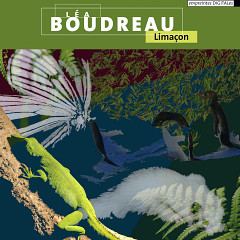
    Released via Canada’s self-proclaimed reference label named empreintes DIGITALes on July 1st, 2023 is Limaçon, the first full CD album release by Léa Boudreau. With a total of five compositional pieces rolled out over the course of roughly 42 minutes we see Boudreau exploring a realm of warm, organic and tentative Electronica structures defined and characterized by a use of comforting and all-embracing sinewave bass pulses and playful, oftentimes non-repetive bleeps and sweeps of probably modular origin, Deep Listening Music and swampy Ambient textures paired with abrasive digital scrapings and little joyful melodic motifs leading into large scale panoramic layers, experimentally plucked string sequences as well as faint echoes of Modern Classical music and deeply enchanted atmospheres especially prevalent in tunes like Recovery which would make a great fit as a score for early 70s style space adventure flics in parts whereas the final cut combines noisy, earth-shaking tectonic shifts, distant Field Recordings and a more collage-like approach for a closing just to pick out two standout cuts in particular. Recommended.

    … noisy, earth-shaking tectonic shifts, distant Field Recordings and a more collage-like approach…

    Limaçon in Bandcamp Daily

    “The Best Contemporary Classical on Bandcamp: July 2023”, Peter Margasak, Bandcamp Daily, August 7, 2023
    Monday, August 7, 2023 Press

    Léa Boudreau, a composer of electroacoustic music living in Montréal, creates most of her work imagining sound for various processes and conditions humans face every day. Dementia, the opening track on this physically tactile new album, tries to capture the mental decay of the titular disease, as a series of motifs and phrases become increasingly splintered and disconnected from any initial patterns we sense. Likewise, Recovery aims to sonify the halting steps and struggles humans encounter as they recover from some mental or physical problem; sonic tension transforms into a kind of drifting serenity.

    These frameworks clearly drive and inspire Boudreau’s work, but even without such background information her dynamic music excels, opening up a collision of musique concrète and synthesis constructed with a rich compositional logic. Abstraction and melodic shards combine in ever shifting proportions, unconcerned with any stylistic purity.

    Her piece Mini-bestiaire pour la fin du monde is meant to convey how several animal and plant species might “evolve beyond the Anthropocene by adapting to extreme environmental conditions,” per the liner notes, but I hear a mix of synthesizer melodies snaking within abstract whooshes and crunches that definitely suggest some elusive kind of thematic development. The middle of the album is occupied by Impromptu[e], where the composer uses cello sounds made by her friend Lara Laverdure as source material — twisted, extended, and chopped-up — for a composition no less rigorous and imaginative than the purely electronic works.

    … her dynamic music excels, opening up a collision of musique concrète and synthesis constructed with a rich compositional logic.

    Drum Machines in Vital

    “Review”, Frans de Waard, Vital, no. 1397, August 7, 2023
    Monday, August 7, 2023 Press

    This CD is not a trio disc of people playing together, but rather two composers, Pierre Alexandre Tremblay and Sylvain Pohu, who composed a piece of music which Martin Daigle performs. Tremblay’s La rage (The Rage) takes up forty-six minutes, and Beat , by Pohu, just over ten minutes. In both pieces, Daigle uses his drum kit and electronics. Sometimes these electronics are triggered by the drums (more in Beat than in La rage, it seems), but I think they are sometimes on a more stand-alone. I don’t know much about Pohu, but Tremblay is a composer of electroacoustic music, with a release on Empreintes Digitales and contemporary jazz.

    Oddly enough, there isn’t much difference between both pieces. Both pieces sometimes sound like improvised music, especially in La rage. Both scores call for extended techniques and materials to play the drums. From both pieces, there are videos of Daigle’s playing on the website mentioned here, and these are great pieces to view. In case you are wondering, it may also clarify these techniques. Beat also uses trigged video material, creating a total experience. La rage is a wild piece, obviously with such a title, with the music going all wild and quiet in seconds. With the electronics brewing and steaming, the work has an additional layer which works great. It becomes more than some wildly improvised drum material. Beat comes across as a similar piece but more organized, seemingly calling for more control. Overall I found this an exciting release, supported by the electronic part. —— Addresses: https://www.martindrum.com/ https://www.ravellorecords.com/

    With the electronics brewing and steaming, the work has an additional layer which works great.

    Limaçon in A Closer Listen

    “Review”, Richard Allen, A Closer Listen, July 26, 2023
    Wednesday, July 26, 2023 Press

    Léa Boudreau is an artist we’d love to meet, not only because of her music, but because of her interest in designing “hybrid and ambiguous creatures.” Her curious circuitry imitates robots, animals and other fauna, blurring the line between entities. The same principle holds true for her electro-acoustic works, which on Limaçon tilt toward an as-yet-undefined apocalypse, as explored in the tracks Mini-bestiaire pour la fin du monde (“Mini-bestiary for the end of the world”) and Quatre machines pour sauver le monde (“Four machines to save the world”).

    If limaçon (also known as Pascal’s snail) refers to a circle attached to a fixed point, rolling around another circle of the same radius to form a curve, one might ask, “what, then, is Boudreau’s fixed point?” Working backwards, if the curve is the stop-stutter-start of the pointillist music, the fixed point may be a series of invisible, mathematical tempos. Every dot and notch is carefully placed, even bursts of static and other protuberances. Mini-bestiaire pour la fin du monde earns its name with odd creature calls cutting through the drone, like a splicing of a monkey and a bird. The tempo reveals itself at the three-minute mark, with electronic patterns laid across forest crunches. After every stall, the tempo relaunches at a swifter pace, before disappearing in a rainstorm, followed by a swelter of synths, which eventually slow and stop like an unplugged appliance, landing with a splash in a river-fed pool. The playful beeps of the emergent beings suggest androids frolicking in the water as their “parents” honk from the overpass.

    The strings of Impromptu[e] and the woodwinds of Recovery are further curve balls. This hybrid of orchestral maneuvers and non-linear robotics is the bread and butter — or shall we say, oil and can of empreintes DIGITALes. The latter piece even incorporates choral snippets, which add a sense of gravitas to the closing minutes. The world, after all, is ending; or is it? Boudreau offers a more positive take than those found in Terminator, The Matrix and other A.I.-phobic scenarios. Humans — or at least recordings of humans — are present in Quatre machines pour sauver le monde, which offers an incredibly busy reflection of the efforts of a few bold machines to prevent global extinction. This urgent composition calls trains, scanners, nanobots and all machines within earshot to report to duty. When the gears settle in the ninth minute, a mechanical rain starts to fall. Once again the hybrid creatures come out to play, reflecting an idyllic, post-organic future.

    What is the opposite of a Turing test? Given her early championing of this as-yet-unrecognized populace, we’re pretty sure Boudreau will have a place in the new society; to repurpose a phrase, she seems “more robot than robot,” which to a machine is a seal of approval.

    Every dot and notch is carefully placed, even bursts of static and other protuberances.

    IV in nitestylez.de

    “Review”, Baze Djunkiii, nitestylez.de, July 23, 2023
    Monday, July 24, 2023 Press

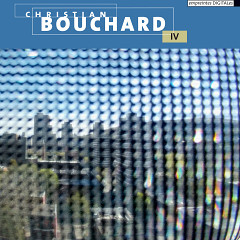
    Released on July 1st, 2023 via the long standing label Empreintes Digitales which saw its first release popping up on the circuit all the way back in 1990 is IV, the — obviously — fourth full length album outing cooked up for the imprint by Quebec-born composer Christian Bouchard. Presenting a total of five extended pieces over the course of roughly 69 minutes Bouchard covers compositions conceived over a period spanning from 2014 to 2022, opening with the spatial unsettling pulses of Birdscape which combine playful Electronica blips and chirps, elements of Noize-informed Industrial Electronics and lo-fi data transmissions in a well fascinating, almost sci-fi-leaning manner whereas Portrait Montréal focuses on vantablack tectonic shifts, tense atmospheres and a collage of cut-up radio communication samples reminiscent of Robin Rimbaud’s Scanner project as well as heavy sonic bursts of Musique Concrete x Plunderphonics. The subsequent UHF-Complex brings forth a brittle, slightly nervous and stripped down fusion of Ambient, Deep Listening Music and Clicks’n’Cuts-referencing glitches — think early Oval works here — alongside irregular low end rumbles, Montréal-mafia fully focuses on collage-techniques, reprocessed Field Recordings and similar electronic interventions whilst the final cut named Nombres et silences pairs ever shifting scrapes and crackles with reverberating electronic textures seemingly resembling the deepest and most threatening subsurface vaults to be found on icy, hostile exoplanets located somewhere in a galaxy far far away. Good stuff.

    IV
    Good stuff.

    IV, Limaçon in Radiohoerer

    “Release Tipp: Empreintes digitales: Léa Boudreau + Christian Bouchard”, Radiohoerer, July 13, 2023
    Thursday, July 13, 2023 Press

    Empreintes digitales oder der „digitale Fingerabdruck“ sind seit Jahren ein Garant für Unerhörtes jenseits aller Richtungen und Gemeinplätze. Für alle mit offenen Ohren sind sie eine Fundgrube ohnegleichen, und diese beiden Neuerscheinungen machen da keine Ausnahme.

    Léa Boudreau ist Komponistin und Klangkünstlerin, außerdem entwirft sie entwirft elektronische Schaltungen und immersive Umgebungen. Sie ist eine multidisziplinäre Künstlerin, die mit Sound, Programmierung und Elektronik arbeitet. Sie interessiert sich für die Beziehung zwischen Natur und Technologie sowie für die Erschaffung von Maschinen und künstlichem Leben. Ihre Klangkunst, Performances und Installationen sind von Naturphänomenen und Tierverhalten wie Phototaxis und Imitation inspiriert und verbinden Aspekte des Experimentierens, DIY, Verletzlichkeit und Verspieltheit.

    In den letzten Jahren hat sie mehrere Preise und Stipendien erhalten (2. und 3. Preis JTTP 2020 und 2019 der Canadian Electroacoustic Community, Marcelle-Deschênes-Preis 2019 der Musikfakultät der Universität Montréal, 3. Preis Hugh-Le Caine 2017 der Socan Foundation usw.), und ihre Projekte wurden rund um den Globus verbreitet.

    Christian Bouchard begann mit der E-Gitarre, wechselte dann zur klassischen Gitarre, dann wieder zur E-Gitarre, dann zur präparierten E-Gitarre… dann hörte er ganz mit dem Gitarrespielen auf und begann mit der Elektroakustik. Er besuchte das Conservatoire de Musique de Montréal, wo er sich in erster Linie auf elektroakustische Musik konzentrierte, aber auch Musik für Theater und Film, Installation, Live-Performance mit dem Theresa Transistor Quartett und elektronische Musik studierte. Er ist Preisträger nationaler und internationaler Kompositionswettbewerbe, zuletzt erhielt er den Joseph S. Stauffer Preis des Canada Council for the Arts. Er arbeitet auch als Tontechniker für Film und Fernsehen.

    Christian Bouchard erschafft einzigartige und fesselnde Klangwelten durch die fließende Verbindung von Soundscapes, experimenteller Electronica, Glitch und akusmatischer Kunst. Sein musikalischer Stil lässt sich als ein spannendes Wechselspiel beschreiben, in dem energiegeladene Momente mit unruhigen Obertönen durch Momente des Schwebens ausgeglichen werden. Für manche kann es ein musikalisches Universum ohne Orientierungspunkte sein, in dem man sich verirren, aber auch mitreißen lassen kann, ohne sich um die Form zu sorgen.

    Wenn man sich mit Léa Boudreau selbst und ihrem Werk beschäftigt, wird immer wieder darauf hingewiesen, dass sie als Jugendliche eine leidenschaftliche Beziehung zu Klängen entwickelt hat, die sie tagelang beschäftigen konnte. In gewisser Weise spürt man das in ihrer Musik. Da ist eine gewisse Verspieltheit, man hört die Müllabfuhr, Lautsprecherdurchsagen und Wassergeräusche aller Art. Fieldrecordings sind nur eine Komponente in der reichen Klangpalette, die sich auch aus u.a. Alltagsgegenständen speist. Eine vielfältige und bunte Klangwelt wartet auf Euch.

    Christian Bouchard ist mit seiner 4 Veröffentlichungen auf empreintes DIGITALes bereits ein „alter Hase“ im Bereich der elektroakustischen Musik. Seine erste eigene Veröffentlichung erschien 2004 mit Fractures. Davor war er schon auf einigen Compilations zu hören. Es ist unverkennbar, dass er Filmmusik schreibt, besonders in Portrait Montréal ist das deutlich zu hören. Es ist ein akustischer Film. Gerade durch die Montage der Fieldrecordings und einer nicht unwesentlichen rhythmischen Komponente entwickelt sich eine ganz eigene Dramaturgie, die dem Stück seinen Stempel aufdrückt. Eine tolle Komposition und ein sehr guter Einstieg in die elektroakustische Welt von Christian Bouchard.

    IV
    For those with open ears, they [Empreintes digitales] are an unparalleled treasure trove, and these two new releases are no exception.
  • 1
  • 2
  • 3
  • 4
  • 5
  • 6
  • 7
  • 8