electrocd
  • This website is also available in English.

Blog

2899 results
  • 415
  • 416
  • 417
  • 418
  • 419
  • 420
  • 421
  • 422
  • 423
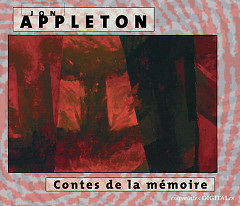
  • Contes de la mémoire in The War Against Silence

    “Review”, Glenn McDonald, The War Against Silence, no. 143, October 23, 1997
    Thursday, October 23, 1997 Press

    Jon Appleton’s Contes de la mémoire, takes a much less abrasive approach to electroacoustic music. Until a giant, sadistic, gong-playing praying mantis infiltrates the album toward the very end, carrying a frazzled television set, most of these pieces sound like Eno, Dr. Who theme music or ethnic field-recording sampler collages.

    The two pieces around which the album revolves, for me, are San Francisco Airport Rock and Newark Airport Rock, both of which are assemblages of random responses to the question “What do you think about the new electronic music?,” asked in Newark in 1967, and San Francisco in 1996.

    The two sets of answers are nearly indistinguishable compendiums of blithe ignorance, indiscriminate approval, rank intransigence and dopey techno-mysticism. I don’t know whether Appleton’s deliberately vague phrasing (perhaps “the new electronic music” meant something specific in 1967, but in 1996 it could refer to practically anything, and Appleton’s academic electroacoustic music is hardly the likeliest referent) was a calculated tactic to elicit amusing stupidity, or he really expects to find a critical mass of sophisticated John Cage fans in a random airport sampling, but either way, the result does for music-appreciation about what Frank Zappa’s Porn Wars did for obscenity.

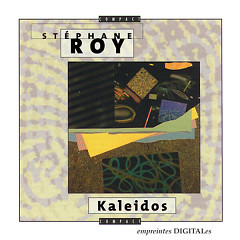
    Kaleidos in The War Against Silence

    “Review”, Glenn McDonald, The War Against Silence, no. 143, October 23, 1997
    Thursday, October 23, 1997 Press

    I’m sure there’s as much distinctive nuance in electroacoustic music as there is in anything else, but I clearly haven’t learned to spot it yet, as Stéphane Roy’s Kaleidos sounds to me like a continuation of Harrison’s record.

    The stars have calmed down a little. Perhaps now they are reminiscing, instead of berating each other; the sequences of sounds build more slowly, and flutter through more intermediary tones, rather than careening breathlessly from octave to octave. There is a bit more textural density, some of Harrison’s spasmodic flare sublimated into an atmospheric sparkle. Roy manages a bit of instrumental reverse-weirdness, too, on Mimetismo, where some of the alien parts are transposed for Arturo Parra’s guitar. Played back to back, though, these two albums [Harrison’s Articles indéfinis and Roy’s Kaleidos] seem to me like an epic 2001-esque expansion of the black-hole journey that Rush glossed over in the transition from Cygnus X-1 to Hemispheres.

    … a bit of instrumental reverse-weirdness…

    Articles indéfinis in The War Against Silence

    “Review”, Glenn McDonald, The War Against Silence, no. 143, October 23, 1997
    Thursday, October 23, 1997 Press

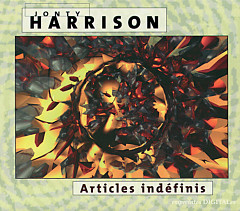
    Noise is available in a wide range of noisinesses, from the subliminal ebb of ambient to the cacophonous roar of industrial noise, but one of its stranger manifestations is electroacoustic music, a form that appears, as best I can discern, to be the near-exclusive province of the Québec experimental label empreintes DIGITALes [produced by DIFFUSION i MéDIA]. The simplest generalization for this style, summarized on the first disc of the Sombient compilation A Storm of Drones, is that it is a lot like ambient, only not relaxing. If you imagine that Brian Eno’s Music for Airports is not a single album, but rather a compilation of isolated peaceful moments from other sources, like an abstract instrumental version of those Enya-heavy Pure Moods collections sold on late-night television, then electroacoustic could be the less-peaceful source material that got left out.

    Most of Jonty Harrison’s Articles indéfinis sounds like the exasperated monologous rant of an R2D2 the size of a killer whale. Noises come in clusters, sudden and decisive, whipping through the stereo field and the human audio spectrum on impatient errands to somewhere else entirely. If stars were actually living creatures, existing simultaneously on time scales both faster and slower than our own, arguing with each other on topics beyond human comprehension, much less grammar, then this is what Fiorella Terenzi’s would hear in her radio telescopes.

    Noises come in clusters, sudden and decisive, whipping through the stereo field and the human audio spectrum…

    Tangram in Splendid E-Zine

    “Review”, Noah Wane, Splendid E-Zine, October 13, 1997
    Monday, October 13, 1997 Press

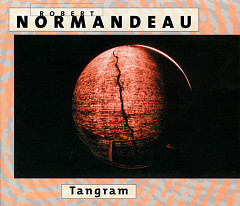
    Academic electronic music can be so cold at times, so calculated and intellectualized, so academic! The pleasure of Tangram is that the music it contains is so human. Part of the reason for this lies in the fact that Robert Normandeau creates his music entirely from acoustic samples (often human voices), thereby giving his music an innate organicism. Another reason is that each piece on Tangram is aurally cinematic in the sense that each tells a story — which is refreshingly human in a century like ours where the trend in ‘serious’ music has been decidedly anti-programmatic. Finally, there is Normandeau’s recording technique, which aims to recreate a live-concert-type atmosphere. Rather than mix his works electronically, he ‘mixes’ them acoustically by routing each track to a speaker and spacing the speakers in different configurations in the studio. Thus each ‘mix’ is actually a distinct capturing of the sonic diffusion created by a given speaker setup. If you want to hear what this adds up to, Tangram has two ‘mixes’ of each piece so that you can compare and contrast. Mr. Normandeau is to be applauded for creating such inviting and sensitive electronic music.

    Mr. Normandeau is to be applauded for creating such inviting and sensitive electronic music.

    Kaleidos in Contact!

    “Review”, Andrew Lewis, Contact!, no. 11:1, October 1, 1997
    Wednesday, October 1, 1997 Press

    All too rarely do recordings appear which present a convincing argument for the value of acousmatic music, but this CD from Stéphane Roy does just that, and with no shortage of eloquence. This is acousmatic art in its purest, highest form. There is a fluidity and mobility in the control and shaping of material which reveals a truly sculptural approach to sound — sound as a plastic medium. One immediately notices the careful attention to detail in this music, yet it is never over-controlled. There is always a sense of real joy, of reveling in the beauty of the sounds for their own sake. This is music which is immediately attractive on first hearing (perhaps because of the strong pitch content), but also promises that closer listening will yield yet greater rewards. What comes over very strongly in all the pieces featured is that the composer is not simply manipulating material as if it were inanimate matter. Instead, the sounds really are made to live and breathe, as if they themselves possess an intelligence, and exhibit particular behaviors in direct response to their sonic environment.

    All the pieces on this CD share common stylistic attributes, in particular a characteristic use of the re-enveloping of sounds, both in intensity and in pitch. The earlier works Ondes / Arborescences and Paysages intérieurs share a vitality which at times can be overwhelming, but at the same time is always clearly under control, while Mimetismo achieves with apparent effortlessness the difficult task of carrying such a strongly acousmatic language over into the live instrumental domain, and in such a way that guitar and tape really do act as one (something often claimed for other pieces, but rarely with real justification).

    An important point is that these works exhibit not just artistry, but craftsmanship too, something indispensable in the acousmatic domain, since the composer not only conceives the music, but also makes it. In the final piece, Crystal Music, this craftsmanship is taken to new heights, with its exquisitely controlled explorations of quiet but intensely active shards of sound. In effect, the sense of craft becomes itself part of the artistic experience. We need more such music.

    This is acousmatic art in its purest, highest form.

    Forêt profonde in Contact!

    “Review”, Jonty Harrison, Contact!, no. 11:1, October 1, 1997
    Wednesday, October 1, 1997 Press

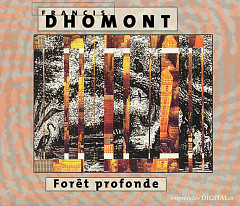
    In Forêt profonde, we may be better able to relate to the central proposition — we have all been children at least, even if this is only one of the many levels on which the piece operates. Dhomont’s evocation of childhood through fairy tales is potent — dangerous, even — to our urbanised sensibilities. What is staggering about this work, as with so much Dhomont, is the sheer accuracy of the observation — he might be talking about me, my life, my singular experience; the insight cuts the listener like a knife. The piece exhibits a masterly and poignant interweaving of the sounds of childhood (actual? remembered?), an adult’s awareness of the ‘real’ subject matter of fairy tales and documentary references to the life of Bettelheim, who survived Dachau but committed suicide in 1990.

    Those who know other works by Francis Dhomont will recognise some fingerprints: the exquisite sound world; the beautifully executed recordings of real-world sounds; the apparent simplicity, yet complete appropriateness to the poetic intent, of the studio transformations (particularly, in these two works, of the voice); the sense of everything happening at just the right time, the right speed, the right density; the staggering depth of field, from infinity to much too close for comfort; the subtle reference, not only to the real world (but what is really ‘real’ in this aural evocation of an internal super-reality?), but to a musical heritage of which he is fully aware, even if his art now extends beyond this. In Sous le regard d’un soleil noir, this manifests itself in the insistent B natural (si in French, also meaning ‘if’) which permeates the work, recalling what the composer calls ‘the memory of Wozzeck’ (from Berg’s ‘Invention’ on this note in his opera of the same name), and echoing Laing’s repetition of what Nattiez calls ‘the conditional if… [which] becomes obsessive alliteration’. In Forêt profonde the primary musical reference is to Schumann. As Dhomont explains, ‘each of the 13 sections borrows a brief element, a colour, an atmosphere, from the 13 Kinderszenen (Scenes from Childhood)’.

    As ever with works by Dhomont, the listener’s ear in these two remarkable pieces is enhanced by the composer — he makes us hear better than we might otherwise. He makes us aware of connections, of subtle exchanges and interplays; and by contrast, he makes radically different material sound ‘right’, sound organic and logical. He holds the listener in a suspension of belief, in a magical land not unlike the ‘deep forest’ of the imagination, guided — so unusually in this day and age, and so all the more strikingly — by our ears. What Dhomont tells us is true — the proof is the confirmation of aural perception: hearing is believing.

    … hearing is believing.
  • 415
  • 416
  • 417
  • 418
  • 419
  • 420
  • 421
  • 422
  • 423