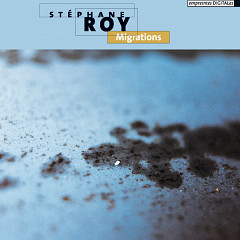
Stéphane Roy (1959) is a well-educated man, with a doctorate degree in electroacoustic composition and a PhD in musicology – but he sounds good anyway! He has spent some years in the US Midwest, but now resides in Montréal.
The idea and concept of immigration, of migrations, of peoples and people journeying for better lives, traveling the roads of hope, have inspired the title – and the content – of this CD. Roy says that “this radical displacement expresses a desire for freedom that transcends territorial and cultural borders.”
Yes, we all should know and remember; remember how a few individuals crossed the Bering Straits to Alaska many thousands of years ago, to seep down into the continent, slowly expanding into all the different Indian tribes across the Americas (a theory lately supported by DNA analysis), and I, for one, remember well the third of all Swedes that emigrated to the U.S.A. in the 19th century and early 20th century; a fact that I think all these racists of late in Sweden ought to ponder some on.
The first work on the CD is Appartenances (Belongings). A vibrating spinning-top, dancing in the gutter, disposed-off newspapers flickering in the wind that blows up the avenue… a loud, richly timbralled thud – and a maddening spinning-top vibrato…
A number of street-vise vexations embellish Roy’s first piece on the CD, and – perhaps – some sampled and disfigured car horns get caught in the whirlwind of the cityscape, the soundscape – but Roy has really – as he also indicated – taken the sounds off of the streets into a formidable manipulative catharsis, so that only your utmost imagination can detect any connection whatsoever, to a street scene of the northern city of Leonard Cohen and the Lady of the Harbor… Voices blend in, towards the end, but they’re mostly indiscernible as to intelligible content, and, I think, of different lingual descent. Formidable!
The transformation into part 2 of Appartenances isn’t smooth or nice, but I suppose Roy wanted it that way. What follows, though, is incredibly intricate and detailed, sometimes just hinted, electroacoustics. There a sweeping, elastic insect motions as well as watery trickles and thin, hardly audible folk orchestras deep inside the theories, as the likeness of voices, forlorn and disguised and probably just remembered or hallucinated, staccato by, smoothed and withheld. Fast, rock n’ rollish rhythms in the soundscape move easily in and out of earshot, until the tempo falls drastically, into some meditation on a city and its secret thoughts. Beautiful! The music touches you like warm summer gusts out of asphalt streets, your body walking by itself down the sidewalks of Quebec!
The third part of Appartenances opens in droning thoughtfulnesses, coats and layers on coats and layers, like varnish on hardwood, thoughts and dreams and fleeing moments caught in the glare… A tender and very close female voice soars about your senses, without Eros but full of Agape, the relief on un-body lifting your unselfish thoughts on high, where they sail about like seagulls on the wind, free of guilt and rebirth.
The voice comes down with a scrubbing harshness of gently applied delay and chorus, until it begins to mimic a young school girl trio all by itself; a daydream of sidewalks of Canada, picturing street-side gardens of lilac arbors and Om Kalsoum addicts sipping refreshing fluids in the afternoons, legs outstretched, dreams among the leaves.
The second piece (tracks 4 – 6) is Trois petites histoires concrètes dedicated to Pierre Schaeffer
A signal haze, a mist of electric calls, a submarine or shortwave matter, taken seriously… and the piece is on its way, but be careful when listening through earphones, for loud, albeit nicely polished spheres do appear, quickly and without warning – with the exception of this warning of mine. Roy’s magic hand is a work here in all its mastery, because I can testify to the beauty and glare of this, the intricacy and the tightly knitted patterns of sometimes infinitesimal specks of audio, which, praise be, grow into magically swelling barrels of sound, tumbling down the alleys of North America like fat French immigrants, high on red wine and lovemaking!
The wood incision makes things even nicer, opening a space between high-rise trees where the songbirds fly in electrocardiogram motions, from hideout to needle hideout. Stéphane Roy does not leave this idyllic atmosphere be, for he brings in the whole industry of forestry, blanking out those birdies in the fumes of heavy machinery…
The last piece is Masques et parades. The tragic-comic nature of the circus is the lifeblood of this work. The circus provides a marvelous metaphor to bring together irrationality and drama, jubilation and self-control: a show spiced up with extreme moments and paradoxical quests where celebration and tragedy hold hands. Following this example, Masques et parades stages the opposite dimensions of introspection and mask, sides hidden and revealed, darkness and light, drama and derision. The work consists of three sections. The lively, euphoric, even brotherly mood of the first, Exultation, contrasts sharply with the grotesque feel and irrational, iconoclastic nature of the second, Burlesque. Noir silence, the last section, draws its inspiration from the art of trapeze, metaphor of the compensatory work done by our psychological mechanisms in answer to the destabilizing assaults of a troubling world out of which one must make sense.
This begins very differently, compared to other get-goings on this CD; a bumpy rhythm, almost comical, later picking up some orchestral residue while hopping down the path, grabbing some atmospheres along the way, of spacious premises, allowing for little bells and prickly tinies too… 0It’s a quick, fun, electroacoustic show-off that leaves no mouth unsmiled! It’s a detailed and extremely varied piece of music, enjoyable and surprising, touching and fun, transparent but sometimes tight and dense, with interspersed reminiscences from 19th century Russian avenues in the snow (thinking about a poem by Lawrence Ferlinghetti).
It’s hard to keep cool hearing this. I’d like to play this loud for those ignorant buddies of mine who will have nothing to do with electroacoustics, those dance band swingers and women chasers in their upper, divorced and aging middle-ages. I’d bang this piece in their somnambulistic heads, to make colors and motions appear behind their eyelids.
The second section of this last piece mangles and cuts and shreds sounds into flying flakes of some kind of reality, an impossible puzzle of existential parts that eventually will come to rest in the most outrageous patterns; a kind of essence of humanism across this bluish sphere of ours. Laughter is suddenly thrown in as just another ingredient, but Roy manages to make this completely maddening progression of shortcuts really work in an over-arching flow, a curvature of thorny bliss that encompasses one and all and everything! Right on! Great!
The last part of the last piece begins with a consoling or just all-knowing female uttering the words “l’immobilité”, at first just like an all-knowing female would, and then chorused and birdied, sounding like a bunch of colibris trembling in the air in front of you, slowly hovering up, down, left, right, in a minuscule motion. A male voice also enters, and later the voices whisper and chew the words, while the electroacoustics amplify or subdue the morphemes in brilliant auditory applications, making everything stick, come together in a wondrous web of sounds. Thins start getting faster and more relentless, but a safe female voice cuts down like an ax, stopping the force of sounds. This exchange between voices, one at a time, male or female, and a tremendous, fast electroacoustism, keeps on keeping on, in a flabbergasting, ear catching amassments of splendid ideas! I am impressed!


![Annette Vande Gorne [Photo: Chantale Laplante, Ohain (Belgique), mai 2009]](https://res.electrocd.com/image.php/image/v/vandegorne_an.9883.jpg?width=n2&cropratio=1:1)