Sauter au contenu principal
electrocd

Blogue

244 résultats
  • 11
  • 12
  • 13
  • 14
  • 15
  • 16
  • 17
  • 18
  • 19
  • 1 – 2 décembre 2007: Dhomont et Dufort à San Francisco

    mercredi 1 août 2007 En concert

    Deux virtuoses de la musique concrète et acousmatique — mentor et élève — seront présents au «Binary Cities Event: Montréal, Canada – Avignon, France», un concert NEXMAP. Francis Dhomont y diffusera Here and There et Phonurgie, ainsi que Moirures (une vidéomusique réalisée avec Inés Wickmann). Louis Dufort y créera la vidéomusique Flesh qui explore la relation entre morphologie sonore et visuelle, puis il diffusera 2 œuvres acousmatiques explorant la notion de mouvement; l’une d’elles, Gen_3, est un hommage à Francis Dhomont et Pierre Schaeffer. Cet événement aura lieu au Recombinant Media Labs à San Francisco (ÉU) le 1er décembre 2007 [et le 2 décembre 2007].

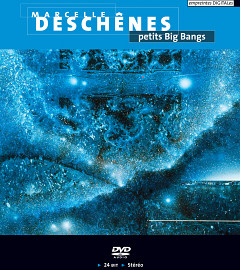
    petits Big Bangs dans Earlabs

    «Review», Jos Smolders, Earlabs, 29 juillet 2007
    dimanche 29 juillet 2007 Presse

    Not only does empreintes DIGITALes release the music of its core composers like Dhomont, Normandeau, Calon — all acknowledged first class acousmaticians — but it also has room for lesser known talents. Marcelle Deschênes is one of the latter group with a very crafty repertoire.

    This disc presents work spanning the years 1976 to 2000. Six major works, two of which are thematically connected. Her sonic language is rich (as is the case with most of the ED composers), explosive, harmonic, and at times sensual. Although the music for the most part fits the acousmatic bill, with sounds in turmoil, audiotechnological machismo and abstract structure there are definitely bends and corners inside the compositions that reveal the touch of a woman.

    Deschênes studied with Schaeffer himself and Guy Reibel during the late 60s. After that she returned to her home state Quebec and worked as a lecturer and was involved in many organisations there. She has connected her work to many multimedia and theatre productions and some of these are presented on this disk.

    The disc starts off with Big Bang II. This is a work that was started in 1987 and has been reworked in 1995. It is a surprisingly versatile composition. It offers very nice and subtle granulated sounds, but also a female choir, short snippets of Tuvalian throat singing and typically sampled sounds. The structure of the piece is very well paced.

    Indigo, second on this disc is the first part of a diptych called Griffes (Claws). Deschênes started this work in 2000 and considers this piece still unfinished. Indigo proceeds at a slow pace. Low drones superimposed by higher pitched covers set the atmosphere until at around 4 minutes a suddenly climax lets the work take a corner and new material is entered. Voices, together with electronic sounds, build up tension several times, each time going from rest into more restlessness.

    Until the Le bruit des ailes (The Sound of Wings) starts with the same low drones acompanied by the sound of wings flapping. Quite a happy scenery. This continues until a huge disruption changes things dramatically. (I was really surprised to hear harsh distorted sounds (lots of loud block waves here), which is quite unusual within the ED context.) The sound of wings takes on different forms which are not at all very nice and sweet. The theme for this piece is from Hans Christian Andersen’s tale The Ugly Duckling, where the wings are stretched and mutilated and mixed with the sounds of ice storms, erupting volcanoes and the sounds of nuclear bombs exploding.

    Lux, the fourth composition here, starts with a voice reciting the word ‘desire’ again and again. Deformed, crying out in a whispering voice, the atmosphere is immediately threatening. This piece is the audio part of a multimedia work that was constructed by Renée Bourassa, in 1985. A very strong work this is, with craftily pronounced text by Openheimer, Shaw, Kant, Rutherford and Bourassa. Interestingly the aural part of this worksounds a bit dated because of use of so typical digital instrumentation especially in the parts approximately from the 5th until the 10th minute and at multiple occasions later in the piece. Sampler, synclavier, however modern and high tech they were in 1985, they sound ancient in 2007. As a whole a very strong work, though. The piece feels a bit like Laurie Anderson who was popular at the time.

    The next work is Moll, opéra lilliput pour six roches molles. This is the oldest work, dating from 1976. this is the only piece that also involves acoustic instruments (clarinets, trombones, percussion and toys). The work is versatile, exciting and a very good mixture of electronics and fantastic craftmanship on the instruments. The booklet tells us that “this suite of 17 miniatures is the result of long, obsessive hours spent looking at the ordinary gray pebbles on the Bas-Saint Laurent beaches”. That gives it lovely exotic touch (especially when I hear the small children’s voice singing a song, while typing) but the work itself is already good enough without any exotic liner notes. It’s brilliant and the world could have known as early as 1976 that Deschênes is a very fine composer.

    Alright then, the final piece: Big Bang III: an hommage to Earth. 2 minutes 38 seconds, a soundscape to accompany a 3D film at the planetarium. And that’s all I have to say about it. Well done, but I would not have entered it in this collection. Ending with Moll would have blasted me away. This is sort of a disappointment, albeit a short/small one.

    It’s brilliant and the world could have known as early as 1976 that Deschênes is a very fine composer.

    23 – 30 août 2007: Milliseconde topographie à Sherbrooke et à Séoul

    vendredi 27 juillet 2007 En concert

    Milliseconde topographie présentera sa vidéomusique Treelogy 3: Orchid le 23 août 2007 à la Galerie Horace art actuel à Sherbrooke ainsi que dans le cadre du festival EXiS 2007 à Séoul (Corée du Sud) du 24 au 30 août. Par ailleurs, Milliseconde topographie lancera à l’automne un DVD-V rétrospective de leurs vidéomusiques. Ce disque inclura un nouveau projet audio amalgamant instruments anciens (orgue de barbarie, clavecin, dulcimer) et nouvelles technologies.

    John Young dans The Guardian

    «De Montfort Academic Wins Music Prize», Anthea Lipsett, The Guardian, 26 juillet 2007
    jeudi 26 juillet 2007 Presse

    An academic has won international acclaim for a piece of music he created about his parents’ courtship in Italy during the second world war.

    John Young, reader in music technology at De Montfort University in Leicester, won first prize in a competition for electroacoustic music composition organised by the French Institut international de musique électroacoustique de Bourges.

    Dr Young’s winning radiophonic work, Ricordiamo Forlì, was created at DMU during research leave. It tells the story of his parents’ courtship towards the end of the second world war.

    “My parents met in Forlì in central Italy in 1944: my mother an Italian civilian and my father an 8th Army soldier. Chaperoned by my grandmother, they met as often as they could, and on one of these occasions my mother’s life was probably saved, as that day she was to have visited her sister — whose apartment was destroyed by a bomb at that exact time,” he explained.

    “The idea for this work grew out of my first visit to Forlì in 2002, when a lot of the emotional significance of that story resounded for me in an entirely new way. Hearing bells from churches around the city — audible across great distances — gave me a strong sense of experiencing the sounds as something resonant of the place and its history; that these sounds were voices from the past — something permanent, yet alive — evoking a sense of being touched by something that others had experienced with the same immediacy over many years and through dark, violent times,” he said.

    He used sounds he recorded in Forlì along with historical broadcasts and war correspondence reports to amplify the wider context of the events, while his father narrated the story. The result is a narrative supported by music developed by digitally transforming many of the sounds into an expanded “surrealised soundscape”.

    The work will be released later this year by Empreintes DIGITALes in Montréal.

    … international acclaim for a piece of music he created about his parents’ courtship in Italy…

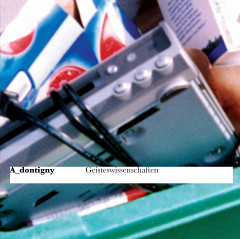
    Geisteswissen­schaften dans Vital

    «Review», Frans de Waard, Vital, no 585, 17 juillet 2007
    mardi 17 juillet 2007 Presse

    The A in A_dontigny stands for Aimé, and he is a free noise composer from Canada. His name may ring a bell or two for his involvement in Napalm Jazz (not reviewed in Vital Weekly), morceaux_de_machines (see Vital Weekly 338 and 454), or his duet CD with Diane Labrosse (see Vital Weekly 384). Quite a busy man, but he never made a solo recording and Geisteswissenschaften is his first solo excursion. He gets help from various people on guitar, cello and bass, but by and large it’s a solo work indeed. What exactly A_dontigny plays himself then? That is perhaps a bit harder to answer, but perhaps it’s safe to say that it’s a multitude of precorded sources — meaning vinyl, CDs, mini discs, computer files of existing material that he treats through further computer processing, electronic effects and such like. He may add highly fucked up rhythm machines and/or samplers of any kind, but the end result is quite a fascinating journey through the world of today: we zap around, on TV, on the net, and we get a true bombardment of sound and images — here only sound. A world that would drive a lot of people crazy, or in fact it perhaps already did. Much better it would be to sit down and enjoy A_dontigny’s release. Turn off the TV, switch of computers and let yourself sink back in this crazy world that is madness enough for those who really want to listen. A_dontigny crosses the world with crazy sounds, and an interesting mixture of techniques to approach the world: musique concrète like, noise based and improvised in playing. It all can be done. If the previous releases by morceaux_de_machines were something you liked, then this new release by one half will appeal to you too: it’s by no means half as good; it easily matches the duo.

    A_dontigny crosses the world with crazy sounds, and an interesting mixture of techniques to approach the world: musique concrète like, noise based and improvised in playing. It all can be done.

    11 – 23 septembre 2007: Normandeau et Dhomont au Música Viva à Lisbonne

    jeudi 5 juillet 2007 En concert

    Le festival Música Viva 2007 aura lieu du 11 au 23 septembre 2007 à Lisbonne (Portugal). Parmi d’autres événements, celui intitulé «Deep Listening» présentera quotidiennement StrinGDberg de Robert Normandeau (du 18 au 23 septembre). Le 19 septembre le «Loudspeakers Orchestra II» présentera notamment: A nova música do rei de António Ferreira ainsi que les pièces Here and There, Vol d’Arondes, Un autre Printemps, Premières traces du Choucas et Moirures (Inès Wickmann, vidéo) de Francis Dhomont qui donnera, par ailleurs, un cours de maître.

  • 11
  • 12
  • 13
  • 14
  • 15
  • 16
  • 17
  • 18
  • 19