
Trois songes
Gilles Gobeil
Trois songes is an evocatively gorgeous work. — Avant Music News
Gobeil plants his flag squarely in that electroacoustic continent where poetic dreams reside. — La Folia, USA
Ombres, espaces, silences… : Prix Ars Electronica 2005 — Mention d’honneur
Prix Opus 2007-08: Disque de l’année — Finaliste
- Composer(s): Gilles Gobeil
- Cover image: Luc Beauchemin
- Mastering: Dominique Bassal
- Canada Council for the Arts • SODEC
DVD-Audio — Surround (IMED 0892, 2008)
- 1Ombres, espaces, silences… (2005), 23:00fixed medium
- 1Vol de rêve, 10:38
- 2Descente au tombeau, 6:39
- 3La nuit, 2:58
- 4Vision, 2:44
- 5Entre les deux rives du printemps (2006), 18:08fixed medium
- 6Le miroir triste (2007), 13:42fixed medium
- Label: empreintes DIGITALes
- IMED 0892
- 2008
- UCC 771028089291
- Total duration: 54:59
- OGplus
- 142 mm × 125 mm × 10 mm
- 55 g
On the web
Download (IMED 0892_NUM, 2008)
- This item can be downloaded and/or listened to at empreintesdigitales.bandcamp.com.
- 1Ombres, espaces, silences… (2005), 23:00fixed medium
- 2Entre les deux rives du printemps (2006), 18:08fixed medium
- 3Le miroir triste (2007), 13:42fixed medium
- Label: empreintes DIGITALes
- IMED 0892_NUM
- 2008
- UCC 771028089284
- Total duration: 54:59
Liner notes
About Trois songes
The pieces included on this disc are related in at least three ways.
First, they were all realized at the same location
Second, they all share the same musical intention. These three pieces could be classified as ‘program music,’ since they are all based on a literary argument.
Their third connection is found in their sound materials. I found inspiration in (and taken liberties with) the marvelous heritage of past music, an extraordinary source of colours that allowed me to borrow from the strong and still fresh poetry of various pieces, some of them ancient. Also, all three works contain materials generated by
I would like to express my gratitude to the manager of the Institut für Musik & Akustik of the ZKM,
—
Some recommended items
-

-
-

-
-
-
-
 Various artists
 -
-
 Various artists
 -
-

-
In the press
AMN Review
I recently revisited the six albums I have from
On
This celebration of nature’s grandeur is soon disrupted… like a velvet curtain, night falls and Gaia departs, leaving us to grope our way through an alien desert. The crawling, unsightly sound of the Daxophone (a recurring appearance throughout many of
Review
Avlyssnat
Review
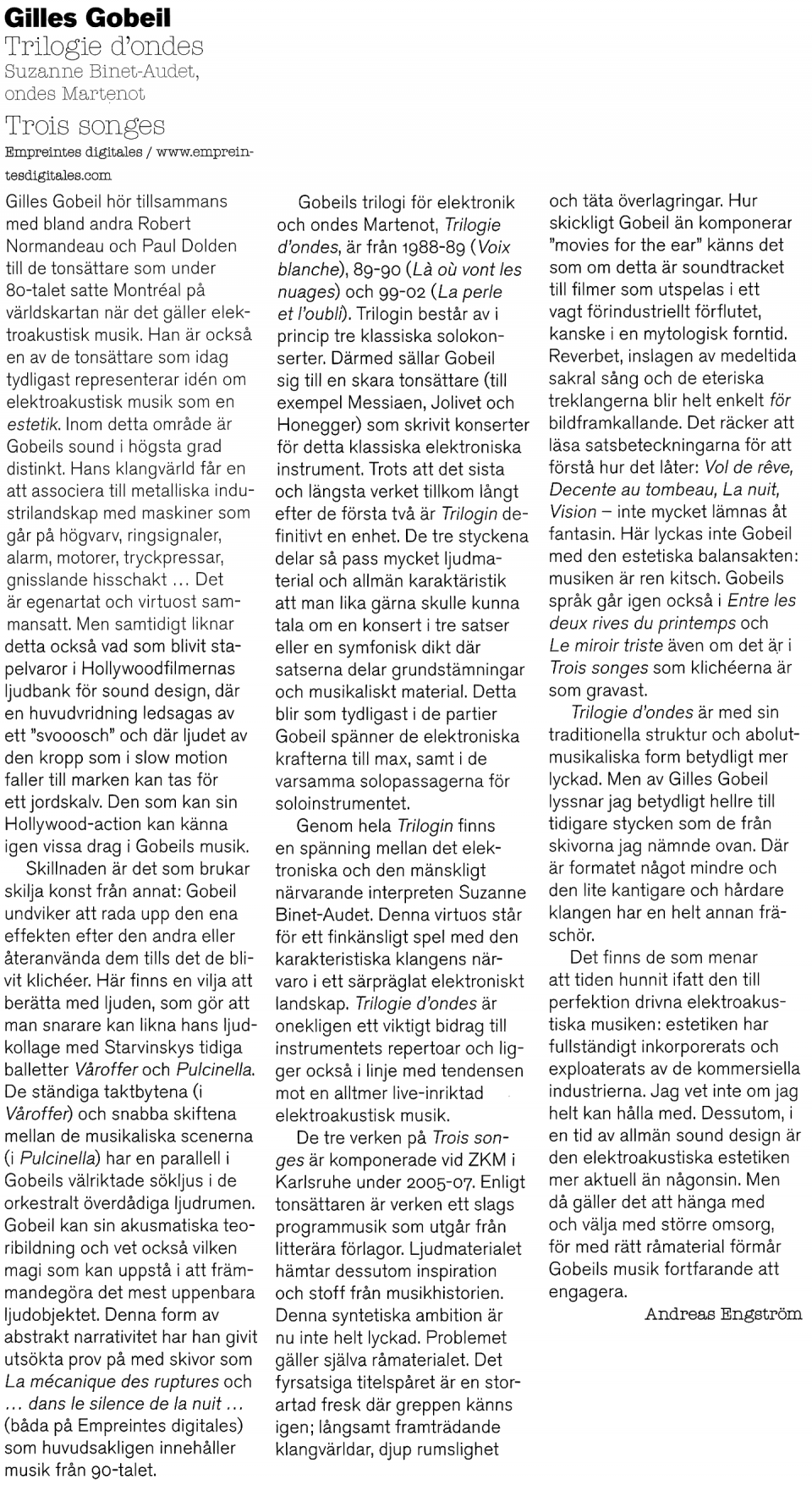
“Cinema for the ear” is a much exploited expression in the acousmatic field — including the description of
Critique
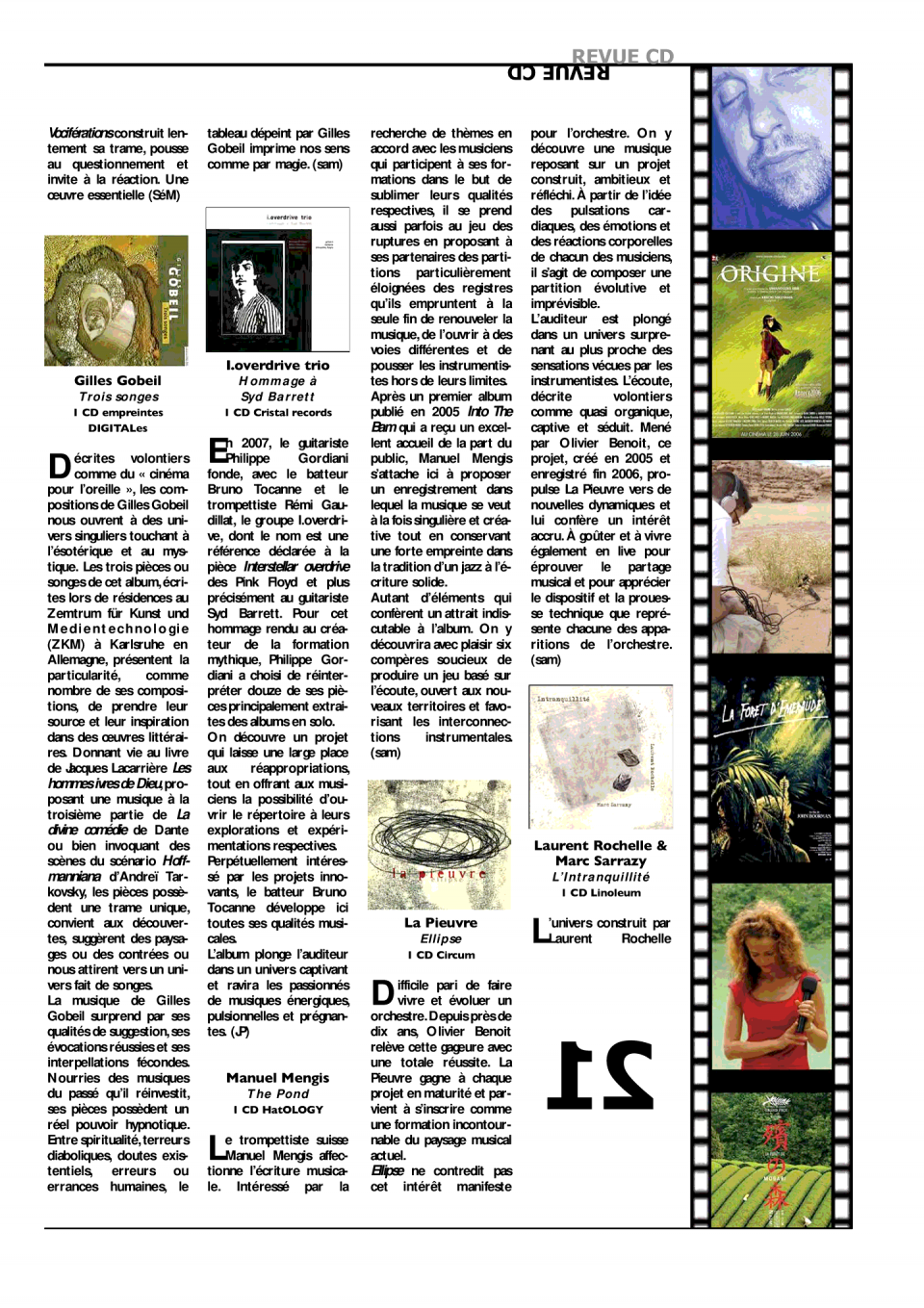
Décrites volontiers comme du
Review
Track 1 — 4.
The history behind this composition — or this set of compositions — is rather original.
The four parts are presented in one, seamless stretch.
The music starts ever so slightly, like the stirring vibrations of dawn through the first bleak light hovering in the east, while a slight, short murmur hiding like an ominous warning below the horizon introduces a serious atmosphere.
Small sounds in the immediate vicinity startles your perception, as if you are lying in a tent in a beach forest as the new day rustles through the dry leaves of the forest floor, insects moving erratically and fast through their miniature worlds.
The wind picks up, and I feel like I’m not far from the ocean, the gray-white sounds of wind transforming into the gray-black might of oceanic force against a rocky shore. A sudden scream from pre-history — I glimpse some sort of lizard — opens up a wilder sonic space, out of which a flock of birds flap violently, while time dips in a downward glissandi of a
Grainy, percussive ingredients are strewn through this eternity, like a mixture of gray gravel and tiny bronze spheres, emitting sonorities the likes of atomic jitter watched through scanning electron microscopes. Heavy forces are at play, riddled with nuances and sonic details that flash by in whirlwinds of quantum mechanic contradictions. Orchestra tuttis extend through this process engineering recasting, like reminders of the social life of reality’s physical musicians
Later I feel the vibrancy of early 20th century concertos through the filter of time, more hinted at through glimmering drones than actually identified, as if being heard and watched through thick, uneven glass, or through an aquarium
The grainiest growl of monks’ chants soars like sandpaper audio, extended beyond the aptitude of man, and far into the soundspace, like those unwanted vibrations from an engine showing the first signs of mechanical failure while you’re speeding steadily down a highway in West Texas, the heat of day about to shift into the chill of night.
As faint barrels roll around a desolate and flat space under a wide sky (like, in a more myopic perspective, empty, opened tin cans through a dark back alley), an orchestral drone appears like a streak of light across a valley, as the combined movements of Sun and Earth open a crack between the summits for the rays to shoot through. The moment grows, only to dissipate and dissolve into the general fabric of sound, just like individual lives sink into life in general and life as a principle, as enough time goes by. Vestiges of a large number of murmuring voices dance like shadows on the brink of perception, deep inside the fabric, on the edge of time. A thundering magnificence of tonal colors wash over you, as from the holy spaces of a thousand domes at dusk, the way God may perceive the essence of piety from his Everywhere.
The forces slowly grow into a mangling, star-crushing time machine, which lets no fragment of matter escape its transmutation, in an Einsteinean matter-energy-matter flip-flop through space-time, talley-ho
However, even this soaring beauty is but a passing moment, as echoes of vicious friction are heard from inside the musical darkness of some huge construction
Close snippets of dry insect wings and ghost movie echoes of werewolves enhance the cinematic atmosphere — but these creepy factors seem more comic than ominous, as if
The composer clamps horror sounds together into tight and dense slabs of ill will, as time rushes past at an unnatural velocity. Whole mountainsides of karmic debris come off and completely fill the valleys with consequences.
Once again the human factor arises, as footsteps occur and approach, in a sharp, piercing cricket concertino.
This does not last, for dark, murmuring sounds come at you, on a backdrop of squeaky, jingling metal audio and forlorn distress calls from out of the likeness of Stockhausen’s most formidable ring modulators. A natural environment is mimicked with birdcalls and rustling wind flurries, soon to give way to pure imagination, dispersed on glowing brass synthesis and the honey dew essences of many centuries of ecclesiastical choral art. As the piece draws to its conclusion, it soars slowly and gradually into an enchanted liturgical realm of small brass bells and jingle jangle New Age sonorities, star shine across endless fields of glittering snow, the cold air biting your cheeks, and then… silence.
Track 5.
This is a free adaptation — as
And I with vision new rekindled me,
Such that no light whatever is so pure
But that mine eyes were fortified against it.
And light I saw in fashion of a river
Fulvid with its effulgence, ‘twixt two banks
Depicted with an admirable Spring
(Paradise, XXX-58)
I’ll be darned if I don’t recognize the fluttering of birds’ wings from the previous piece, right at the outset of this Danteism
The horn — or so it first seems — from a car or a truck, which blasts away surprisingly — or is it an Indian oboe (shehnai)
All of a sudden the scenery changes
Right off this stops, as you continue your path by sheer inertia, finding yourself in a singing bowl timbre that involves dark nuances as well as the winding, multi-faceted high pitch drone of the singing bowl type…
A dramatic rise of intensity loses itself in a crash and a bang — which allows for a silence in which church bells toll, in the finest of French electroacoustic traditions, instituted by the likes of
Reality soars in a thermal for a while in
A new atmosphere opens with an increasing, indefinable truckload of audio, presenting speed and fast motion, like the trailing white fumes of a jetliner across the sky, past those thin, high veils of summer clouds. Thunderous incidents distress this scenery, time after time, but in the background an angelic choir sings beyond matters of life and death. Things slow down and dissipate for a few seconds, in which pigeons speak in muffled pigeon matters. The pigeons, however, are obliterated by a whole year of steel business noise packed into a few seconds of unendurable noise
Follows a most peculiar section with a low-pitched murmur, on which the voices of playing school children dance like sunlight across the sea. The time-filtered glare of a Dutch barrel-organ — remotely like the dreamy organ of
The chorale property of this organ(ic) sonority grows in volume and intensity, eventually dominating the space, albeit soon dissipating into the fairytale realm again, with small, prickly and rustling sounds appearing up close and a thumping, dark resonance of the Heart of the Matter rising out of clay and soil.
Yet another utterly strange — but pleasant
The high-pitch friction of crickets fill the air, until one of those
The commotion at the level of the factory floor intensifies, until cut short with a
Towards the end of this piece, in a receding rumble, the sounds all die down and dissolve pleasantly and gradually into their end state
Track 6.
I’m getting used to this behavior now
A whirlwind — a worldwind
After all hell breaks loose and dissipates, the weak-minded humming of a man lost in time is heard. Supposedly this man is
A crescendo involving children and some kind of carriage carries over into a beach scenery with wading birds calling, as electronic strangeness fills in the cracks of perception with pure imagination, the wader calls transforming into embroidered birds forever locked in a tapestry above the sofa bed in a rural kitchen of the 19th century.
A thin bell tolls twice, in all peacefulness, until the most brutal whammo hits your head again, this time with the inclusion of a mad werewolf scream. The period is indicated quite clearly by some Beethovenish bars (
Fresh water sounds, as if someone cups his hand and drinks out of a stream, are heard very close, while electronic hum permeates the surroundings, the totality of the sound picture eventually wringed and bent out of shape, only to be let loose in another sonic direction, after a while assembled into a brownish drone speckled with tolling bells and flurries of birds and the century’s paraphernalia, all vaguely exposed. Hoffmann wraps his dark coat tighter around himself
No solution is in view, but the life of
Mission
Kritik
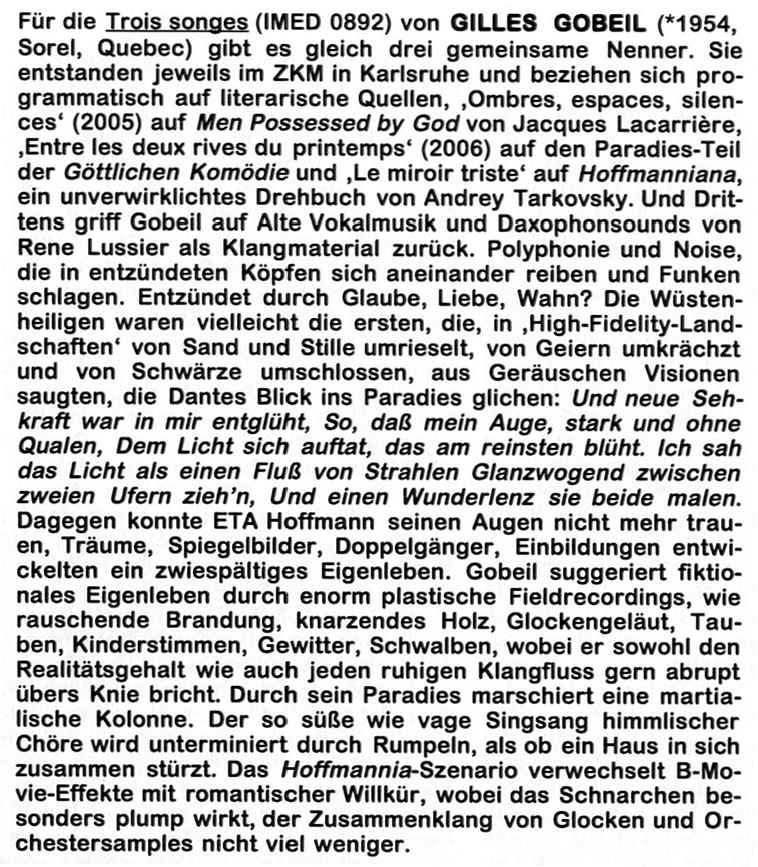
Review
It took me a while to review this DVD, but as you can imagine it’s one of those releases you need to “understand” and that needs to be listened to really carefully and ma’am, I swear I did it
Tapage nocturne
Blog
- Friday, July 30, 2021 / Press
Trois songes is an evocatively gorgeous work. More - Thursday, April 1, 2010 / Press
Gobeil plants his flag squarely in that electroacoustic continent where poetic dreams reside. More - Monday, December 15, 2008 / General
Louis Dufort’s Matériaux composés and Gilles Gobeil’s Trois songes are both nominated for the Opus Prize in the category “Disc of the Year — Musique actuelle, Electroacoustics.” Gilles Gobeil is also nominated in the category “Concert of th… More