electrocd

More from the blog

29 results
  • 1
  • 2
  • 3
  • 4
  • 5
  • Électro clips in Ojo Rojo

    “La computadora y la musica”, Ojo Rojo, no. 2, May 1, 1992
    Friday, May 1, 1992 Press

    Enmedio de una gran expectación se desarrollo en la Ciudad de México el Primer Encuentro Internacional La computadora y la Música. E1 evento reunió a los máximos exponentes de la música electroacústica del planeta. Músicos de Polonia, Canadá, España, EUA, México y otros países se presentaron en conciertos en vivo y formaron parte de las conferencias, talleres y ponencias, además de las audiciones vía DAT que nos permitieron escuchar sonidos de otras latitudes en ausencia física de sus creadores.

    Hablando concretamente de los conciertos, hay que mencionar que hubo algunos que impresionaron gratamente y que sinceramente fueron los que se llevaron el evento. La precisión y técnica ejecutoria de Javier Álvarez (México) con ASÍ EL ACERO (steel drum y DAT), confirmaron el porqué el mexicano es considerado como uno de los mejores músicos en su género en el mundo. Otra sorprendente ejecución fue llevada a cabo por el estadounidense Daniel Oppenheim. Por Canadá tuvimos la presencia de dos excelentes músicos: Jean-François Denis y Claude Schryer, que presentaron La dernière minute para clarinete y electrónica en vivo. Por cierto, el primero de estos dos es el director de la compañía editora de música electroacústica DIFFUSION i MéDIA con lo cuál logramos interesantes acuerdos para distribuir su magnífica serie de discos compactos en México (Christian Calon, Robert Normandeau, Alain Thibault, Électro clips; Daniel Scheidt, Yves Daoust, Francis Dhomont, Brégent, Boudreau y Duguay). Además contactamos gracias a Marie Marais a la compañía DAME que incluye en su catálogo muy buen material de cual comentaremos a futuro. Otros exponentes dignos de mencionar: MASOS (México), Wlodzimierz Kotonski (Polonia), Angel Cosmos y Andreas Mniestris (España), el genio musical de Roberto Morales Manzanares (México) y el grupo GEIME (México).

    En fin, este encuentro favoreció desde nuestro punto de vista a la incorporación de los músicos mexicanos al movimiento mundial de esta especialidad; para el público asistente representó el ampliar el panorama auditivo y entrar de lleno en la eterna discusión: definir dónde termina el sonido y dónde comienza el roido.

    Électro clips in Circuit

    “L’électroacoustique sur orbite [5]”, Francis Dhomont, Circuit, no. 3:1, March 1, 1992
    Sunday, March 1, 1992 Press

    Électro clips, 25 instantanés électroacoustiques.

    Au départ une excellente idée et un défi: commander vingt-cinq miniatures électroacoustiques de trois minutes exactement à vingt-cinq compositeurs d’Amérique du Nord et du Mexique. Pari gagné. Bien sûr, ces micro-compositions ne sont pas toutes d’égale valeur mais leur parcours est très vivant et donne une excellente idée des actuelles tendances canadiennes, sinon américaines. Si la personnalité des compositeurs n’est pas toujours clairement révélée par ces instantanés (n’est pas japonais qui veut, tel qui excelle dans l’épopée échoue dans le haïku), beaucoup néanmoins ont su aller très vite à l’essentiel.

    On se doute qu’il ne saurait être question, dans les limites de cet article, de consacrer à chacun la place qui lui revient, mais peut-être, après tout, qu’en toute insolence confraternelle… À œuvres-flashes, portraits-express: 1) Michel A Smith: rigolard et bien portant. 2) Craig Harris: piano fantôme. 3) Jean-François Denis: subtile histoire d’un tremblement. 4) John Oswald ou l’échantillonneur bien tempéré. 5) Yves Daoust: résumé des chapitres précédents. Bien joué! 6) Claude Schryer: à l’écoute du monde ou de ce qu’il en reste. 7) Martin Gotfrit: presque riens et chuchotements doux d’une machine onirique. 8) John Oliver: l’envers des funérailles. 9) Zack Settel: fascination et sortilèges des fonctions de transfert. 10) Stéphane Roy, un musicien du tressaillement intérieur, 11) Daniel Scheidt: charmes cagiens d’une construction en abime. 12) Bruno Degazio: le fractal lambda 0,900 — 0,901534 a encore frappé! 13) Richard Truhlar: pauvre Baudrillard! 14) Gilles Gobeil: description d’un combat (relire Kafka) ou Gobeil tel qu’en lui-même. 15) Robert Normandeau: «Kinderszenen,» terreurs pour rire et comptine très tendre. 16) Laurie Radford: le mal des profondeurs. 17) Calon-Schryer: le «tube» de l’année. 18) Hildegard Westerkamp: «The big sleep.» 19) Amnon Wolman: sous des ponts pavés de bonnes intentions. 20) Francis Dhomont: autocensuré. 21) Roxanne Turcotte: sueurs froides. 22) Christian Calon pose la question libertaire. 23) Dan Lander ou la fraîcheur du retour aux sources. 24) Javier Álvarez: un morceau en mille morceaux. 25) Charles Amirkhanian répond à la question libertaire. Avec toutes mes excuses à ceux qui ne possèdent pas ce disque compact (une raison supplémentaire pour eux de se le procurer).

    Pari gagné.

    Électro clips in Sound Choice

    “Review”, Bill Tilland, Sound Choice, no. 17, March 1, 1992
    Sunday, March 1, 1992 Press

    These 25 «electroacoustic snapshots» purport to extract a three minute essence from each of the 25 North American experimental sound artists represented. If Électro clips itself is considered as an extended composition — which in a sense it is — then the alternations between space and density allow the piece to breathe, and provide necessary transitions between radically different textures and treatments. Most of the clips are worthy of attention, and the overall sequensing seems carefully organised. On either count — as a collection or an aggregate — this is a very successful effort.

    On either count — as a collection or an aggregate — this is a very successful effort.

    Électro clips in Revue Notes

    “Disques”, Alain De Filippis, Revue Notes, no. 38-39, October 1, 1991
    Tuesday, October 1, 1991 Press

    Non! La musique contemporaine n’est pas toujours austère et stérile, cette excellente compilation vient le rappeler.

    La musique électroacoustique a éclaté en de multiples directions et c’est un plaisir de voyager au gré des 25 univers proposés ici.

    Arrêts sur image: poésie sonore délirante (Zack Settel), espace méditatif (Charles Amirkhanian), cha-cha cubiste (Javier Álvarez), jeux d’enfants narquois (Michael Smith), uppercuts sonores liés à la guitare de René Lussier (Gilles Gobeil), cinéma d’épouvante humoristique (Roxanne Turcotte), Claude Schryer et Hildegard Westerkamp quant à eux nous proposent deux créations inspirés par le concept d’écologie sonore (utilisation de sons naturels sans traitements).

    Les autres compositions sont soit plus «classiques» soit franchement décevantes (John Oswald qui nous avait surpris par un très bon travail de reprise et d’adaptation du Parade de Satie nous propose ici un travail sans conviction). Électro clips reste néanmoins un ensemble très cohérent. Il est à parier que certains compositeurs présents ici auront encore à se faire entendre dans un proche avenir, n’attendez-pas ce moment-là pour les découvrir.

    … c’est un plaisir de voyager au gré des 25 univers proposés ici.

    Électro clips in Computer Music Journal

    “Review”, Kevin Austin, Computer Music Journal, no. 15:3, September 1, 1991
    Sunday, September 1, 1991 Press

    Few releases are so integrated in medium and message. Most CDs continue the tradition of simply being a medium for the storage and transport of sonic artifacts, sound recording being the twentieth-century equivalent of the Guidonian hand. Like the unjustly neglected Nonesuch recording commissions from the mid-1960s most of the works included on the Électro clips release were created explicitly for the recording medium.

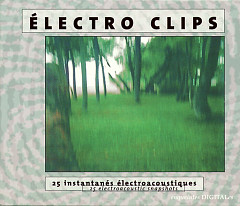
    Électro clips is the fourth CD from the Montréal-based label empreintes DIGITALes. It consists of 25 commissioned 3-minute works by 24 North American composers. The release, timed to coincide wich New Music America held in Montrcal in November 1990, carries on a centuries-old tradition of asking composers to write within predefined constraints for a specific occasion or event.

    Coproducers Jean-François Denis and Claude Schryer desired to merge the 3-minute popular song form with the concept of the vidco clip. The invited composers embraced this task to varying degrees. I find the most interesting works on the CD to be those written with that goal as the original inspirational seed, rather than those that are reworks of longer, preexisting compositions.

    Like most labels specializing in electroacoustic music, empreintes DIGITALes continues to lace the daunting challenge of distribution, the costs, and its vagaries. To reach as wide an audience as possible, the recording is accompanied by a 58-page booklet that is trilingually French, English, and Spanish. It includes biographies of the composers, program notes, and a series of 25 photographs commissioned from the Quebec City photographer Joanne Tremblay.

    Thirteen of the composers represented were born in the 1950s, and five of them in the 1960s. Eleven live in Montréal, four in Toronto, four in Vancouver. Four are from the United States, and one is from Mexico. The compositional and electroacoustic orientations are the polyglot that is rather characteristic of the Canadian Electroacoustic Community. This is part of this collection’s charm and strength, and a great part of its beauty.

    As an educational tool, this CD could be a major resource. The 3-minute constraint provides a balancing framework for the study of compositional styles and schools and the works provide excellent examples for analysis.

    Using the analytic hierarchy from linguistics — morpheme, vocabulary element, syntax, and semantic — these compositions can be parsed and described at each level. The following should clarify how I am applying these terms to music. By “sonic morpheme,” I mean the lowest level and smallest sonic unit; an indivisible instance of sound, that which constitutes a particular timbre’s integrity. “Vocabulary” is the set of sound sources that populate a given composition; the “orchestra.” This set may consist of one source or multiple sources (uni- or multi-family), and may include members that combine attributes of more than one source (cross-families). The term “syntax” can be applied to various units of music composition, just as it is when applied to natural language. Note-to-note transitions, phrase, section, and whole-composition structures all have a syntactic element. So, there is micro-syntax and macro-syntax. Both concern the application of transformations, transitions, constraints and procedures. Electroacoustic music often uses syntactic plans such as collage, layering and continuous transformation. “Semantics” (or what the composition “means”) may simply be the result of all the previous levels of organization. This might be the case in pure music. The semantic level is perhaps more distinct in program or other music that is based on metaphor, direct source quotation of text-sound or life-sound, or other extra-musical (personal, emotional, social, or political) statements. Each of the pieces presented exists on all of these levels, with some of them resting more solidly and completely on some subset of levels.

    John Oswald’s Bell Speeds, a sampled bell played at numerous octaves, resides heavily in the area of vocabulary (simple, uni-family, predictable within the sampled-instrumental model). Syntactically and macro-structurally this work is uncomplicated, producing a memorable sonic identity with a relatively low semantic complexity John would probably point out that this structuralist approach completely fails to hear the piece (see Konybski, above). Tamed structuralism appears in the self-replicating algonthmic composition What If by Daniel Scheidt, and the tonally fractal piece by Bruno Degazio entitled Humoresque 901534.

    Political statements form the basis of several of the compositions, making them semantically deep. Examples include Charles Amirkhanian’s Bajanoom (“Separation”) and John Oliver’s Marimba Dismembered. The latter contrasts and compares the violent confrontation of the Guatemalan Mayans over land claims, to the native resentment with Quebec’s nonresponse to the Canadian constitutional accord (Meech Lake). Social injustice is the fœtus in Yves Daoust’s Mi bémol and Christian Calon’s Temps incertains.

    There are numerous, multilevel continua for sonic, æsthetic, and pedagogical exploration, including the problem of sonic identity, both internally within each work and across all 25 of the compositions. The obviousness of sound processing is one of the criticisms frequently hurled at electroacoustic music. Histoncally the indiscriminate slathering of sounds with reverberation has been one of this genre’s weaknesses. Several of the works on this CD have stimulated lively discussion as to whether the processing is integral or mearly decorative. This leads back to the question of sonic identity and the special case of quotation.

    Quotation, in its broadest sense, is present in just about all of the pieces on this collection, from the sonic “objet réalité” tradition of musique concrète in Yves Daoust’s Mi bémol. to the quotation of traditional instrumental sources found in Craig Harris’s wonderful piano in Somewhere between.

    Quotation may be clear or hidden, sonically and metaphorically. Francis Dhomont’s masterful epithet Qui est-là? retrospectively examines his own work and the works of those who influenced him. It ends with an original quotation about the unknowability of the self by others, and of others by the self.

    The use of text in more than half of the pieces is clearly a type of quotation. In both Amnon Wolman’s Man-Bridge and Robert Normandeau’s sampled child’s voice in Bédé. text is used to convey information at all levels of organization, from the sonic morpheme to the complete semantic statement. In some cases, speech rhythms are preserved and the utterance is completely stripped away. Several compositions make an indirect reference to such rhythms, not in an obvious fashion, but rather as a profound underpinning for their macro — and micro — structure. Such is the case in Jean-François Denis’s Point-virgule, Martin Gotfrit’s The Machine’s Four Humours, John Oliver’s Marimba Dismembered and, in a completely unvoiced work, Simulant by the Toronto composer and sound-poet Richard Truhlar.

    Some of the works on the CD obtain meaning through their reference to other media, easily recognized musical styles, or readily identifiable experiences. A few examples include the comical, horror-film qualities of Roxanne Turcotte’s Minisérie, Javier Álvarez’s Mambo à la Braque with its upbeat, boogie-woogie jazz references, and Breathing Room by Hildegard Westerkamp, with its peaceful life-force evocations.

    At a practical level, an adventurous, independent producer today must explore the potential audience and consider how and where the product will be used. Possible applications for Électro clips run the gamut from personal entertainment, to radio and concert presentations, educational uses, and as material for integration with other media (e.g., dance, film, or theater).

    Possibly the most commercially viable application of this material is in radio, where there are plenty of 3-minute slots calling for interesting diversity. Within an academic environment, Électro clips will prove itself of great value. Discussions of style and electroacoustic languages can be pointedly illustrated because of the diversity of the materials and the brevity of the works.

    Concert venues with multiple speaker systems (8 to 16 or more not being unusual in Montréal) can reveal a hidden dimension in many of the works. Those pieces with collaged, environmental realities benefit enormously from the articulation of space. A brief list of the works in this category includes Dan Lander’s I’m looking at my hand, Christian Calon’s Temps incertains, Claude Schryer’s Les oiseaux de Bullion, and the Calon/Schryer collaboration Prochaine station. Works such as these really depend on the spacial parameter, not only with respect to acoustics, but also in terms of their extramusical content. Multiple speaker facilities can make the difference between an intimate and an aloof performance.

    Few releases are so integrated in medium and message.

    Électro clips in Musicworks

    “Review”, Devin Hurd, Musicworks, no. 50, June 1, 1991
    Saturday, June 1, 1991 Press

    The new CD Électro clips from the young Montréal label empreintes DIGITALes is a potpourri of twenty-five electroacoustic compositions. This is not a sampler compilation — that is, it does not contain excerpts of works found on other releases. These twenty-five pieces were commissioned specifically for this CD to represent twenty-five different artists working in the electroacoustic medium.

    The careful consideration of the concept and packaging of this CD help it succeed. Each piece is exactly three minutes long and the compact disc comes with a set of numbered, loose pages for each selection: a black and white snapshot is on one side and information about the composer and his or her piece is on the other. The numbers on the pages refer only to the program number on the CD. One may shuffle the pages and the order of pieces on the CD player to eliminate any sense of hierarchical ordering. The equal length of each piece combined with clear documentation gives each artist equal representation.

    Some of the pieces that interest me most are Mambo à la Braque by Javier Álvarez, Somewhere between by Craig Harris and Marimba Dismembered by John Oliver. Javier Álvarez is a Mexican composer whose Mambo à la Braque offers a more whimsical atmosphere that contrasts with the prevailing sombreness of the rest of the CD. Álvarez creates a “sound mosaic” using segments of a recording of Caballo Negro, a well-known mambo by Damaso Perez Prado. Álvarez preserves the recognizable sounds of mambo music while giving the piece a definite electronic slant.

    Craig Harris’s Somewhere between uses piano sounds for its source material. Different timbral variations on piano sounds are used freely to create a remarkable piece. It opens with the scraping of various strings and lowpitched sounds. Later, more melodically oriented material appears that is soon integrated into the initial texture.

    John Oliver’s Marimba Dismembered is described as “a dirge for Guatemala’s national instrument: a cry for an end to the genocide of the Mayan people”. The music alone does not make the same impression as the liner notes. It is not especially dirge-like and the political references are abstract enough that they wouldn’t exist without the liner notes. The music itseif is a fascinating study of marimba timbres. The slowed-down backward marimba sounds are easiest to identify and they run through most of the piece. The other sounds are electronically manipulated to such extremes that one is freed from any sense of their initial source.

    Électro clips represents a wide variety of aesthetic approaches to electroacoustic music. There is a healthy eclecticism of sonic experimentation, political statement, audio cinema, sound journeys and studies of sound sources that are both obvious and abstracted.

    The most successful pieces on this CD are the ones that used the limited time frame to their advantage. Pieces like John Oswald’s Bell Speeds or Daniel Scheidt’s What If made effective use of the time constraint by setting up a process that was followed throughout the course of three minutes. Another way composers made effective use of the time frame was by structuring the dynamic shape so that the dramatic material unfolded in effective proportions. This was achieved in Gilles Gobeil’s Associations libres by building toward a climactic section near the end. Since these pieces were specifically commissioned to be exactly three minutes long there was seldom a sense that these were simply short excerpts of longer pieces.

    The empreintes DIGITALes label is clearly dedicated to the needs of its artists; each composer on the Électro clips CD receives a full representation. I am pleased to note that this label plans to release other works by some of the artists found on this collection, and that a second pressing of this release has been made; the initial pressing sold out in less than six months.

    The empreintes DIGITALes label is clearly dedicated to the needs of its artists…
  • 1
  • 2
  • 3
  • 4
  • 5