electrocd
  • This website is also available in English.

More from the blog

29 results
  • 1
  • 2
  • 3
  • 4
  • 5
  • Électro clips in Keyboard

    “Review”, Mark Vail, Keyboard, no. 17:3, March 1, 1991
    Friday, March 1, 1991 Press

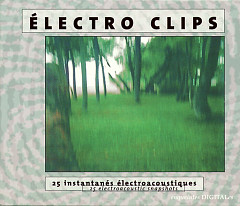
    Subtitled “25 instantanés électroacoustiques de trois minutes” (25 three-minute electroacoustic snapshots), this CD presents a pot-pourri of inspired, moody, and sometimes frightening music. Total running time is over 77 minutes. Too many pieces to detail here, but we’ll touch on a few outstanding ones.

    Michel A Smith opens with Style de bougalou (Bougalou-like), which features some entertaining vocal (baby sighs, cries, goos, and other strange whisperings) and instrumental (only piano is familiar) samples. Smith molds these into a delightful rhythm that gradually builds into a screaming runaway train at the climax.

    You’ll think Jabba the Hut has invaded your listening space when you hear Zack Settel’s SkweeitChupp. The humorous, nonsense speaking narrator, who often sounds Russian, is interspersed with sometimes fun, sometimes macabre vocal and FM sounds. Altemately cute and scary.

    Associations libres (Free Associations), by Gilles Gobeil with René Lussier on electric guitar, comes as close as any music we’ve heard to causing instant nightmares. The cacaphony of shrieking guitar tones, sonic collisions, jungle noises, frightening machine simulations, and slamming booby traps certainly made our skin crawl. Very impressive.

    Creative sampling — in both realistic and bizarrely edited forms — abounds on Électro clips. You’ll hear crowd noises, flowing water, electric trains, trucks, television newscasts, and so on — even “Where are you?” from Prince’s The Future on his Batman Motion Picture Soundtrack. The distinctively female yawn in Francis Dhomont’s Qui est là? is absolutely infectuous.

    Twenty-five individual sheets — each with a black-and-white photograph on the front and a trilingual composer introduction and brief description of the corresponding piece on the rear — accompany the CD. Électro clips provides a varied taste of current trends in electroacoustic music. Besides, if you can’t stand a piece, the next one is less than three minutes away.

    Very impressive.

    Électro clips in Les Cahiers de l’ACME

    “Critique”, Stephan Dunkelman, Les Cahiers de l’ACME, no. 112, February 28, 1991
    Thursday, February 28, 1991 Press

    Idée originale et intéressante que celle de demander à 25 compositeurs de créer, chacun, une œuvre courte (trois minutes). Exercice de style moins aisé qu’il n’y parait dans la mesure où ces compositeurs sont habitués à évoluer sur une durée beaucoup plus longue. Cette difficulté ne semble pas étrangère aux compositeurs de musique électroacoustique, mais ce genre de CD permet néanmoins d’offrir un large éventail de styles. Espérons que cette initiative se réitérera sous d’autres formes…

    Électro clips in Factsheet Five

    “Review”, R Seth Friedman, Factsheet Five, no. 40, January 1, 1991
    Tuesday, January 1, 1991 Press

    A collection of 25 minute “Electroacoustic snapshots,” together with 25 black and white photographic snapshots and descriptive notes from the composers. Ranges from highly experimental noise to the sound of breathing and trains. Strangely soothing in its unexpected changes, and ideal for listening to in a shuffled order on the CD player.

    Strangely soothing in its unexpected changes…

    Électro clips in L’attention

    “Critique”, TP, L’attention, no. 4:4, December 1, 1990
    Saturday, December 1, 1990 Press

    La communauté électroacoustique nord-américaine est réunie. On lui a commandé 25 pièces de trois minutes et elle les a faites. Un tour de force pour ces 24 artistes qui font souvent des pièces de 10… 20… 40 minutes. En liste: Michel A Smith, Craig Harris, Jean-François Denis, John Oswald, Yves Daoust, Claude Schryer, Martin Gotfrit, John Oliver, Zack Settel, Stéphane Roy, Daniel Scheidt, Bruno Degazio, Richard Truhlar, Gilles Gobeil, Robert Normandeau, Laurie Radford, Christian Calon, Hildegard Westerkamp, Amnon Wolman, Francis Dhomont, Roxanne Turcotte, Dan Lander, Javier Álvarez et Charles Amirkhanian. Une fiche de notes explicatives (en français, anglais et espagnol) est consacrée à chacune des pièces et agrémentée d’une photographie noir et blanc. Le livret totalise 58 pages et 26 photos… et ça rentre dans le boitier! Non, c’est pas une blague.

    Le disque a été lancé aux Loges, le 2 novembre dernier, dans le cadre du festival Montréal musiques actuelles/New Music America 1990. Plus de la moitié des compositeurs de Électro clips étaient en ville pour le festival et ont pu venir présenter eux-mémes leurs pièces. Excellent timing qui leur a valu une reprise, le dimanche suivant, dans la salle de concert de Concordia.

    Électro clips in The Globe and Mail

    “Snapshots That Stimulate”, Robert Everett-Green, The Globe and Mail, November 26, 1990
    Monday, November 26, 1990 Press

    Twenty-five composers, three minutes each: that’s the rate determined in advance for this attractive compilation from Montréal of “electroacoustic snapshots.” The shutter speed may be a bit fast for the average serious composer, but the snaps featured on this disc capture a fairly wide segment of the scene. Included are works commissioned from composers across Canada, a few Americans, and one senior trans-Atlantic figure (Francis Dhomont).

    The methods and materials used in these sound-bites could hardly be more diverse. Some fabricate a world from a few sounds and timbres, a practice pioneered in Canada by the late Hugh Le Caine. Craig Harris’s Somewhere between teases a symphonic essay from piano tidbits, while John Oswald’s Bell Speeds conjures a hefty carillon from a single pea-sized bell.

    Others play with language and its voices, carrying on the two-fronted assault that busies musicians and “sound artists” alike. Zack Settel’s jivey Skweeit-Chupp, for instance, is synthetic skat; as is Robert Normandeau’s dreamier, grander Bédé, in which a child’s voice is split right across the audible spectrum. Dan Lander’s rougher I’m looking at my hand is an audio equivalent of the language-laden “personal films” that turn up at alternative film screenings.

    Others pick up a thread of musical journalism that has been pretty much invisible since Paul Hindemith wrote Neues yom Tage (The Daily News). Yves Daoust lards his intriguing Mi bémol collage with politically-charged clips from last summer’s Oka broadcasts, Christian Calon patches indpendentiste speeches and open-line exchanges into his Temps incertains.

    Still other entries defy classification. Dhomont commits self-cannibalism in Qui est la?, plundering a decade’s work in a fiercely protean essay that whips past like a high wind. Gilles Gobeil teams up with guitarist René Lussier for the partly improvised Associations libres, by far the most aggressive item on the disc. Hildegard Westerkamp, one of only two women on the album, shapes her Breathing Room with exhalations and heartbeats, a strategy that seems more interesting in theory than in her practice. And Bruno Degazio transforms a formula of fractal geometry into the amusing Humoresque 901534, the closest Electro clips comes to danceable, pop music.

    All in all, it’s a stimulating collection, with half a dozen snaps suitable for framing. The disc booklet includes a set of 25 commissioned black-and-white photographs by Quebec City photographer Joanne Tremblay.

    … snaps suitable for framing.

    Électro clips in Voir

    “Critique”, Félix Légaré, Voir, November 22, 1990
    Thursday, November 22, 1990 Press

    Si vous vous intéressez à la musique électroacoustique et que vous ne savez où commencer, voici une visie en 25 courts montages de compositeurs d’Amérique du Nord, d’ici et d’ailleurs. Chaque création se présente comme une porte ouverte sur l’imaginaire de chaque musicien, où abondent des extraits sonores de la vie courante. En prime: pour chaque auteur, une biographie et un résumé de leur démarche. Intéressant et accessible. Sur CD seulement.

  • 1
  • 2
  • 3
  • 4
  • 5