electrocd

Blog

87 results
  • 1
  • 2
  • 3
  • 4
  • 5
  • 6
  • 7
  • 8
  • 9
  • Autour in Computer Music Journal

    “Review”, Laurie Radford, Computer Music Journal, no. 22:4, December 1, 1998
    Tuesday, December 1, 1998 Press

    Awareness of the diversity and wealth of sounds around us, a respect for “indigenous” sounds, the sounds of nature, of humankind, of the winds and oceans as well as the machines that dominate our daily aural experience, and the use of these sounds in a powerful artistic form embodied in electroacoustic musicthese are some of the objectives of a growing number of composers over the past quarter century. The World Soundscape Project (WSP) was founded in the early 1970’s at Simon Fraser University (SFU) in Vancouver by Canadian composer R Murray Schafer as a means of confronting and revealing the sounds that surround and accompany us in our daily lives, about their effects upon us, and our effects upon them. Several prominent composers such as Barry Truax and Hildegard Westerkamp were part of this seminal project in soundscape archiving and the development of methodologies for acoustic ecology.

    The recent founding of the World Forum for Acoustic Ecology (WFAE) has brought to the fore several young composers who have taken up the cause and spirit of the WSP and developed and integrated its concerns and objectives into their own creative pursuits. Claude Schryer has been very active in this movement for over a decade and the 1997 release of Autour on the empreintes DIGITALes label gathers together some of his most representative work. The first selection on the disc, Musique de l’Odyssée sonore (1996-97), is a revised and condensed version of the music for a National Film Board of Canada (NFB) documentary on the soundscape of Quebec City and the theories of R Murray Schafer (as embodied in his 1977 text, The Tuning of the World). Film soundtracks do not always make for great pieces of music. But in this case, the origin of the film and its sounds are one and the same. Schryer’s sensitive shaping of sound materials, and his subtle timbral and temporal transformations blend the diverse array of materials into a convincing whole that confidently bridges the gap between original sound source and radical manipulation with obvious respect for the materials involved.

    El medio ambiente acústico de México (1995-96) takes us to the southern point of the North American acoustic experience. Schryer, referring to this work as a radiophonic soundwalk, takes the listener on a sonic journey through six dynamic and evolving Mexican soundscapes. From the opening fragmented Mosaico, through the undulations of Océano, the raucous interjections and bombardment of Transportación, to the children’s choirs and street festivals of Música, the buzzing, snorting, chortling and spattering of Naturaleza, and the irregular rhythms of the final meditative Campanas, there is a sense of unity and cohesion, of crafted phrasing, of a care taken in the presentation of these beautiful urban and rural sounds such that the listener is invited to share in the awe and wonder with which the composer approaches his materials.

    The pioneering spirit and activity of the WSP was highlighted and honored during the 1996 Vancouver New Music Festival where a number of new soundscape compositions were created utilizing the WSP archives at SFU as well as new recordings from Vancouver’s unique sound and seascape. One of these works, Schryer’s Vancouver Soundscape Revisited (1996) is included on Autour. (The entire series of compositions, as well as examples of original 1973 World Soundscape Project archive materials, is available on the Cambridge Street Records Soundscape Vancouver 2CD set [CSR 9701].) As with the other two works mentioned so far, this piece is a suite of short, thematically focused movements. They alternate calm, spacious waves of sound with frenetic exchanges of wildly diverse materials. The pandemonium of call and response between boat horns, trains and power line oscillations in Fire, or the granular cascades of Industry, contrast vividly with the calm of the opening movement Eagle, the duet between boat horns and a resident itinerant in Dronesong, or the gentle conclusion of Blowin’. A favorite is the visceral and politically charged juxtapositions in Beans. Schryer confidently leads us through diverse sound environments in a way that subtly clarifies the constituent sounds, their context, their shape and intrinsic character.

    The artistic use of the sound-producing potential of natural objects as well as man-made mechanisms is a fundamental premise of much audio art, sound installation work, and soundscape composition. Stemming from this is a tradition of harbor symphonies where the horns of various seafaring vessels, moored in various cities around the world, are used as a euphonious, bigger-than-life orchestra (that taking place in the city of St. John’s, Newfoundland, part of the bi-annual Sound Symposium, is perhaps the most well known). Autour d’une Musique portuaire (1996), created in collaboration with radio producer Hélène Prévost, documents a similar event in the harbor of Montréal where ships, trapped by the frozen St. Lawrence River, serve as instruments for several composers each spring. The original performance included six boats and their distinctive horns, the bells of the nearby Notre-Dame Cathedral, as well as the bells of two Canadian National Railway trains (in motion!), all coordinated by written scores and walkie-talkie communication with the composer. This ensemble’s performance was then recorded and broadcast live by Radio-Canada FM. The original recording captures the vastness of the Montréal port as it resounds and shapes the music of the horns and bells. The particular recording offered on this disc presents a group of soloists on saxophone, trombone, and bass clarinet improvising in a large studio with the original harbor recording. The sonorous impact and rhythmic possibilities inherent in the original piece are expanded upon and refined within the original framework. The inclusion of Schryer’s opening countdown and the cheering crowd assembled at the Vieux Port de Montréal at the work’s conclusion lend an air of exhilaration to this version of the piece.

    For those who have been intrigued by the idea of ‘soundscape’ composition, have never had a chance to experience it, or have wondered what could be done with that great series of recordings captured on your last exotic vacation, Claude Schryer’s Autour may offer your some ideas and a rewarding listening experience. The accompanying booklet and overall production of Autour is exemplary as has come to be expected from releases by empreintes DIGITALes. For those wishing more information about electroacoustics and ecology, check out the Spring 1998 issue of [Canadian magazize] Musicworks dedicated to individuals involved in soundscape composition.

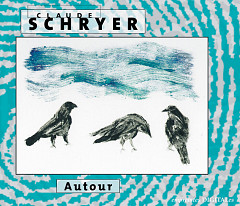
    Autour is exemplary as has come to be expected from releases by empreintes DIGITALes.

    Zoo in Aegri Somnia Vana

    “Review”, Philip von Zweck, Aegri Somnia Vana, December 1, 1998
    Tuesday, December 1, 1998 Press

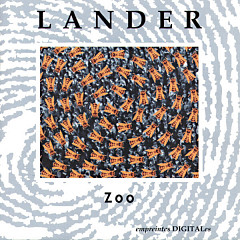
    Zoo is a must-have CD. Talking to a Loudspeaker, a piece originally part of the New American Radio Series, was one of the first pieces to make me think about sound, text, and communication. It is an amusing an intelligent run through ideas of radio and communication, broken down in to short, easy-to-digest pieces. For example [The News], there is an exercise in radio news, which presents two sides of an abortion protest, the political right positioned in the right speaker, and the political left in the left speaker, allowing the listener to adjust the balance. Destroy: Information Only is an experimental documentary of Lander’s problems with a back injury. It’s a frightful but beautifully executed piece. Failed Suicide is the shortest and oddest piece, in which unidentified voices depict, in a very strange manner, a suicide. The last track, City Zoo / Zoo City, is a piece of digitally manipulated field recordings of a zoo, reinventing the animals as anything but animals. A very smart CD.

    Zoo
    A very smart CD.

    Kaleidos in Computer Music Journal

    “Review”, James Harley, Computer Music Journal, no. 22:4, December 1, 1998
    Tuesday, December 1, 1998 Press

    The 40-year-old Stéphane Roy brings a background in literature to his work in electroacoustic music. This Montréal-based composer has received numerous awards for his music. The composer associates his style with the school of “acousmatic” composition of the GRM in Paris.

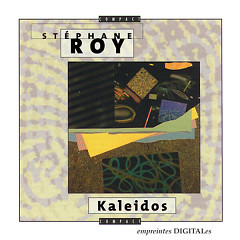
    Kaleidos brings together four compositions composed over the period 1987-1994. Mr. Roy’s sonic palette is consistent throughout this collection. In sudden gestures, he scatters fleeting sprays ot oily resonant grains. These are often mixed on top of distant, amorphous textures. Stéphane Roy also relies on another strategy: wide variations in dynamic range. Violent outbursts of energy emerge dramatically from near-silence to make curious gestures, then quickly disappear.

    Mimetismo (1992) is a virtuoso composition based on strumming in the style of Spanish flamenco guitar, spanning 10 min and 36 sec. The piece was realized in several stages, with initial work using the SYTER system at the GRM studios, and final editing at the studios of the Universite de Montréal. The piece hegins gradually, building frenetically to an extended summit (but not a climax) at 3:30. The intensity gradually lowers, and we are transported to a realm of distant atmospheres. I was impressed by the composer’s fluid treatment of macro form.

    Paysages intérieurs (1988), realized at the Universite de Montréal studios, works with a limited palette of source sounds that are transformed in the manner of musique concrète: filtered, transposed, remixed, spliced. The first several minutes consist of variations in what sound like small bells. The opposition between distant, Iooming figures and nervous cross-panning grains creates a dramatic landscape. As the composer states: “In these landscapes, where the unspoken reigns, a thousand fears suddenly emerge under the pressure of an interior murmur. The mysteries of our spirit open up ancient fratricidal debates, nourished by our entire existence” (program notes). This is a mysterious yet intriguing work, continuous in texture with a beautiful low-layer weaving throughout.

    Ondes / Arborescences (1987), created in Montréal a year before Paysages intérieurs, Iasts 9 min and 36 sec. It begins with a cascade ot high and low frequencies. The source of its watery timbres is untraceable. Pitch plays more of a role in the opening of this work, which adds layers of long sustained tones to create harmonic fields that eventually destadestabilize into noises. The (analog synthesizer?) pitches return, drifting down in amplitude and across the spatial panorama. The melodic material seems improvised and quasi-random, so although the piece is skillfuily mixed, I did not find this piece to be as strong as the others.

    Crystal Music (1994), at 14 min and 46 sec, is the newest and longest work on this disc. The work unfolds in the same unstable style as Mimetismo Realized with the Common Lisp music language, the first minute opens in a dramatic “acousmatic” style. As the composer states: “Like glasswork, the material has been expanded, moulded, transmuted in the fiery furnaces of experimentation.” A wide range of dynamics and techniques of granulation plays a major role in this tour-de-force of mixing.

    A wide range of dynamics and techniques of granulation plays a major role in this tour-de-force of mixing.

    Autour in Slug

    “Review”, Tom Schulte, Slug, December 1, 1998
    Tuesday, December 1, 1998 Press

    Autour is the name of Schryer’s release. First presented is a seven-movement Sound Odyssey [Musique de l’Odyssée sonore] which is a vicarious journey decorated with hooves, horns and bells. Called a “radiophonic sound walk” El medio ambiente acústico de México begins with a gunshot and ends with quiet footsteps and birds. It brings together a great collection of visual, recognizable sounds, Schryer’s work will strike the listener as the most disturbing or intriguing of recent [empreintes DIGITALes’] DIFFUSION i MéDIA releases…

    Les corps éblouis in Slug

    “Review”, Tom Schulte, Slug, December 1, 1998
    Tuesday, December 1, 1998 Press

    Two composers you [will] not find on Miniatures concrètes are Christian Calon and Claude Schryer, but they both have recent releases on the label.

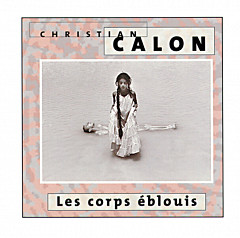
    Calon’s work Les corps éblouis is presented on a CD EP (22:45) of the same name. It seems an artists study in string tension. Sounds leap out of silence as an electrical guitar is used to in every conceivable way short of strumming. The results are further treated, for a final effect that is alien and complete.

    Miniatures concrètes in Slug

    “Review”, Tom Schulte, Slug, December 1, 1998
    Tuesday, December 1, 1998 Press

    A friend once looked through my CD collection and asked ‘what sort of songs’ were on a certain [empreintes DIGITALes’] DIFFUSION i MéDIA release. “Well, it is more a collection of sounds than songs” I offered. [empreintes DIGITALes’] DIFFUSION i MéDIA put out exquisitely recorded collection of musique concrète and other avant forms of experimentation. A few releases are slimline packaged, but most are in handsome cardboard packaging with thick booklets (text in French and English) and attractively cuts sleeves for the disc itself.

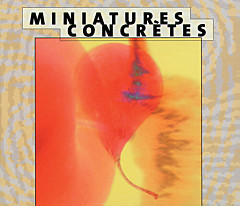
    An excellent introduction to their vast catalogue is the compilation Miniatures concrètes. Blips, environmental sounds and strange loops flit across the stereo range on this recording. It is best to climb right it and experience this strange world through a pair of headphones. Two dozen short works from a many composers are presented here. This also marks the fiftieth anniversary of musique concrète, the French name for the creative sequencing of tape recorded music and natural sounds. A thirty-two page booklet offers text on every track.

    … exquisitely recorded collection of musique concrète and other avant forms of experimentation.
  • 1
  • 2
  • 3
  • 4
  • 5
  • 6
  • 7
  • 8
  • 9