Ned Bouhalassa: In January 2000, the empreintes DIGITALes label will celebrate its tenth anniversary. It is recognized around the world and its catalogue receives rave reviews from the critics. How do you explain this success?
Jean–François Denis: In 1990, there were no independent record labels specializing in electroacoustic music. There were labels of course, but these were parallel activities of studios or organizations. We were a ‘fresh’ idea. Also, from the start, empreintes DIGITALes developed an artistic ‘policy’ (regarding both sound and graphics) and became very visible in the electroacoustic and experimental circles (due to its large publicity and the many mailings of catalogues). So there was a will to develop a signature, to be recognized. Of course, the quality of the works was always a priority.
NB: What inspired you to set up your own record company?
JFD: No one else wanted to do it. I went around to the other existing record companies (of this country) to offer to develop an electroacoustic sub–division, but returned unsuccessful. I also talked to several composers about a record production project: all were very interested… that someone else do it. When I spoke about it to Claude Schryer, he mentioned that he had been thinking about setting up a label as well. So in August 1989, we founded DIFFUSION i MéDIA (today a distributor) and the label empreintes DIGITALes, and we conceived the first 4 projects of the collection (Calon, Normandeau, Thibault and Électro clips).
NB: Starting a new business is always risky, even more so in the case of a serious music record company. Did you have many doubts in the beginning?
JFD: The risks? We were ready to work and, with the indispensable help of the composers, we faced only beautiful risks: to produce decent, superb, lavish CDs of music that we like. I believe that we need risk in order to constantly redefine ourselves, to question ourselves (even if it may mean going back to the starting point). The doubts? I wondered then what I would do with 1000 copies (the minimum at the time) of the same disc in my home: how do I get them out there to be heard? what about distribution? sales? We almost had to invent ways to reach our public! (We didn’t even know where to really find this public!)
NB: The first Francis Dhomont double–cd, with its large booklet, was launched with pomp and circumstance before two exceptional concerts. Was this one of your most memorable launches? One of your wildest projects?
JFD: The Montréal launches have always been a little special: in a Planetarium; disguised as a party–concert; café–croissant at 7 AM; in disco or punk bars. Of course the Dhomont box–set launch was important, though, if my memory serves me right, it was but a small part of a night which was celebrating Francis Dhomont’s 65th birthday. There was also a collage–homage piece from his students, assembled by Gilles Gobeil. There have also been other launches in Vancouver, Norwich (UK), Toronto, Birmingham (USA), and Paris…
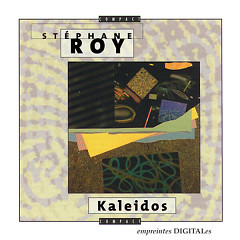
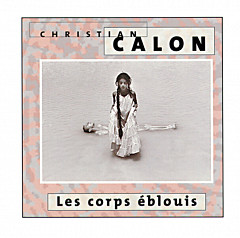
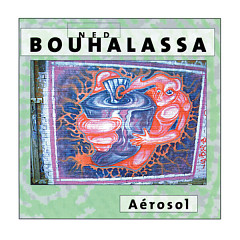
NB: The image of your label is immediately recognizable. What is always obvious is the attention that is given to the quality of the graphics. How would you describe Luc Beauchemin’s role?
JFD: Luc Beauchemin conceived of the first design overhaul in 1991 (with the Daoust), as well as the second in 1996 (with the Harrison). (The OPAK cardboard box, used since 1996, is a collaborative effort.) As for the cover art, the composer is the one who suggests a work or commissions an artist (since Luc Beauchemin is also a graphic artist, some of the covers feature his work).
NB: The only CDs on your label that feature works by different artists on the same release are the clips CDs (Électro clips and Miniatures concrètes). Why don’t you combine normal length pieces by different composers on one cd?
JFD: Because I find these (mixed composers) CDs uninteresting to listen to. Each individual empreintes DIGITALes cd represents a unique musical ‘idea’; as a listener, I find that extremely enjoyable. The only exceptions stem from a very strong and original ‘concept’ (especially in 1990): that of the 3–minute electroacoustic clip. That, to me, is what makes it ‘possible’ to listen to these kinds of CDs.
NB: How do you choose your cd projects?
JFD: It usually starts with the music (heard in concert, during festivals — but very rarely from ‘demos’ received by mail) and follows with the composer’s approach, the integrity of their artistic approach.
NB: How can a composer interest you in a cd project?
JFD: It’s not easy actually, since I’m already drowning in daily mail in which I occasionally find a ‘demo’ – and I’m somewhat overloaded with work. But I can say that when a composer is recommended by a colleague, it usually helps (one should not forget as well that the production of a cd depends greatly on it being somewhat funded).
NB: What do you think of distribution via the Internet? Do you intend one day to allow your clients to buy works that can be downloaded?
JFD: The cd is only a medium. The advantage that it offers over previous formats is its sound quality specifically in the case of electroacoustic music duration and durability. As soon as there exists another support which offers similar sound quality, we’ll offer music in that format. It’s pretty obvious. So my answer is yes.
NB: You wrote many works during the 80s. Do you think that you might one day make a cd featuring your own works?
JFD: A few pieces have withstood the test of time (ten and fifteen years later). I really haven’t thought seriously about this. What do you think?

![Jean-François Denis [Photo: Brad Ardley (SOCAN), Toronto (Ontario, Canada), September 17, 2025]](https://res.electrocd.com/image.php/image/d/denis_je_15346.jpg?width=n2&cropratio=1:1)