electrocd

Blog

267 results
  • 35
  • 36
  • 37
  • 38
  • 39
  • 40
  • 41
  • 42
  • 43
  • The Freest of Radicals, No Type, No Type (web) in Voir

    “Critique”, Nicolas Houle, Voir, February 14, 2002
    Thursday, February 14, 2002 Press

    Actif depuis trois ans dans le milieu de la musique électronique expérimentale, le label virtuel No Type a publié plus de 70 albums en format MP3. Pour sa quatrième année d’existence, l’étiquette se lance dans les parutions CD avec The Freest of Radicals, une compilation double comptant près de 40 titres. Du noise au jazz, de l’ambient à la house, l’album offre une série d’univers musicaux singuliers, peuplés de boucles analogiques et de programmations atypiques parfois exigeantes, mais toujours dignes d’intérêt. Véritable historique sonore de l’étiquette, The Freest of Radicals témoigne bien de la qualité et de l’inventivité des artistes de No Type, qu’ils soient québécois (Magali Babin, Napalm Jazz) ou étrangers (Tomas Jirku, Chris Degiere).

    The Freest of Radicals témoigne bien de la qualité et de l’inventivité des artistes de No Type.

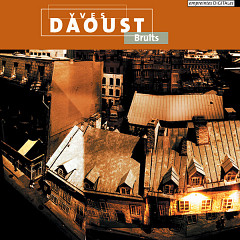
    Bruits in Splendid E-Zine

    “Review”, Luke Martin, Splendid E-Zine, February 6, 2002
    Wednesday, February 6, 2002 Press

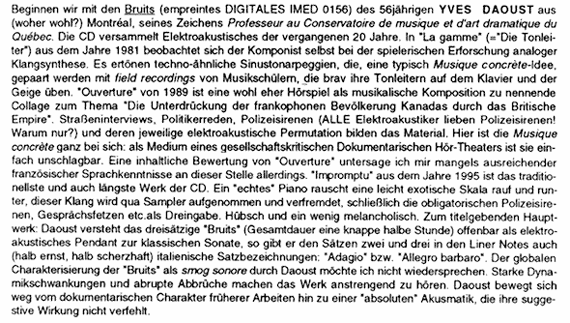
    [The CD] Bruits is a much more personal affair than the usual sound-collage. The titular, tripartite composition, Bruits, is a portrait of Montréal that’s endearing, though without losing a sense of urban malice. Children’s Corner is a fast-forward examination of daytime sounds, while Nuit is less frenetic; more time is spent on peaceful image-building, though it’s with more of an ear towards the unsettling — strange noises interrupt the feeling of sleep that’s created, producing the sensation that you’re hiding under the bedclothes. The piece’s closer, Fête, is a return to the dynamic daylight — troops of musicians pound the ears, bringing a sense of energy and jubilant humanity that’s hard to match. The three components of the title composition are all experiments in sound compression — it feels like Daoust is trying to make the listener hear every sound that occurs in a city at the same time — that seem to actually work, and not just fall in a heap; it’s no wonder Bruits took more than four years to compose.

    The rest of the album is taken up by individual compositions, each clocking in at around fifteen minutes — though it’s the first of these, Impromptu, that really shows Daoust’s brilliance. This composition melds a Chopin piece with the sound of detuning pianos, reversing trucks and squeaking uneasiness. Rushes of sound interrupt the already tense atmosphere, amping up the tension level to near-unbearable. Finally, the piece ends with the sounds of a thunderstorm, and a reduction of added sound — though behind the Chopin, in the distance, buzzsaws and sirens slowly circle. There are waves of sound, quietly menacing, and the sound of tapping, behind your head. It’s a brilliant conclusion to one of the best pieces of music of this type that I’ve ever heard. Phenomenal.

    La Gamme sounds like an alien race observing children, sending out scanner beams to probe their bodies. The sounds of the playground drift, and give way to what ultimately sounds like a deep-bass game of Pong — in a good way. Chunky analog sounds jostle for space with synthesized siren-songs, until they ultimately sound like they’re emanating from an old radio in a rehearsing music student’s room. From alien technology to practiced scales in fifteen minutes: that’s quite an achievement.

    The only piece on the disc that was a little lost on me was the closing composition, Ouverture. Composed to celebrate the French Revolution, it’s a largely-French-language lesson in the history of Québec, realized through snippets of riots, speeches, and vox-pops. While my lack of understanding — due to the language barrier — is my own fault, this piece still exhibits a powerful grip on even the most uncomprehending listener — though admittedly it’s the vocal manipulations, rather than their meaning, that will pull attention in those cases.

    In short, Daoust has delivered a winner that lives and breathes. Hear this now.

    Phenomenal… a winner that lives and breathes. Hear this now.
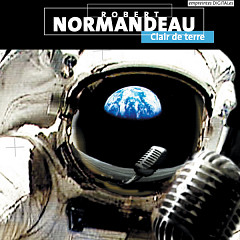
    Robert Normandeau Wins the Masque for Best Sound Design

    Sunday, February 3, 2002 General

    Composer Robert Normandeau was awarded the “Masque” for best sound design, in a ceremony held February 3, 2002, for the play Malina by Ingeborg Bachmann, adapted and directed by Brigitte Haentjens. The composition was then completely reworked for the concert thanks to a commision by the IMEB in June 2000. The piece was premiered at the Synthèse festival held in Bourges (France) in June 2001. Malina appears on the composer’s most recent CD, Clair de terre, released on the empreintes DIGITALes label. The piece will be presented in concert during the “Voyages: Dublin-Montréal” event, coproduced by Concerts M and Réseaux, on March 14, 2002.

    Parasites in KindaMuzik

    “Review”, Bas Ickenroth, KindaMuzik, February 2, 2002
    Saturday, February 2, 2002 Press

    Turntablism that has absolutely nothing to do with hiphop. These soundconstructions come from the comunity around the Ambiances Magnétiques label, and that information ought to be enough to start some serious drooling on the avant-garde fanatics, such as myself. Diane Labrosse and Martin Tétrault are the soundsculptors on the Parasites album, and their tool, among modern electronic equipment and other toys, is the turntable. Not that it can be identified as such. But there are more unidentifiable aspects: where is the melody? Where is the songstructure? Where ends one track and begins another? The answer to all three: unknown. This completely improvised electronic soundscape varies in atmosphere and texture and does this without adding any kind of melody or structure. And why they bothered to cut things up into 15 tracks and name each track in both English and French as well, we’ll probably never know. I could mention that Bad Amoeba sounds like this and Stop Interfering! like that, but why? The sonic exploration goes by continuesly, without pauses. This adds to the hypnotic effect the music surprisingly has. When at first the soundscape tends to float by leaving anything lasting, at a certain moment you’re just getting into it, and you’ll slowly be sucked in the electronic swamp. And although there is a complete absence of melody or even a steady and comfortable drone, that swamp is far from unpleasant.

    When at first the soundscape tends to float by leaving anything lasting, at a certain moment you’re just getting into it, and you’ll slowly be sucked in the electronic swamp.
  • 35
  • 36
  • 37
  • 38
  • 39
  • 40
  • 41
  • 42
  • 43