electrocd

Blog

234 results
  • 31
  • 32
  • 33
  • 34
  • 35
  • 36
  • 37
  • 38
  • 39
  • Jean-François Denis, empreintes DIGITALes in SOCAN — Paroles & Musique

    “L’univers électroacoustique de Jean-François Denis”, Benoit Poirier, SOCAN — Paroles & Musique, no. 16:1, March 1, 2009
    Sunday, March 1, 2009 Press

    C’est lors de ses études à l’Université Concordia, au début des années 80, que Jean-François Denis s’est initié à la musique électroacoustique et a découvert la grande liberté qu’elle permet. Pour le musicien, producteur et éditeur, qui avait appris la guitare classique très jeune et fait ses classes au sein d’un groupe rock progressif, ce fut une révélation. «Ce qui est fantastique avec l’électroacoustique est que l’on est en concert, dans la création d’une œuvre que personne n’a entendue auparavant, c’est qu’à peu près tout peut se produire. C’est la liberté totale! Il y a cette possibilité.»

    Ont suivi une maîtrise (en Californie) dans ce créneau musical, puis un poste de professeur, à Concordia. «Dans mon bureau, il y avait une magnétothèque assez imposante: plus de 700 titres. Là-dedans, il y avait des chefs-d’œuvre qui méritaient d’être entendus plus qu’une fois en concert ou à la radio! De là est née la volonté de rendre la musique électroacoustique accessible.»

    Ce courant musical n’est pas nouveau. Soixante années d’exploration ont donné fruit à un impressionnant patrimoine. De quoi certainement ravir un pionnier comme le compositeur français Pierre Henry, à qui l’on doit la célèbre pièce Psyché Rock [co-composé avec Michel Colombier en 1967], popularisée par Maurice Béjart et Costa-Gavras, en 1967. Cette musique dite concrète, comme on la nommait à l’époque, a d’ailleurs fait des petits. «Aujourd’hui, note Jean-François Denis, quand on écoute de la musique électronique, qui est un genre musical cousin, si on enlève certains paramètres comme la pulsion, on retrouve, chez les créateurs, des approches très similaires à celles de la musique électroacoustique.» Mais cette musique, qu’il compare au monde de la poésie, suscite l’engouement d’un nombre relativement restreint de personnes. «Historiquement, je pense qu’il y a toujours un décalage dans la musique par rapport à son temps.» Les inconditionnels sont principalement concentrés en Europe (Angleterre, Scandinavie, France, Belgique et Allemagne), ainsi qu’au Québec. Il y a également quelques îlots aux États-Unis et au Japon.

    Pour être en mesure de rejoindre ces mélomanes, Denis fondait, à la fin des années 80, la maison d’édition YMX Média et la compagnie de disques empreintes DIGITALes. Celle-ci n’est pas la première à avoir vu le jour dans ce secteur pointu, mais sa pérennité et son catalogue, probablement le plus vaste du genre, la démarquent: 584 œuvres réparties sur 98 disques, dont le tout dernier paraissait en novembre 2008. «Avec l’approche d’édition musicale d’une part, et, d’un autre côté, la production de disques, d’avoir ces deux structures-là séparées, mais liées, c’est assez unique.»

    D’autres entités sont venues par la suite se greffer à l’entreprise: les disques SONARt, l’étiquette web No Type et le portail electroCD.com. Alors, qu’à leurs débuts, son équipe et lui faisaient la promotion des catalogues imprimés par la poste — «C’était presque moyenâgeux.» — ils ont fait figure de précurseurs en étant parmi les premiers, soit dès 1995, à se doter d’une vitrine sur Internet. De même, alors que les créateurs devaient jadis trimbaler tout un arsenal, ils se présentent aujourd’hui sur scène avec, sous le bras, leur portable. Et une foule de sonorités en tête.

    Au fil des ans, Jean-François Denis a siégé à plusieurs conseils d’administration, tels que la Communauté électroacoustique canadienne, le Centre de musique canadienne, section Québec et Réseaux des arts médiatiques, dont il est aussi l’un des fondateurs. Il a mérité plusieurs bourses et prix, dont celui de la Ligue canadienne des compositeurs, en 1994, pour son engagement exceptionnel à l’égard des compositeurs canadiens.

    En plus de composer et de donner des prestations, il a d’autres projets en chantier. Celui, entre autres, d’amener les secteurs télévisuel et cinématographique à s’intéresser de plus près à la musique électroacoustique. À plus court terme, Jean-François Denis est actuellement à finaliser la programmation d’une grande fête, en collaboration avec l’ensemble des diffuseurs de musique électroacoustique. L’événement, qui se déroulera tout au long de 2010 à travers l’Occident, soulignera le 20e anniversaire des éditions YMX Média et de son étiquette phare, empreintes DIGITALes. L’idée première, souligne-t-il, est de faire circuler encore plus, avec l’argument des 20 ans, la musique électroacoustique afin de mieux faire connaître ses créateurs.

    Ce qui est fantastique avec l’électroacoustique […] c’est qu’à peu près tout peut se produire. C’est la liberté totale!

    Les arbres in Tokafi

    Nicolas Bernier & Urban9: Sound Dimensions”, Tobias Fischer, Tokafi, February 25, 2009
    Wednesday, February 25, 2009 Press

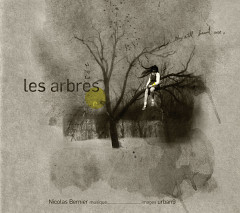
    It is easy to see why two dynamic media, like music and film, should be able to complement each other. But what happens when the equation becomes asymmetrical and moving sounds are juxtaposed with static images? On Les arbres, Canadian composer Nicolas Bernier has joined forces with visual artist Urban9 to find out. A collection of six electroacoustic works and six accompanying postcards featuring paintings by his artistic partner, the album is an attempt of researching how different techniques of creative expression can be combined into a coherent new entity. As natural as the result has turned out after a collaborational process of four years, Bernier gladly admits to the challenging nature of the endeavour: “To create music on ‘static’ images was a hell of a deal!”, he says, “I see this music creation for static images as if I were adding a third dimension to the 2D image. Except that this third dimension is not ‘visual’, it is sound. With the music, I’ve tried to go deeper and explore what the images are suggesting. Is there sound in the picture? Is there somebody else near? Or far? Are we moving in front of it or are we still? Is it raining? Is it windy? Are we far or close?

    That, for sure, are a lot of open questions. But they are definitely leading somewhere. The images of Urban9 revolve around themes like childhood and a magical view of the world around us, humanity and nature or, on a more technical level, monochromatics and colour. Bernier’s music mirrors these sentiments without ever simply copying them. On the postcard to // Piano, two little girls are standing on an open field in front of a solitary tree at the edge of the forrest. Even though they are only metres apart, each seems to be caught in thoughts, unaware of the others’ presence, black specks covering up the contours of their faces. And yet, a rope is binding them together, as though to protect them from getting lost and from loosing sight of each other. It is a scene of great discomfort, of an uneasy tension waiting to be released and Bernier’s soundtrack, with its echoes of Jazz, slowly decaying Trumpet tones, glitchy beats and thundering piano clusters, does just that: At one point, he even allows the sky to explode in a burst of thunder, as if trying to wake the children from their horrific nightmare.

    “Even tought we are often speaking about ‘static’ music, we could refute the theory that images are static because the mind is extrapolating so much with images. And the way our mind works is not static, it is moving in time”, Bernier elucidates, “The fact that Urban9 and me have been working together for a long time and the fact that we we’re sharing a common love for certain aesthetics and that we we’re attracted by the same kind of subject implied that everything went really smooth in our creative process. I was quite aware about his visual world and Urban9 was aware of my musical world. But the project did evolve a lot since the bigginning. Sometimes I was giving a new track to Urban9 and he was starting new images listening to it and vice-versa. Sometimes, the images he was sending to me were the starting point of a new piece… Or they were giving me some ideas to add or remove some material in an existing piece.”

    Physical Qualities

    Les arbres is not just yet another collaboration either. It documents an artistic friendship, which budded in one of the most trivial of environments: Their day job. Bernier and Urban9 were sharing an office in an agency for Web programming. Quite unlike any of his other colleagues, Urban9 turned out to foster a deep interest in experimental music and their conversations at work would suddenly be infused with discussions about new releases, sounds and their various projects. Coincidentally, a great record shop was just around the corner and both would happily spend their hard-earned money on the latest CDs and Vinyl — which, of course, would spark new talk and an even stronger bond. “Urban9 and me were sharing a strange fascination for electronic and “organic” visuals and musical landscapes. It’s like if we couldn’t assume the burden to work in a virtual world (the internet) all day”, Bernier remembers.

    After contributing a track for the Urban9 homepage, the duo decided it was time for a more extensive collaboration. Because their quotidian routine already involved them surfing immaterial spaces, it was established that this project should have distinct “physical” qualities. In fact, for a long time, Les arbres was to be a combination of a book and DVD, which was only discarded at the last minute after no publisher was ready to take on the financial burdon of investing in it. This physicality was, of course, easy to achieve for the images. Awarding similar characteristics in terms of sound was less straight-forward and involved a deep, sonorous production, which seems to bulge out into the room, and a lot of acoustic instruments such as Vibraphones, Accordions, Cellos ans Trumpets. To match the stylistic integrity of the visuals, Bernier composed each piece using the same basic ingredients, while always avoiding obvious repetition. As a result, the images and sounds of Les arbres work both as works of art in their own right and as a multimedia experience which encapsulates its audience in a nostalgic, discreetly melancholic and romantic emotional bubble.

    That, as it turns out, is what Bernier has been meaning to do ever since he got involved in scoring music: “My aim with music at the more basic level is to create a mood. This does not mean that I want to do background music, not at all acutally! To create music for other art forms is also to find the right mood, but instead of only creating a space by filling an architectural form (when the work is only musical), the music is completing the other art form by finding the right sound mood.” Towards the end of Les arbres, which dies down with the beautifully disharmonic digital brass band of // Ouverture, that mood is a silent kind of elation.

    The images and sounds of Les arbres […] encapsulates its audience in a nostalgic, discreetly melancholic and romantic emotional bubble.
  • 31
  • 32
  • 33
  • 34
  • 35
  • 36
  • 37
  • 38
  • 39