electrocd

Blog

122 results
  • 11
  • 12
  • 13
  • 14
  • 15
  • 16
  • 17
  • 18
  • 19
  • Francis Dhomont in Umbria Left

    “Suoni e immagini/ A Perugia la seconda edizione di “Segnali””, Umbria Left, May 3, 2012
    Thursday, May 3, 2012 Press

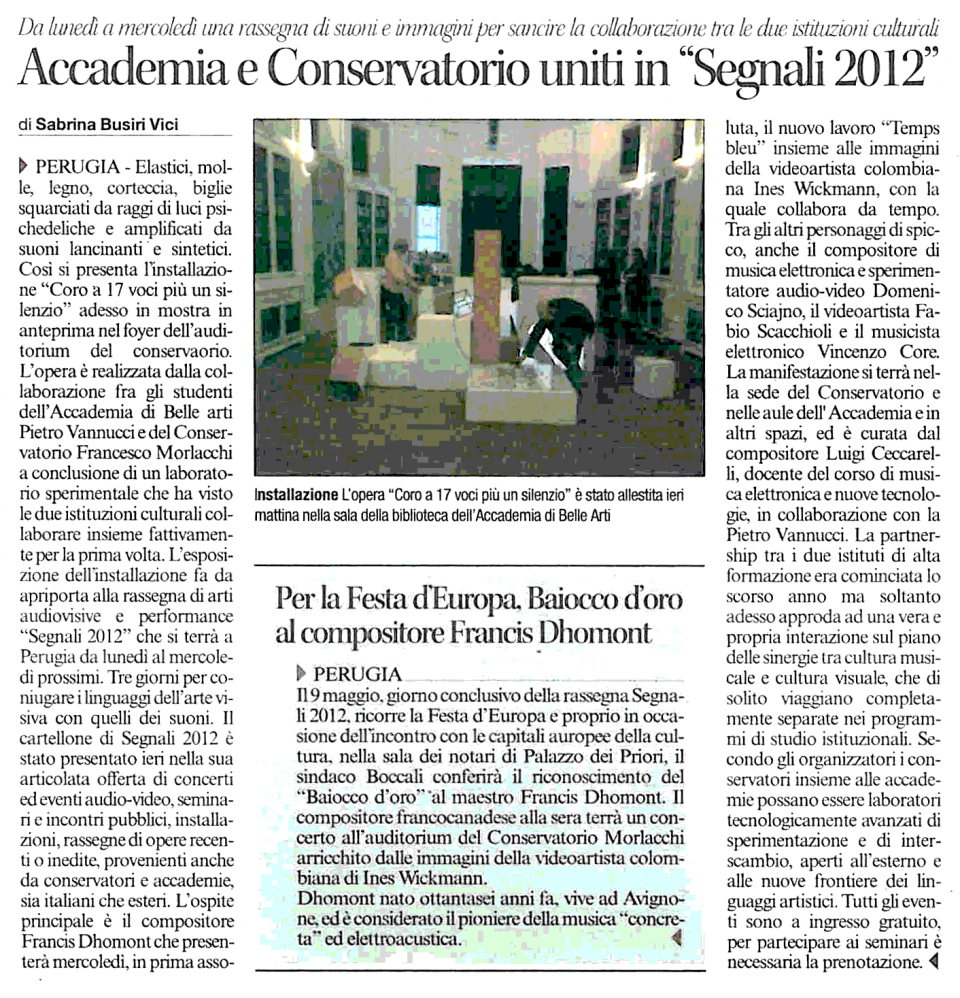
    “Segnali 2012”, manifestazione che coniuga l’arte delle immagini con quella dei suoni, è stata presentata oggi a Perugia e si svolgerà da lunedì a mercoledì prossimi. L’iniziativa nasce dalla collaborazione tra due importanti istituzioni culturali, il Conservatorio Morlacchi e l’Accademia di belle arti Pietro Vannucci.

    Per la seconda edizione offre un articolato cartellone di concerti ed eventi audio-video, seminari e incontri pubblici, installazioni, rassegne di opere recenti o inedite, provenienti anche da conservatori e accademie, sia italiani che esteri.

    L’ospite principale è Francis Dhomont, ottantaseienne franco-canadese pioniere della musica “concreta” ed elettroacustica, che presenterà mercoledì, in prima assoluta, il nuovo lavoro Temps bleu insieme alle immagini della videoartista colombiana Inés Wickmann, con la quale collabora da tempo.

    L’anziano maestro sarà ricevuto a Palazzo dei Priori dal sindaco, Wladimiro Boccali, che gli consegnerà il Baiocco d’oro.

    Tra gli altri personaggi di spicco, anche il compositore di musica elettronica e sperimentatore audio-video Domenico Sciajno, il videoartista Fabio Scacchioli ed il musicista elettronico Vincenzo Core.

    La manifestazione si terrà nella sede del Conservatorio, presso l’Accademia ed in altri spazi, ed è curata dal compositore Luigi Ceccarelli, docente del corso di musica elettronica e nuove tecnologie, in collaborazione con l’Accademia.

    La partnership tra i due istituti di alta formazione era cominciata lo scorso anno ma soltanto adesso approda ad una vera e propria interazione sul piano delle sinergie tra cultura musicale e cultura visuale, che di solito viaggiano completamente separate nei programmi di studio istituzionali.

    Le opere, secondo gli organizzatori, testimoniano come oggi i conservatori insieme alle accademie possano essere laboratori tecnologicamente avanzati di sperimentazione e di interscambio, aperti all’esterno e alle nuove frontiere dei linguaggi artistici.

    La rassegna gode del patrocinio di “Suona Francese”-Ambasciata di Francia in Italia, ed è sostenuta anche da Regione e Comune di Perugia. Tutti gli eventi sono a ingresso gratuito. Per partecipare ai tre incontri seminariali con gli artisti ospiti bisogna prenotarsi.

    Travaux mécaniques in Blogcritics Music

    “Music Review”, Greg Barbrick, Blogcritics Music, May 3, 2012
    Thursday, May 3, 2012 Press

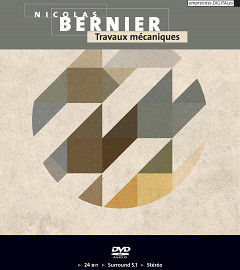
    Discussions of “The soul of the machine” have been going on since at least the time of the Luddites, and probably since the debut of the wheel. This is one of the reasons that I enjoy the new Nicolas Bernier album Travaux mécaniques so much. On this new DVD-Audio, Bernier explores the subject primarily through the use of electronic music, which makes for a nice bit of irony.

    The five tracks that make up Travaux mécaniques are concerned with the sounds of industry in many different forms. One description of the album would be to call it musique concrete. That term certainly applies, but there is much more to this recording than that somewhat simplified musical categorization would imply. There is no doubt in my mind that each of the five pieces were deeply thought out, yet the overall effect sounds random. This speaks to the compositional talents of Nicolas Bernier, for it must be a very difficult thing to make music that sounds as if the machines are playing themselves.

    For this listener, one of the most compelling tracks is Les chambres de l’atelier (10:48). As Bernier describes it in his liner notes, the piece is “The workshop. A place of sudden agitation, of ideas both clear and unclear that disappear just as quickly as they surge.” During this track, both electric and non-electric sounds converge to create a mysterious and oddly intriguing ambience.

    Even more fascinating to me is Writing Machine (15:28). The piece is inspired by the famous “cut-up” writing technique of William S Burroughs, and “By some similarities between his writing, and electroacoustic composition,” as Bernier again states in his notes. The use of disconnected spoken word elements, along with a great deal of various tonal directions certainly adds up to a very interesting listening experience. It shows just how effective this music can be when a composer of Bernier’s obvious talent treats sound as an all-encompassing ecosystem.

    Nicolas Bernier’s Travaux mécaniques has been released on the Canadian empreintes DIGITALes label, who specialize in some of the most adventurous electronic music currently available. Check out their website for more information about Travaux mécaniques, and other electroacoustic artists on the label.

    It shows just how effective this music can be when a composer of Bernier’s obvious talent treats sound as an all-encompassing ecosystem.

    Automacité in Circuit

    “Critique”, Martin Marier, Circuit, no. 22:1, May 1, 2012
    Tuesday, May 1, 2012 Press

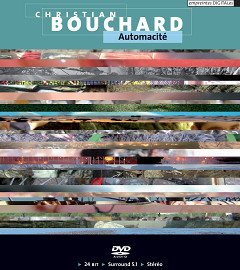
    Christian Bouchard, avec son disque Automacité, propose une musique très énergique, voire frénéti que. Le montage très serré, les sons électroniques et les artefacts de traitement plongent l’auditeur dans un univers franchement glitch.

    Impasto, un triptyque de quarante-cinq minutes, est, aux dires du compositeur, une pièce sur les peintres expressionnistes abstraits (Pollock, Riopelle et Shiraga). La forme générale est volontairement intangible et sans climax, ce qui rappellerait le style «All-over» de Pollock et des autres. Ce type de transposition de la peinture vers l’art sonore est très risqué: le «All-over» fonctionne bien pour une forme qui se déploie dans l’espace, mais le résultat est moins heureux si elle se déploie dans le temps. Malgré cela, Bouchard s’en tire plutôt bien. On aurait souhaité une structure plus claire, mais la matière sonore est si habilement articulée qu’on ne s’ennuie que rarement.

    Les deux autres pièces du disque sont plus tranquilles. On est toujours dans le glitch, mais le rythme est moins effréné et les formes sont un peu plus classiques. La dernière pièce, Objet menacé, est bien équilibrée: les moments plus fougueux sont contrebalancés par de profondes respirations et les sons électroniques sont parfois ponctués de sons concrets plus sensuels. Cette symphonie de parcomètre est, somme toute, plutôt sympathique.

    Cette symphonie de parcomètre est, somme toute, plutôt sympathique.

    Quelques reflets in Circuit

    “Critique”, Georges Forget, Circuit, no. 22:1, May 1, 2012
    Tuesday, May 1, 2012 Press

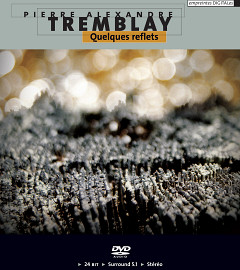
    Que s’est-il passé dans le monde de la musique électroacoustique récente pour que l’on porte à ce point aux nues et qu’on s’extasie devant ces «fameux» sons, ceux participant de ce que l’on pourrait désormais appeler le classicisme de l’inconfort? Telle pourrait être la première question de l’auditeur des premières minutes du morceau Reflets de notre société crépusculaire, tiré du nouveau disque de Pierre Alexandre Tremblay, tant ce dernier semble a priori fonder son discours sur une esthétique de la discontinuité, de la rupture et de l’attente…

    Se méfier parfois des premières impressions… Rapidement, le propos se fait plus clair, plus directif, à la fois par l’émergence d’une écriture plus soutenue ainsi que par une rupture stylistique franche, aux accents pop britanniques assumés. Car on trouve dans le disque Quelques reflets des pièces résolument accessibles, frôlant parfois l’ambient music, comme Ces enseignes lumineuses, qui apporte une véritable proposition d’alliance entre acousmatique et musiques à saveur post-rock. Ou encore, la très «baylienne» For Ever Now Soon an End, qui, dans cette volonté de réconcilier électroacoustique savante et musique plus intuitive, plus sensuelle, poursuit le disque dans ce qui s’avère être littéralement une randonnée musicale. Au rythme des pas d’un marcheur décidé, l’auditeur traverse principalement trois paysages, deux landes horizontales et étendues, avec, en leur centre, un parcours plus accidenté, mais non moins lumineux et chatoyant, et qui, même s’il laisse parfois entrevoir la facture technique en arrière, se révèle être un petit bijou d’orfèvrerie électroacoustique.

    Bel exemple de ce que peut apporter l’intégration et la fusion de styles pour ce nouvel opus de Pierre Alexandre Tremblay qui, s’il ne parvient pas toujours à convaincre par son unité, permet de découvrir de véritables trouvailles stylistiques innovantes et laisse imaginer à quoi pourrait ressembler une acousmatique «pop».

    Bel exemple de ce que peut apporter l’intégration et la fusion de styles

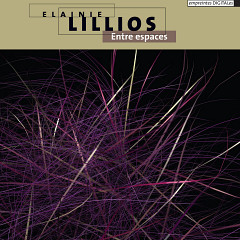
    Entre espaces, Scènes in Vital

    “Review”, Frans De Waard, Vital, no. 829, May 1, 2012
    Tuesday, May 1, 2012 Press

    Two releases from two composers I never heard of on the Empreintes Digitales label, home of the world of acousmatic composers.

    Her [Elainie Lillios’s] biography reads like a list of official institutions and festivals, which is no doubt to impress the reader, but none of these mean much to me. The music however on this CD is quite interesting. Unlike others on this label not all here is about putting sounds through computer processing, which in this circle of composers often leads to similar results, but the power here lies in the use of field recordings (cars, voices, water) to come to the listener untreated but put together in a radiophonic manner. Sometimes the use of electronics is a bit too much of a cliche, me thinks, but the poetic Arturo and the filmic car sounds of three piece suite of Backroads are quite nice.

    From the UK is Pete Stollery, BMus(Hons), MA, PGCE and PhD, a professor of electroacoustic music and composition. His music seems to be build from field recordings which sometimes shimmer through all the electronic processing that is going on. Like with the release by Lillios, things for me are most interesting when it moves away from all the well-known practice of acousmatic sound processing and focussing on primarily field recordings, such as in Field of Silence. In Resound he uses interviews with people and here its is where the music becomes great. It has a fine radiophonic character, with mumbling voices, street sounds and what seems an absence of electronic processing. It’s only with the third piece, Still Voices, that we hear more and more of these field recordings, as the first two sink away in sound processing. A combination of electronics and pure field recordings done well is the closing piece, scènes, rendez-vous, which has a fine soundtrack like capacity.

    I wasn’t too happy a few years with the direction this label heading, but these two pick up matters where I like to see them best: a fine combination of pure sound and treatments.

    … a fine combination of pure sound and treatments.
  • 11
  • 12
  • 13
  • 14
  • 15
  • 16
  • 17
  • 18
  • 19