electrocd

Blog

85 results
  • 7
  • 8
  • 9
  • 10
  • 11
  • 12
  • 13
  • 14
  • 15
  • Firmament in The Sound Projector

    “Review”, Ed Pinsent, The Sound Projector, January 25, 2016
    Monday, January 25, 2016 Press

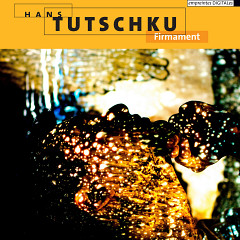
    Three long pieces of electroacoustic composition from German composer Hans Tutschku on his Firmament (empreintes DIGITALes IMED 15131) collection received here 8th July 2015. As with many of the musicians on this label, he’s got a conservatoire / academic background, with highlights of his career including a three-year tour with Stockhausen (mainly to study the master’s ideas about sound projection) and earning his doctorate under Jonty Harrison at the University of Birmingham.

    2010’s Firmament — Schlaflos is like an abstract painting with its strong contrasts of highs and lows, quiet and noisy passages; and it has that “rushing” effect as of music travelling along a long tunnel at high speed, which I’ve always associated with Parmegiani (I think this is where I first heard it; presumably it’s a matter of layering and vari-speeding). There may be some human voices in the mix, whimpering or bleating in awe of the cosmos. Tutschku manages to transcend his technique and arrives at something more than just a nice blend of drones and textures; it’s something to do with his ambitious theme, which is to describe the “universe of sound” that he believes is constantly playing inside every human being. He sees that as a good thing; we don’t need to be afraid of it, it means that there are no limits to our space.

    2011’s Klaviersammlung is a piano piece of course. The composer describes it as “an outrageous sound travel into the world of piano”. Every time he went to the University of Cologne he walked a long corridor filled with decrepit broken pianos, and he imagined (it’s becoming clear what an old-fashioned romantic he is) that they still contained happy memories of the music that was once played on them. This composition is his bid to unleash those memories. The sounds he captured from the actual pianos after he raised their dusty lids was not apparently very “musical”, but it’s the studio assembly and processing that’s the relevant part of the work. Again, it’s large-scale, transformative, intuitive, exciting. Crazy arpeggios, impossible glissando statements; the ghost of Harry Partch walking through clouds in the stratosphere. Conlon Nancarrow was not invited.

    2014’s Issho ni is perhaps the strongest work here. We might call it a “sampling” piece, except that word doesn’t begin to do justice to the care, attention and compassion with which Tutschku has diligently curated and assembled his collection of vocal recordings from around the world — songs, prayers, lullabies, folk singing, children’s songs — an ongoing project which he’s been doing since 2009. Using this personal library, he builds what he calls “an illusory celebration”, a vocal pan-cultural ritual in which the listener will slowly become involved as it unfolds. I suppose it’s “illusory” because these people (from varying cultures, histories, countries) have not only never met in real life, but may not even share any common ground, except in the idealised artistic space created by the composer. He’s done something similar in the past for Ailleurs-intérieur, where the recordings were combined with composed phrases and instrumental sounds, to create “utopian” musical works, and with Together which was used for a dance performance in Boston. Issho ni is a profoundly moving listen; without ever overstating his case, nor editorialising (something which Stockhausen could not resist doing on his 1960s epic work Hymnen), Tutschku makes a strong humanist case that transcends faith, ethnicity, and geography; in his mind, he’s clear that the voices “are joining to memorialise unity, and to rejoice.” Given the state of the world in 2016, can any political, economic or military agency say this?

    Tutschku makes a strong humanist case that transcends faith, ethnicity, and geography; in his mind, he’s clear that the voices “are joining to memorialise unity, and to rejoice.”

    L’envol in Yle Radio 1

    “Avaruusromua: Binäärilukuja, kaaosta ja aurinkotuulia”, Jukka Mikkola, Yle Radio 1, January 14, 2016
    Thursday, January 14, 2016 Press

    […]

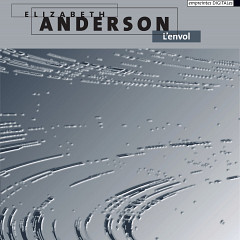
    Muinaiset maya-intiaanit palvoivat Aurinkoa. He tutkivat sitä ja muitakin taivaan ilmiöitä tähtitieteellisesti. Amerikkalainen nykysäveltäjä Elizabeth Anderson on ollut kiinnostunut sekä aurinkotuulista että maya-kulttuurista. Hän yhdisti nämä asiat sävellyksessään Solar Winds, jonka materiaalina ovat radioastronomiset äänitykset aurinkotuulista. Teos valmistui vuonna 2012 ja paria vuotta myöhemmin hän sävelsi teokselle jatkoa. Jatko-osa sai nimekseen … and Beyond, ja sen ajatuksena on kuvata avaruutta Aurinkoa kauempana, jossakin meidän tietämyksemme ja mielikuvituksemme rajoilla. Mitä on meidän mielikuvituksemme tuolla puolen, kysyy Elizabeth Anderson. Millainen maailmankaikkeus siellä on?

    Mitä on meidän mielikuvituksemme tuolla puolen…

    Séquences et tropes in The Sound Projector

    “Review”, Stuart Marshall, The Sound Projector, January 13, 2016
    Wednesday, January 13, 2016 Press

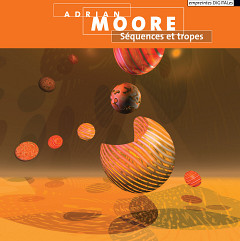
    Science and strategy define Adrian Moore’s 3D warfare and his inter-/inner-galactic travel, much of which takes place behind the veil of fog or darkness. But far from being cold and calculated, these four pieces elicit the supernatural wonder of good ballet or a sudden plot twist. Like much acousmatic music, his pieces approach sensory phenomena as portals to a unified field, decelerating, filtering or otherwise transforming sounds to alter perception/conception of their natures and our vantage point to one either planetary or atomic in magnitude.

    While grand in scope, openers Battle and Counterattack are not as explosive as might be expected, balancing both halves of the word ‘warcraft’ in their demonstrations of the grand choreography of well-co-ordinated armies via masterful manipulation of ‘“scenes”, “feints” and “attacks”’ within multichannel space, resulting in corresponding episodes of subterfuge and sudden ambush. American cinema may have gulled us into believing that victory lies solely in gung ho bravado, but Moore’s bewildering stratagem draws strength from Sun Tzu and Carl von Clausewitz, keeping pace kinetic and unreadable.

    Spaces outer and inner are examined in Nebula Sequence and Strings and Tropes, the former marked by startling accelerations and serene spells breaking the sense of near-constant motion amid ‘clouds of swirling dust and gas’, all of which arise from such mundane ingredients as rocks and ball bearings. I’m reminded of the peregrinations of the gestalt-mind protagonist of Olaf Stapledon’s Star Maker as it tears through galaxies at the speed of enlightenment, witnessing the births and deaths of civilisations and constellations along the way; by and by coming to recognise the immeasurable intelligence of the stellar bodies. This living universe is just as evident in the dense and magnified vibrations of Strings and Tropes — the last of these majestic works — in which the listener shrinks to the size of an atom to listen to the titular strings as if they had the proportions of a nebula. Thus we encounter the more fascinating properties of a potentially paint-drying instrumental solo.

    This living universe is just as evident in the dense and magnified vibrations of Strings and Tropes — the last of these majestic works

    Le dernier présent in The Sound Projector

    “Review”, Stuart Marshall, The Sound Projector, January 13, 2016
    Wednesday, January 13, 2016 Press

    At the end of Grant Morrison’s run on Batman Incorporated, readers learned of arch rival Ra’s al Ghul’s secret stock of super-foetuses, cloned from the caped crusader’s genes and gestating for some future Battle Royale. On the strength of this latest batch from electroacoustic label empreintes DIGITALes, of whom ample note has been made here, a similar programme seems to be well underway in deepest French Canada, with a plot to inundate listeners with award-winning, electroacoustic composer-pedagogues.

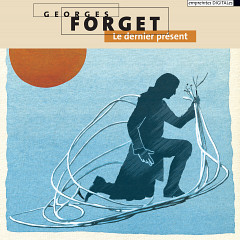
    Georges Forget is the latest of these luminaries to alight upon these pages, following a trail unremarkable only among his peers: schooled to PhD level in Bordeaux and Quebec, scooping up awards along the way, and moonlighting for stage and screen while teaching electroacoustic composition at his alma mater. The journeys in these pieces (mostly from 2008) are suggestive of an ambition that can blast through shield doors; a ferocity evident in Métal en bouche (Metal in Mouth), which detonates millions of charges at stifling, oceanic depths; its claustrophobic paranoia constituting a debt to Wolfgang Petersen’s epic adaptation of Das Boot.

    If Forget favours high-minded literary extracts over lucid description of his sound sources, he still shares a passion for the elements, especially water and metal. This he appeases by sticking a mic in everything from sea waves to the kitchen sink and capturing the frothing tension that ensues.

    Peaks may be difficult to detect in these careening escapades, but a telling reference appears in his notes on the WWII (account)-inspired Orages d’acier (Storm of Steel) in which he refers in both sound and text to the ‘moments (in battle) where violence gets so intense it becomes hallucinating and stripped of any emotion… separated by long stretches of emptiness’, the corresponding result is an alternation between harrowing, ballistic frenzy and scenes of dead air that lashes together emotions such as revelry, violence and horror as definitively as anywhere else on this fine collection.

    … the corresponding result is an alternation between harrowing, ballistic frenzy and scenes of dead air that lashes together emotions such as revelry, violence and horror as definitively as anywhere else on this fine collection.
  • 7
  • 8
  • 9
  • 10
  • 11
  • 12
  • 13
  • 14
  • 15