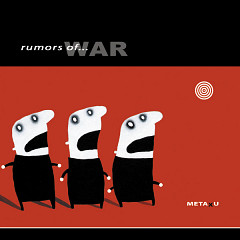
Admit it: you’ve thought about war more in the last twelve months than you ever have before. Most of us have. We’ve discussed it, sometimes heatedly, with friends and co-workers, read and responded to polls and surveys, and perhaps even attended a rally or two. But how many of us have undertaken an existential examination of modern-day war?
Italian duo Metaxu (Filippo Paolini and Maurizio Martusciello) have engaged in just such an exploration. They present their thoughts in Rumors of War’s twelve pieces, each of which is named for a significant conflict or human-engineered disaster. The album begins with the event that set the ball rolling for World War I — the assassination of Archduke Franz Ferdinand on June 28th, 1914 — and takes us through (what else?) September 11th, 2001. Metaxu have even included the fateful dates in their track titles, just in case you want to grab an encyclopedia.
These aren’t songs in a conventional sense (thank God — can you imagine the lyrics?). At best they’re abstract, conceptual collages punctuated by moments of musicality, some of which are startlingly lovely; at worst, they are aural reconstructions, full of metaphors writ large and loud. 06091945 Hiroshima is a cyclical accumulation of elements from the IDM palette — pops, clicks, clacks, bleeps and burbles — with voices half-audible in the background. Perhaps it’s meant to conjure the sterile stillness that follows a nuclear explosion. 07121941 Pearl Harbour ties more directly into reality, progressing from an ominously beautiful minor-key string sequence to an abrupt and ferocious attack, sounds and voices screaming from the sky like giant angry insects. 02051982 Falkland gradually layers an ominous, rumbling bass presence over a gentle pastoral atmosphere as if directing the full weight of the world’s attention at the titular islands.
11092001 New York will be most listeners’ best bet for making a contextual connection with Metaxu’s muse. If you think you’re no longer haunted by the World Trade Center disaster, listen to this one on headphones and get ready to be disturbed. The hint of Arabic music deep in the collage may not get to you, but later in the tune, when the central, keening drone rises in volume and intensity, becoming the scream of a tortured jet engine pushed beyond its design tolerance, you’ll be well and truly creeped. Fortunately, Metaxu don’t linger over the actual crash; the end, when it comes, is as sudden and sharp and devoid of detail as the real thing must have been.
Rumors of War is an unusual, intermittently powerful album, capable of leaving you disturbed (the aforementioned 11092001 New York) and frustrated (it’s mastered pretty low, so plan on being jolted out of your chair by a handful of quiet-to-loud transitions) in roughly equal measure. There’s no real dialogue between Metaxu and the listener, and no revelation beyond the fact that violence and war are sad, terrible things. Then again, that’s clearly a lesson we need to relearn every twenty years or so.

![Hildegard Westerkamp [Photo: Jens Buss, Ca. June 2014]](https://res.electrocd.com/image.php/image/w/westerkamp_hi.8840.jpg?width=n2&cropratio=1:1)