This review was not meant to become so thoroughly academic: but the music in question is thoroughly academic, from start to finish, from its origin to its reflection in our ears. Electroacoustic music is a startling mixture of playing with theoretical models in a geography of organic instrumentation and digital manipulation — to explore their soundness, their structure, their resonance and dissonance — and a love of sonic experimentalism, of the perverse pleasures of the ear, that has propelled musicians since the birth of Art on January 17th, about 2 million years ago (according to Fluxus).
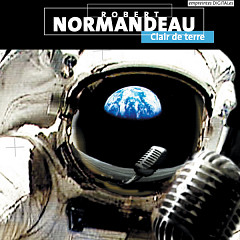
Robert Normandeau works in a genre of electroacoustic called acousmatic sound. Acousmatic sound, according to Michel Chion, is a sound “one hears without seeing [its] originating cause — an invisible sound source.” Born in Québec in 1955, and currently a Professor of Composition at the Université de Montréal, Normandeau explores the outer ranges of the acousmatic in Clair de terre through three separate works: Malina, Erinyes, and the title track, Clair de terre. Or at least the liner notes claim that he is exploring the acousmatic, that which seems devoid of origin; for paradoxically, the first two movements are purely concentrated upon issues of origin and centricity. “At the origin of the work is a play,” begin the liner notes to Malina, which is the score to a theatrical adaptation of Ingeborg Bachmann’s 1971 novel of the same name. Likewise, Erinyes begins with: “At the centre of this work is the voice.” The attempt, according to Normandeau, is to “bring out the primitive nature of the voice.” The paradox inherent in the definition of the theoretical project — acousmatics — and the stated intent of the individual works is fully realized in the last piece, Clair de terre, which focuses upon humankind’s newfound ability to see Earth from space. Clair de terre is a French play on words: “claire de lune” is a Québécois expression — of the moon at night, its clarity and cold purity — which grounds many Québécois folksongs. The reversal of this — to see the Earth in a pure state, from the moon — illustrates the paradox: for we cannot actually see the Earth, we only see it in a reflection, in pictures or representations of the Earth, taken from the Moon. What has traditionally grounded French folksongs such as “Au clair de la lune” is now displaced: the origin itself is decentred through its reflection. According to Normandeau, the result is a realization that “Earth is not at the center of the universe,” leading to a “state of unbalance that is reflected in the way we see the world.” This very reflection — a mirror image of balance interpreted as imbalance, an interpretation that can never be sure of a true balance beneath its simulacra of instability — is the stuff of Normandeau’s “acousmatic” explorations, for even his definition of acousmatic differs from that of Chion’s. For Normandeau, “‘meaning’ contributes to the development of the work as much as does ‘sound,’” whereas Chion understands the term as devoid of referential meaning. The paradox lies within our consideration of the works in question: is it necessary to critique the stated origins to grasp the paradoxes inherent in Normandeau’s acoustic logocentrism? Or can it be heard within the “sound” of the work itself—devoid of meaning, at a loss for representation?
Malina strikes directly into my memory, deep at a Western Orientalism: I “hear” the sounds of the East… and for good reason, as the principle source of sound is the ghostly playing of the Japanese flute called the shakuhachi, processed with spatialization and delay to add a spectral quality. And perhaps it is a sense of the unheimlich (uncanny) that directly confronts us in the rawness, the startling orgasmic quality, of the human voice. Drawn from onomatopoeia, sampled from a production of Sophocles’ Elektra, and at times processed to trill like flocks of birds, the treatment of the voice is akin to sonically imagining the deconstructive critique of the voice Derrida offers Rousseau in Of Grammatology. Voice — is it the raw primitivism, similar to the birdsong, poetic at its core, as Rousseau claims? Or is voice mixed with writing — that corrupt, perverse, guilty pleasure — from its incestous origins? Writing: the Meaning that centres voice. And it is the third piece, Clair de terre, that explicitly reveals the violence of this conflict, of the paradox. A countdown at the beginning of the piece leads to industrial sounds — hammering, doors, squeaking, distorted fuzz — clashing with fat sighs from the human voice. The palette shifts and we are led once again into a sonic memory that can only be described as uncanny: off-key pitches, high drones, rubbings and metal taps, metallic squeaks and echoes. We are in the wasted trainyard of the mind at the very indeterminate juncture where we cannot determine conscious/unconscious, mind/body, voice/writing, meaning/sound. It is perhaps fitting, then, that after a burst of bagpipes, the last sounds heard are the squeaky hinges of a closing door — or perhaps, a crypt.

![Denis Smalley [Photo: George Kinnear, Ca. July 2019]](https://res.electrocd.com/image.php/image/s/smalley_de.9722.jpg?width=n2&cropratio=1:1)