Sauter au contenu principal
electrocd
  • This website is also available in English.

Robert Normandeau

162 résultats
  • 19
  • 20
  • 21
  • 22
  • 23
  • 24
  • 25
  • 26
  • 27
  • Sonars, Robert Normandeau dans Splendid E-Zine

    «Review», Eric Cook, Splendid E-Zine, 25 juin 2001
    lundi 25 juin 2001 Presse

    Canadian composer Robert Normandeau comes from a distinctly academic background, with degrees in Electroacoustic Composition, a fistful of international “contemporary music” prizes and a CV filled with commissions and residencies. But Normandeau is also no stranger to crossing the invisible membrane between the world of university appointments and composer conferences and the more challenging side of pop culture electronic music, getting involved with Asphodel Records’ Recombinant festival some years back and now releasing this collection of “acoustimatic” compositions on the Rephlex label. Perhaps that’s because Normandeau seems to have mastered a challenging feat — combining truly exploratory sound manipulation, creation and compositional structures into works that are still engaging outside of their theoretical frameworks. In other words, they’re actually interesting to listen to.

    Sonars collects six works, spanning fourteen years, from 1985 to 1999. Despite the wide time frame in which Normandeau created these compositions, the CD is surprisingly coherent and unified. Each piece is a seamless continuum between dramatically artificial and dislocated organic sources. You’re continually confronted with roiling cascades of chiming synthetics — sounds that seem entirely unnatural at first listen. With closer attention, the layers of artificiality and resynthesis are peeled away, revealing the source material (in many of these pieces, wordless vocalizations and mouth sounds). Carefully calculated, this play between the natural and the synthetic draws you deeper into each piece, inviting you to listen and analyze each fragment. The earlier works on this collection seem more self-consciously dramatic (Le cap de la tourmente, for example). While this is not necessarily disappointing, they’re not as subtle, layered or perhaps internally referential as some of the more recent pieces. 1999’s Ellipse is especially satisfying, creating a mysterious soundscape of half-defined scraping and scratching, suggesting strings, contact microphones, late night movement in your walls…

    Each piece is nonlinear, self-sustaining and self-propelling — they’re consistent in their sonic language, and attentive listeners will hear and sense the progression and development in the composition without Normandeau ever stooping to draw an explict line from one to the next. These aren’t simple works, however, and they’ll not be for everyone. Normandeau doesn’t entirely shy away from rhythmic construction like some in academic electroacoustic music, but listeners seeking the more explictly beat-oriented material of Rephlex, or more traditional song structures, will be left scratching their heads. Dispense with those expectations and you’ll be richly rewarded by Normandeau’s universe of familiar yet foreign tones — a “cinema for the ear” which will lead you down unexpected paths.

    … a “cinema for the ear” which will lead you down unexpected paths.

    Robert Normandeau dans Le Devoir

    «Cinéma sonore», Bernard Lamarche, Le Devoir, 7 avril 2001
    samedi 7 avril 2001 Presse

    Quatre jours d’électroacoustique, neuf concerts (deux par soir pendant quatre soirs, en plus d’un programme de jeunes compositeurs montréalais), 35 haut-parleurs, quatre compositeurs invités: c’est ce que propose la nouvelle édition de la série Rien à voir, la neuvième, toujours organisée par l’organisme Réseaux, diffuseur et promoteur montréalais de la musique électroacoustique.

    Du «cinéma pour l’oreille»: l’événement conserve sa formule et présente une armada de haut-parleurs en guise d’orchestre, dans un environnement plongé dans le noir et où les signes visuels sont réduits à leur plus simple expression. Mais encore plus, la série n’a jamais mieux porté son nom que depuis qu’elle est accueillie dans les entrailles du Complexe Ex-Centris, boulevard Saint-Laurent. «Ça permet de lever le malentendu de la scène. Là, on est dans une salle de cinéma, il n’y a pas de scène. On est encore plus proches de notre propos, la diffusion sonore. C’est la musique qui importe», explique Robert Normandeau, compositeur et cofondateur de l’organisme Réseaux et de la série Rien à voir.

    Lundi, le Britannique Adrian Moore interprétera plusieurs de ses œuvres, dont certaines viennent d’être publiées sous l’étiquette montréalaise empreintes DIGITALes. Un compositeur dans la jeune quarantaine, de la deuxième génération en Angleterre, Moore «est de la génération des compositeurs qui sont tombés dedans quand ils étaient petits, explique Robert Normandeau. Ils ne sont pas passés de la musique instrumentale à la musique électroacoustique». Moore est reconnu pour sa palette sonore extrêmement étendue. «Il travaille sur la matière, avec des timbres riches.» Avec Jonty Harrison, auprès de qui il a fait ses études à Birmingham, «ils ont carrément un orchestre de haut-parleurs, avec lequel ils font des tournées. Ils sont passés maîtres dans le domaine de la spatialisation sonore».

    Le lendemain, le Français Régis Renouard Larivière dévoilera ses musiques, dont la plupart n’ont jamais été diffusées ici. À l’instar des compositeurs d’une jeune génération qui, «délibérément, se sort du postmodernisme», Régis Renouard Larivière «revient à une musique minimale, plus pure, plus dépouillée, dans laquelle le silence a autant d’importance que le son. Il fait des musiques comme à peu près personne n’en fait». L’an dernier, Normandeau avait présenté une des pièces de Renouard Larivière lors d’un de ses concerts. La réaction du public et la critique dithyrambique ont précédé son invitation.

    Mercredi, le Montréalais Gilles Gobeil, un des cofondateurs, en 1991, de Réseaux, y ira de sa prestation sur console de son, dont le style est reconnaissable entre tous. «C’est assez exceptionnel, assure Robert Normandeau. Depuis 12 ans, il enfonce le même clou, revient aux mêmes thèmes. Les mêmes éléments sonores, caractérisés par des écarts absolument incroyables entre les sons les plus forts et les sons les plus faibles.»

    Seule femme de cette édition — elles sont plus rares dans le domaine —, Beatriz Ferreyra, originaire d’Argentine mais résidant en France, clôturera la série, jeudi. À la suite du Traité des objets musicaux, de Pierre Schaeffer, une référence dans le domaine, publiée en 1966, Ferreyra a collaboré de façon importante à trois disques publiés deux ans plus tard, Solfège de l’objet sonore. «Elle était à la source même des recherches de Schaeffer», explique Normandeau. Dans sa musique plus référentielle, moins abstraite, Ferreyra a recours à des sons dits anecdotiques, «repérables», et propose un travail «très fin» qui «raconte des histoires». La compositrice donnera également une conférence le mardi 10 avril à la faculté de musique de l’Université de Montréal, à 13h (salle B-399).

    Les musiques de Rien à voir (9) seront diffusées ultérieurement sur les ondes de la Chaîne culturelle de Radio-Canada, dans le cadre de l’émission L’Espace du son, réalisée par Mario Gauthier. Ceci dit, rien ne vaut l’expérience d’avoir des points de diffusion démultipliés, d’entendre plusieurs sources sonores, d’entendre et de goûter l’art de l’interprétation: «La part d’interprétation est énorme.»

    Normandeau arrive de Bruxelles où il a participé, à titre de membre de jury, à un premier concours de spatialisation. «J’étais assez convaincu de la chose, et le concours a confirmé ce que je pensais. L’interprète prend l’espace intérieur de la bande et, à titre de diffuseur, le magnifie. Si des sons s’éloignent dans la pièce, il va accentuer ce phénomène. Essentiellement, c’est un travail d’amplification des gestes qui sont faits sur la bande. C’est un travail extrêmement difficile à faire. Il y a très peu de bons diffuseurs. Ils doivent rendre justice à ce qu’il y a dans l’écriture.» Heureusement, les gens invités par Rien à voir sont reconnus comme de bons diffuseurs, qui peuvent assumer cet aspect.

    L’interprète prend l’espace intérieur de la bande et, à titre de diffuseur, le magnifie.

    Francis Dhomont, Robert Normandeau, Stéphane Roy, empreintes DIGITALes dans Le Devoir

    «Constats électroniques: La mouvance acousmatique», François Tousignant, Le Devoir, 16 octobre 2000
    lundi 16 octobre 2000 Presse

    Première chose qui saute à l’oreille après le concert de jeudi soir: il y a bel et bien une «école de Montréal» en électroacoustique. Toutes les œuvres entendues au programme participent d’une même approche, celle lancée par Pierre Schaeffer. Cela consiste en le fait qu’il a fallu, pour le nouvel art qu’était la musique faite de sons enregistrés, manipulés ou électroniquement générés, définir un vocabulaire, inventer un solfège et composer un répertoire de sons et de manipulations sonores. Ce dernier point est malheureusement trop souvent confondu avec la composition elle-même, ce qui rend l’art alors un certain art acousmatique stérile.

    Le programme s’ouvrait et se fermait avec deux extraits de Francis Dhomont. On ainsi voulu rendre un hommage à celui qui est de plus en plus reconnu comme le «fondateur» de cette école. À l’heure où il œuvrait à la Faculté de musique de l’Université de Montréal, quand on parlait de musique électroacoustique, le membre artistique de l’équation primait sur le technique.

    Non seulement la musique de Dhomont reste-t-elle encore belle et jeune, mais diffusée ainsi en salle — Robert Normandeau!, sublime poète de la console! — sa dimension réelle éblouit avec autant de force que de sensualité, d’intelligence que d’inspiration. Peu importe le média, la grande musique, c’est cela. Mémoires vives, du ci-nommé Normandeau, est une pièce un peu rhétorique (je maintiens mon jugement antérieur), mais qui passe mieux en salle qu’au disque — comme tout le reste du programme d’ailleurs; après tout, on n’a chez soi que deux haut-parleurs plutôt que l’armada ici sollicitée et l’espace utilisé. Dommage pourtant que le climat fût brouillé par un impair technique, équivalent du trou de mémoire au concert «habituel» et qui a toutefois démontré que, oui, quelque part, ces machines à musique restaient humaines.

    Le plus beau moment, là où vraiment on a senti une succession au maître fondateur, reste les Paysages intérieurs, de Stéphane Roy. Non seulement la «bande» est splendide, mais Normandeau s’est hissé à des sommets d’inspiration interprétative pour la rendre exceptionnellement sensible. On est pris par cette mouvance qui s’ouvre et qui nous ouvre, qui tourne qui appelle, parfois répond, et qui nous dit… que si on fait cette musique, c’est qu’elle doit être faite ainsi car le message ne saurait être livré autrement. […]

    … il y a bel et bien une «école de Montréal» en électroacoustique.

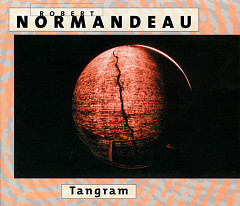
    Tangram, Robert Normandeau dans SAN Diffusion

    «Review», Gred Horton, SAN Diffusion, 1 octobre 2000
    dimanche 1 octobre 2000 Presse

    Normandeau freely admits to having been influenced by various other music forms including rock; these influences are obviously audible in most of his works. For example his piece Venture, which was created in 1996, uses as its sole source material the music of Jimi Hendrix, Led Zeppelin, Pink Floyd and other rock artists. Certain pieces on Tangram share some of the common elements which can be derived from rock music, i.e. long determined passages and repetitive rhythms.

    Tangram’s first track Bédé (1990) uses onomatopoeia through the voice of eleven–year–old Marie–Helene Blain. The effect is of children giggling, whispering and conspiring together in an ethereal world, tentatively touching the real world like Alice Through the Looking–Glass. Was Charles Lutwidge Dodgson listening to this when he wrote about Alice? Éclats de voix (1991), also uses onomatopoeia through its spoken passage: various sections lead us through processed effects; ghostly mutterings and industrial sound textures which lend a sadness and emptiness to a spectral score, introducing the listener to an elaborate sound world. Spleen (1993), for which the composer was awarded the Main Prize at the Musica Nova 95 International Competition held in Prague, is full of tension built up through a percussive heartbeat, but there is an underlying irritability in the piece like the weariness a traveller may feel at journeys end. An undoubtedly complex work. Track 4 Tropes (1991) contains excerpts from Mozart’s chamber works. Beyond the treated piano and orchestral soundscapes lies a delicate inner core. Normandeau appears to dissect and then reassemble Mozarts music whilst still maintaining the original composers subtle creation of character. The title track Tangram (1992) is at 27:05 minutes — the longest piece on the disc. This powerful piece strains to give birth to the perfect Chinese Tangram, a seven piece geometrical form, finally emerging into fluidity and composure.

    Robert Normandeau’s Cinema for the Ear aesthetic lends to his work a depth where meaning, sound and music become one. Either composition on this disc could be placed into a film script, these are soundtracks for the mind, very filmic in structure, and will therefore affect each listener differently creating a personal imaginary element.

    I first bought the CD and listened to these compositional works in 1994, found it excellent then and I still find it drives my imagination in the year 2000.

    … soundtracks for the mind…

    Tangram, Robert Normandeau dans Amazon

    «Stunning sounds; captivating compositions», Steve Benner, Amazon, 17 août 2000
    jeudi 17 août 2000 Presse

    The original 1994 release of Robert Normandeau’s Tangram from DIFFUSION i MéDIA (on the empreintes DIGITALes label) was a double CD edition. It contained TWO copies of the same music: one disc having straight transcripts of the DAT masters, for diffusion use; the other being a recording of the same music diffused into a studio space from an 8-speaker array, better suited for playback over domestic hi-fi. This re-release (in DiM’s new environmentally friendly cardboard OPAK packaging) contains just the latter CD but as the two versions were all but indistinguishable from each other (at least on a domestic hi-fi system), there is little lost for the home purchaser.

    The five works presented here showcase the works of Québécois acousmatic composer Robert Normandeau produced between 1990 and 1993, and includes two prize-winning entries in the Noroit-Léonce Petitot International Competition. Éclats de voix (“Bursts of Voices”, 1991) was winner of 1st Prize for Jury as well as Public’s Prize at Noroit 91. The work is constructed entirely from computer-processed samples of the voice of an 11-year old — although this source is, in fact, hardly ever obvious. The exquisite sonorities (representing five childhood ‘states’) that Normandeau wrests from his source are entirely captivating (like most of his work) and the piece is an absolute delight from start to finish. The disc’s opening work, Bédé (1990) is an electroacoustic miniature, of just 3 minutes duration, derived from the same source material but making an interesting contrast with Éclats de voix. The source sounds in Bédé are more discernible for what they are; the piece is also rather darker and gives a somewhat more disturbing view of childhood than that presented in the later work.

    The third work on the disc, Spleen (1993) continues the same theme. Awarded the Public’s Prize at Noroit 93, this piece is constructed entirely from processed vocal samples of the voices of four 16-year old adolescents. Its restless pulsing rhythms and sudden mood-swings portray only too well most people’s experience of that time of life and in a way that is impossible to draw away from! Fabulous stuff!

    Tropes (1991) presents a different face to Normandeau’s work. The starting point for this piece is the chamber music of Mozart. More specifically, recordings of Mozart’s music, here computer-manipulated out of all recognition-not just as originating from Mozart, but even, in fact, as being instrumental music at all-except for a very few short passages. The result is an entirely individual — almost deconstructivist — view of the relevance of Mozart to the modern musician as well as the contribution that he made to the development of western art music. In this work, Normandeau demonstrates his complete mastery of his own chosen art, demonstrating a genius not far short of that of the great master, himself! The final work on this compilation, Tangram (1992) is a purely acousmatic composition. Part of Normandeau’s “Cinema for the Ears” oeuvre, this 27-minute epic takes the listener on an electroacoustic journey through the seasons, “highlighting the elements and materials associated with each.” The work is inspired by the Chinese puzzle from which it derives its name and shows a sonic equivalence to it, utilising simple sound elements to form complex structures, which become recognisable through their very figurative or associative natures. Here we have another entirely captivating auditory experience. Throughout, abstract or barely recognisable sound materials are blended perfectly with more recognisable, richly associative material: the calling of loons, crackling of flames, pulled zippers or the unmistakable sound of freight-train air-horns echoing through the Rocky Mountains above Banff-to name just a few of the more obvious environmental sounds from which this work is built. This is definitely a work to play and to savour over and over.

    Like most of Normandeau’s music, this disc deserves to be in the collection of every lover of serious, contemporary music. If you already have it and are looking for more, the release Lieux inouïs from the same company contains almost all of this composer’s works which pre-date the music here. His latest works are featured in DiM’s CD release Figures. Both are every bit as good as this.

    This is definitely a work to play and to savour over and over.

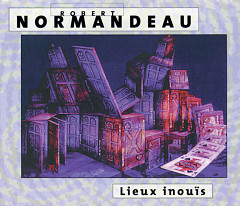
    Lieux inouïs, Robert Normandeau dans Amazon

    «Exquisite acousmatica», Steve Benner, Amazon, 15 août 2000
    mardi 15 août 2000 Presse

    This 1990 release from DIFFUSION i MéDIA (on the empreintes DIGITALes label) represents the first disc entirely devoted to the works of Canadian acousmatic composer Robert Normandeau. The five works presented here span Normandeau’s output from 1985 thru 1989 and represent, in the composer’s own words “[virtually] the only [works] I have chosen to present publicly after more than ten years of full-time work.” That statement attests more to Normandeau’s humility and modesty, than to any shortcomings he may have as a composer.

    Indeed, there is not a single uninteresting moment on this disc, which is absolutely captivating from start to end.

    Its title, Lieux inouïs, (“Unheard-of Places”) is a reference to the unique aural landscape that Normandeau’s pieces inhabit and the surreal imagery they evoke. He calls his particular approach to acousmatic ‘Cinema for the Ears’ and so it is no surprise that the works on this disc — derived entirely from computer-processed real-world sounds — are constantly conjuring up dramatic moments in the mind’s eye of the listener. And the composer handles it all with such consummate mastery. Who else but Normandeau could so seamlessly join massed choirs singing Pérotin’s Viderunt Omnes with the sounds of pneumatic drills; or mix the chatter of children playing with the clatter of railroad trucks?

    For ears unaccustomed to this genre, probably the most easily approached work is the 12-minute acousmatic masterpiece Rumeurs (Place de Ransbeck) (1987). This work constantly oscillates “between pure sound and meaning, without ever resolving to one or the other,” thus providing endless suggestions and hints but no solid facts (rumours, in fact!) of life around the Place de Ransbeck (home of Annette Vande Gorne’s studio Métamorphoses d’Orphée, where the piece was produced).

    The slightly longer Matrechka (1986) is a more abstracted work, with its complex sound-world (of largely undiscernible origin) unfolding by degrees, each of its sections revealing another within it, like the nest of Russian dolls of its title. The 15-minute Mémoires vives (“Vivid memories,” 1989) provides another mostly abstracted vision, this time of the composer’s musical heritage, evoked by the reworking of (recordings of) fragments from other composers’ music for the Requiem Mass. The sparkling 24-minute work Jeu (“Play,” or “Game,” 1989) that opens the disc is ample testimony to Normandeau’s ability to exploit the inherent punning (i.e. ‘play on words’) connotations that his source material offers. Finally, Le cap de la tourmente (1985), which closes the disc, is a dark and brooding 7-minute ‘movement’ from the much longer Musique holographique, which accompanied an exhibit of sculptures with holograms (holosculptures) by Georges Dyens.

    … there is not a single uninteresting moment on this disc, which is absolutely captivating from start to end.
  • 19
  • 20
  • 21
  • 22
  • 23
  • 24
  • 25
  • 26
  • 27