Sauter au contenu principal
electrocd

Blogue

201 résultats
  • 21
  • 22
  • 23
  • 24
  • 25
  • 26
  • 27
  • 28
  • 29
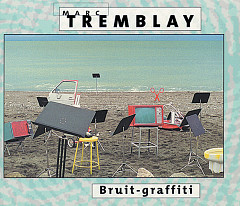
  • Bruit-graffiti dans Les Inrockuptibles

    «Musiques», Philippe Robert, Les Inrockuptibles, 3 avril 2001
    mardi 3 avril 2001 Presse

    Le bruit, voilà le thème de ce disque de l’électroacousticien canadien Marc Tremblay, ancien élève d’Yves Daoust dont le chemin musical a croisé celui de quelques improvisateurs dont le platiniste Martin Tétreault. Quelle que soit sa nature, une sonnerie de téléphone, des voitures qui passent au loin ou un avion dont les réacteurs déchirent le ciel, le bruit, qui est une des composantes essentielles de notre univers quotidien, nous ramène inéluctablement à l’instant qui passe, à un chaos sur lequel nous n’avons aucune prise. Selon Tremblay, le bruit serait un élément perturbateur dans la quête de l’harmonie. Pas certain: souvent, on ne perçoit plus ce qui est familier. Aussi, pour redécouvrir le bruit, et qui sait, l’apprivoiser, Tremblay s’est attelé des années durant à en explorer le potentiel expressif, dénichant de la poésie là où beaucoup n’entendent plus qu’agression. Bruit-graffiti part donc du postulat que les objets parlent, et propose une espèce de symphonie réaliste à partir d’objets bruyants articulée en six parties qui renvoie l’auditeur à son quotidien. Ainsi sont évoqués la voiture (dont le son du moteur est quasiment devenu le fond sonore de la vie urbaine), le téléphone (sa vie, ses voix), la maison (la chasse d’eau!), la bourse (ses échanges économiques) et les réminiscences de l’enfance. On devinera à l’énoncé de ces thèmes que la démarche du compositeur, basée sur le cut-up qu’explore également, mais à partir de musique existante uniquement, John Oswald, s’inscrit dans une filiation qui va de “Revolution #9” des Beatles à AutoJazz de Barney Wilen en passant par Toilet piece de Yoko Ono. La pièce la plus étonnante est un hommage au western qui ravira les cinéphiles: on y entend, mixées, des sources altérées provenant de La Prisonnière du desert de John Ford et El Dorado d’Howard Hawks. Coups de fusils, trains à vapeur et bribes de Rambling Man d’Hank Williams recomposent un film imaginaire. Pour le seul plaisir des oreilles celui-là.

    Évidence matérielle, Jonty Harrison dans The Georgia Straight

    «Evidence Often Extraordinary», Alexander Varty, The Georgia Straight, 1 avril 2001
    dimanche 1 avril 2001 Presse

    It’s not unusual to hear people talk about recordings that take you on a journey, usually in the context of sounds that are tropical, uplifting, or expansively — and expensively—produced. Jonty Harrison’s Sorties, however, doesn’t so much lead you through a sonic landscape as buridle you, blindfolded and confused, into the back of a car, destination unknown.

    A series of linked soundscape vignettes, this 15-minute piece begins placidly enough, perhaps any ordinary urban street. Heels click against the pavement; cars — thrum by on what sounds like wet asphalt; children’s voices clatter from the reflective shop windows nearby; an indistinct bass line wafts from a second-floor studio. But then the mood changes: the squealing of subway brakes leads to a minor scuffle, after witch a door slams shut and the ambient noises fade to black. But the work is far from being over. Keys rattle against locks, tumblers turn, an oddly musical creak — electronically processed saxophone? — signifies the opening of another door.

    In this new world, it’s raining; thunder booms, and then the downpour stops as the listener kicks along a shingle beach, waves plashing nearby, before being pulled through yet another door into a leafy garden of birdsong; in the distance, a puzzled child cries “Mommy! There’s a shoe!

    What domestic or criminal drama is being played out here remains unexplained, as the listener is quickly taken away from this pastoral scene. A buzzing fly morphs into droning industrial noise and then into a silvery synthesized chord, which in turn becomes the noise of a passing bus as the initial street reappears, this tune overlaid with a mesh of clicking and whirring. The piece continues for another minute or so until, finally, ominous low pulses signal its uneasy end.

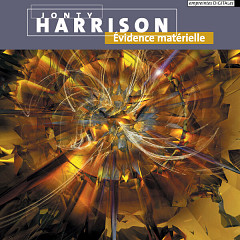
    Sorties a title intended to be read for both its English and French meanings — is taken from Évidence matérielle, Harrison’s new CD on the Montréal-based empreintes DIGITALes label, and in the liner notes the composer explains that “the dominant sound image of the work is that of leaving (exiting, escaping, fleeing) an interior space for an exterior one, only to find that one is mysteriously and inevitably trapped once again in another ‘interior’.”

    Be that as it may, when one listens to this work on headphones, in a darkened room, it’s hard to detect that the listener has any hope of escape. Harrison’s sonic images have such presence that one really does seem kidnapped, swept away in the composer’s design, and although the feeling is not always-comfortable it’s as gripping as a pair of handcuffs.

    Sorties is an extraordinay piece, as are most of the other works collected on Évidence matérielle. The glorious, metallic physicality of Klang; the fractured yet evocative images of Splintering the appropriately transparent liquidity of Streams: all use a supposedly cool medium — electronic music — to paint warm portraits of human experience. Only Surface Tension fails to cohere: it’s an attempt to make music by sampling and manipulating the sounds of discarded packing materials and other rubbish, but those noises are too amorphous and its structure too indistinct to be fully involving.

    Harrison’s compositions are typical of those featured on empreintes DIGITALes, which with 58 titles in its catalogue is perhaps the world’s leading record label dedicated to electroacoustic music. Its productions run the gamut from “environmental” sounds made up of electronically manipulated field recordings to the purely digital concoctions of the recording studio, and its roster includes such Vancouver composers as Sergio Barroso, Paul Dolden, and Hildegard Westerkamp. Vancouver and Montréal are both hotbeds of this kind of work, but an indication of empreintes DIGITALes’ status in the world at large is that only one Canadian composer is represented in its four new releases. Accompanying Harrison’s CD are albums by his student and fellow Englishman Adrian Moore and New Zealand’s Denis Smalley, in addition to one from Montréal’s Louis Dufort.

    Space precludes full reviews of these, but it’s probably fair that all four composers share a common aesthetics — although whether that is the result of a shared philosophical outlook or something forced on them by the technology they’re working with is hard to say. Whatever the case, if you’re looking for drama Dufort is your man; his dynamic range is greater and his sounds harsher than those used by his English and Kiwi counterparts. But, like them, he’s interested in building long, flowing compositions from small sound sources. By compressing, stretching, and twisting familiar noises, and by the steady aecumulation of sonic detail, all four make music that is transporting — even if, as in Harrison’s Sorties, the journey isn’t always fun.

    … one really does seem kidnapped, swept away in the composer’s design…

    Présence II dans La Folia

    «Review», Grant Chu Covell, La Folia, 1 avril 2001
    dimanche 1 avril 2001 Presse

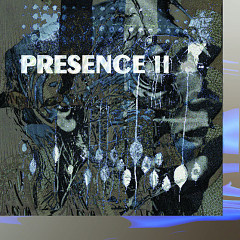
    Presence II is a 2-CD anthology of 34 works from 32 composers from 11 countries. The diversity is overwhelming and it’s hard to single out individual works. They’re all arranged alphabetically.

    Where to start? Bradley’s “volalle melodie vi to trot” / “fowl melody to trot” is very, very disturbing: under or over a text that seems to be foreign language instruction we hear parents of young children at their wits end. Fitzell’s Zipper Music II (an earlier version is on DISContact! II below) is a nifty exploration of the sounds a zipper can make. McIntosh’s Climb to Camp One is built from the sounds of climbing equipment being used inside an amplified piano but it doesn’t recall ostensibly similar works by Cowell or Cage. I’m partial to the 3 short works by Joachim (the oldest works in the set) which explore the filtering of computer generated sounds. Solursh’s We extracts some neat noises out of water, while Teller’s H a e i o u y æ ø å pt. 2 (ex.) gets mileage from laughter. Of course I like the seemingly random collage effects of Trudel’s Ce n’est pas ici and am wonderfully at a loss to explain what the crowd noise, fire, marching band and nature noises are all about. There are many works here, and this is an easy anthology to pop in the CD player and savour.

    Stepping back to 1997, Presence is a 2CD anthology of 23 composers. Some of the many good pieces that jump out are Tape Measure in which Steve Bradley has played a Verdi LP with a sewing machine needle attached to a tape measure. No, you can’t hear the Verdi, but it’s with childlike fascination that you will hear some micro-level gurgling and rumbling. James Harley contributes a long work, Voyage, a grand arc of sound, intricate and spacious. Monique Jean’s If finds an essay in a simple spoken phrase, and in Squeaky Chair Christopher K Koenigsberg finds a symphony in, yes, a squeaky chair. Jean Routhier’s Face à claques is a deviant piece of assemblage, something to do with things overheard we shouldn’t be privy to.

    Also still available is DISContact! II from 1995 that offers 51 short works on 2 CDs. The CEC makes somewhat limited quantities of their productions and this one was reissued in 1997. This is an enriching anthology filled with works created by members of the CEC. The brief works pack in variety and contrast, as well as varieties of technique and sound worlds. Spoken political pieces, song settings, inscrutable noise works, musique concrète and collage are well represented and thriving in the hands of these composers.

    Looking forward, the CEC has put out the call for inclusion in Presence III, so watch this space!

    Connexion dans Ampersand Etcetera

    «Review», Jeremy Keens, Ampersand Etcetera, no 2001_6, 1 avril 2001
    dimanche 1 avril 2001 Presse

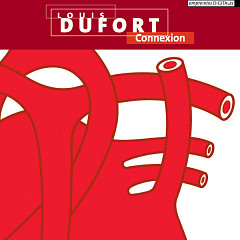
    Louis Dufort, born in 1970, is a year younger than Moore (god, that makes me feel old), and from Montréal rather than the UK. He also has a different general approach — his pieces have more variation in volume and density and he has a strong interest in using the voice — usually sampled and stretched, but recognisable. The variation within the pieces again emphasises the difficulty in description per se. Transit is a piece “that makes use of continuous discontinuity,” and it does shifting between high ringing tones with cluttering and rushes behind; into a descending tinkling and ringing with voices; machinelike rhythms, unstable, clickings, tones and a buzz; banging and the voices of a lost chorus; clatter quiet; slow wind, rebuilding, more voices to a squeaky climax and then quiet fade. Unstable and decentred. The mode of Pointe-aux-Trembles is more obvious in this “impression of the refineries of East-end Montréal” with its regular ebbing and flow — we are getting periods of factory-like loud rhythm with noisy loops of machines, sirens and trains (is that a voice in there?) interspersed with quieter sections, perhaps between the refineries with soft high tones. There are programmatic titles which approximate to the changes I noted — and a nice long fade. With Zénith the voice becomes more prominent — high singing tones open it, and the main body of the piece uses voiced notes throughout. It builds slowly from the almost solo start adding soft tinklings to a first climax of voice and ‘orchestra,’ cymbals crash, horns swirl. Some mouth-sounds shift into a loud, aggressive phase which includes some growling voice which is a cross between death-metal and Mike Oldfield’s Neanderthal man on Tubular Bells. And it seems way out of place here (it reappears on Décap). The ending is surer, with an angelic choir of voices. Finally Décap at 24 minutes, described as “a study for wrist and ankles,” is partly excerpted from a dance piece, and is more rhythmic in both its overall structure (like Pointe-aux-Trembles it shifts between active, loud phases and quieter contemplative ones) and in the local approach. The opening could be from a glitch collection as strong attack whooshes with long fades, pulsey percussion and whispering drive us into the piece. From here we alternate between percussive active parts and more moody, tonal components. In addition to the gruff voice, there are also voice loops where syllables are repeated into nonsense and layered interplaying choirs. The whole builds through some minor climaxes to a big percussive shimmering looped conclusion.

    So two complex albums, sonically fascinating. The similarity in their descriptions ‘continuous discontinuity’ and ‘shaping form continuously’ should prepare you for the active and involved listening expected of you. Not for easy-listening background pleasure, but for focussed attention.

    … sheer exhuberance.

    Traces dans Ampersand Etcetera

    «Review», Jeremy Keens, Ampersand Etcetera, no 2001_6, 1 avril 2001
    dimanche 1 avril 2001 Presse

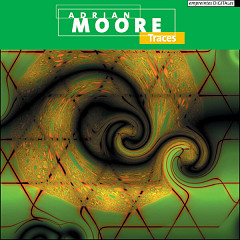
    A first for &etc — two disks from the renowned musique concrète/electroacoustic Québec label, in their unique cardboard constructed boxes. It also presented me with a challenge (which I hope I have achieved): to find a description appropriate to their work. It has struck me in the past when looking at ‘academic’ electroacoustic work (such as Philip Samartzis or some of the Metamkine) that these artists are working in an area which has its own theory and language, recognised across the ICAMs, departments they studied in and competitions that appear to be awarding prizes all the time (4 of the five tracks on Traces received ‘mentions’ or ‘places’). Yet my methodology of reviewing seems to me as even more inadequate than usual — the gestures and changes are so small, precise and rapid that the forest is lost for the pine needles. So I will immerse myself in them and try for a bigger picture. A quote from Moore seems appropriate — one of his tracks “reverts back to more abstract electroacoustic material, shaping form continuously and using gesture as the primary means of communication” which seems a pretty good description to me: and also leans towards some glitch/laptop artists. A great way in for me is Moore’s Study in Ink — as a lecturer I often enjoy dragging out the line of a whiteboard marker if it squeaks, and it seems that Moore noticed the sound as well, and applied his training. This track has one sound source — the marker pen. And what a web he weaves from it: generally you can hear the marker as it makes a gesture, but then the processing comes in to play — long echoed tones, pulsing beats, squeal, groans, trawls and sweeps, together with percussion and voices. There is an almost synaesthesia as you see a trail of movements follow and envelop the pen, sometimes hiding it all together, at others shrinking back into the image. Primarily entertaining, it demonstrates the possibilities available to the sound artist. The following track Foil-Counterfoil uses close-miked tin foil together with glasses, bottles and balloons: the whole thing shimmers and shifts, periods of intense small fragment activity, periods of relative stasis as things bubble away, streaming to the surface. Recognisable sounds shifting to manipulated echoes of themselves or pieces thrown together. A movement possibly discernable in the changes, a fascination in the drama. The first two pieces Junky and Dreamarena are both ‘abstract’ works — described with the quote above. Junky is more structured with “three main sections… and a more detailed structure… in each of the primary sections.” Electronic sounds (processed primary sources taken beyond recognition) play blippy, sqirly games (at times sounding like speech) over a sustained organ tone in the slow section, things speed up in the next section, the drone pulsing and the surface activity becoming denser, and finally an interchange between the two parts. The shifting structure works very nicely, giving an overall feel to the piece. Complex layered and drifting, Dreamarena lives up to its name and has that narrative feel you get from a dream — semirecognisable elements forming structured units which then slide into something else, providing some stability before sending you along new lines. It is not chaotic (in the original sense, though as with many pieces like this the fractal side of chaos science sometimes seems appropriate) but, to quote Robert Fripp (quoting Blake, I think) “resplendent in divergence.” And finally Sieve — a surreal soundscape. Sounds are taken from their natural environs, manipulated and thrown together: bird sounds and passing motors, complex swirling processed sounds, bells and horns layered and echoed against each other, breathing, coughing into a flushing, hubbling voices. The mind tries to extract a narrative, to ‘sieve’ out the main details, but is overwhelmed by the sheer volume; which nonetheless makes a dramatic auditory experience — sheer exhuberance, reflecting the feel of this disk. There is so much activity and all exciting and enticing.

    … sonically fascinating.

    Présence II dans Chroma

    «Review», Ross Bencina, Chroma, no 30, 1 avril 2001
    dimanche 1 avril 2001 Presse

    Consisting of 34 works by 32 composers from 11 different countries, the Présence II double CD compilation represents a diversity of current electroacoustic practice. It is the second such compilation to be produced by PeP — the “arms length” production team of the CEC (Canadian Electroacoustic Community). The production quality on these discs is generally high, although on my copy, track one of disc one suffered from noticeable clipping artefacts.

    Disc one begins with Jorge AntunesLa beauté indiscrète d’une note violette (1995) which uses sustained tones punctuated by vocal events to articulate a short study on the color violet, organised according to the composers Chromophonic theory. Alastair Bannerman’s In th’air or th’earth (1997-99) is a peaceful flow of sustained enharmonic gestures peppered with processed voices and spectral implosions. Points of No Return (1997) by Chin-Chin Chen is a beautifully shaped series of interrupted tension building episodes articulated by a variety of processed percussive sounds. Peter Batchelor writes of his ballistic rollercoaster ride Velocity (1996): “this piece involves an exploration of ways in which speed (or, conversely, stagnancy) might be implied through the use of sound.”

    jef chippewa’s DUO (1997-98) explores a “correspondence of timbre and articulation” between the alto saxophone and analog synthetic sounds, Jef continues: “instead of a lethargic experience of linear continuity, and establishment of familiarity on a superficial level.” Ian Chuprun makes effective use of linear continuity in To many moments passed (1998), at one point a node of sustained tones warps through time, and erupts into an amazing pulsating rhythm, somewhat reminiscent of an idling Harley Davidson motorcycle. This is followed by Chuprun’s poignant etude Reading Allowed (PA 11) (1998) which processes the following spoken phrases “How do you want this read?” – “Am I supposed to read this like a child?” – “Let’s try this out here.”

    In Zipper Music II (1998) Gordon Fitzell explores the musical potential of zipper sounds in an active dialog of dynamic spatial gestures. Martin Alejandro Fumarola’s ARGOS (1988) and SET IN (1994) are slowly unfolding journeys though a world of sustained tones, synthetic bells and in the case of ARGOS, unusual modulated bird call like sounds. Éphémere (1997) by Yves Gigon makes subtle use of processing and deep resonant reverberation to treat recordings of the percussed ‘Primordium’ sound sculpture.

    I found the tracks on Présence II containing only mixed or minimally processed, recorded sound to provide an excellent contrast to the dense spectral masses of the more synthetic works. Steve Bradley’s fowl melody to trot combines domestic histrionics, french voice over and a variety of concréte hummings and tappings to address “the challenge of learning French growing up in a mediated psychic society.” Thomas Gerwin’s 6 Aphorisms (1998) presents a series of environmental snapshots, as does Pascale Trudel’s Ce n’est pas ici (1999.) Barbara Golden’s Whipping the Boys (1981-99) overlays pulsing analog tones with an informal discussion of recreational disciplinary activities. Spirit Wheels: Journey (part 1 of a puppet opera) (1997) by sylvi macCormac is an ethereal collage of voices, penny whistle, bells and bowed drones which I found to be one of the most striking works on these discs.

    Disc two contains 22 tracks, ten of which are excerpts or movements taken from larger works, in many cases I would have liked to hear the full compositions – in some cases the pieces are available in full on other releases. Few of the tracks on disk two exceed four minutes in duration, some are edited in such a way that it’s easy to imagine that you are listening to a single composition – at least that was my initial experience of the first five tracks of disc 2. The disc begins with A Palaver with Procrustes (1998) by Martin Gotfrit, which consists of a variety of synthetic tones modulated at different rates according to the Fibonacci series. Otto Joachim’s Three Electronic Sketches (1984) taken from a larger cycle of 7 are interesting sonic scenes rendered using randomly modulated voltage controlled synthesisers. The sequence of analogesque tracks concludes with Suk Jun Kim’s structured composition Sudden Cry (1998).

    Following sylvi macCormac’s previously mentioned Spirit Wheels: Journey (part 1 of a puppet opera), is Kevin MacLeod’s pacific (1998) in which pulsey and percussive textures slowly fade in and out to form a dialog. Climb to Camp One (1989) by Diana McIntosh is a slow performance from the inside of a piano – climbing equipment is used to percuss the piano’s body and excite its strings. Gritty pulse-like gestures articulate Dugal McKinnon’s Horizont im Ohr (1998), after which Adrian Moore’s Soundbodies: Bodypart (1998) congeals into a pulsating mass of vocal fragments, percussion and fast, syncopated melodies.

    David Prior’s fifth movement from Somewhere Submarine (1996) for piano and tape combines a paced jazz-angular piano score with long decaying resonances on tape. Jean Routhier’s brief Stereotyped Latter-Day Opinion (1999) has it all: a throbbing beat with synth drones, glitches, and cats meowing. B-Side (1998) by Antti Saario begins with a series of drum fills, interspliced with concrete sounds, somewhere in the middle guitar feedback becomes seagulls – in the end there’s a rock-band rehearsal. Dave Solursh’s We (1998) presents a coulorful narrative of processed water, modulated noise and harsh synthesised tones. Jørgen Teller’s H a e i o u y æ å part 2 (1997) is an exercise in extreme laughter processing.

    Ben Thigpen’s step, under (1998) features some intriguing comb-like resonances, which appear to bend in pitch as the amplitude of the excitation source changes. The cinematic Voices Part I (1997) by Todor Todoroff presents a subtle sequence of slow ambient resonances, punctuated at various times by voices and clunking metal. Hans Tutschku’s extrémités lointaines (1998) combines sounds collected from south-east Asia into an interesting scene sometimes involving stretched and processed dynamic gestures. Annette Vande Gorne’s Vox Alia: Amoroso (1998) is a subtle wash of heavily processed singing voices – a modal character with traces of sweeping filters. Chris Wand’s to be led (1993) presents a concise spoken text with accompaniment. Disc two concludes with Daniel Zimbaldo’s intense pulsating tone mass Au-delà du miroir.

    In summary, this is a mammoth compilation of contemporary electroacoustic music. A large number of styles are represented, and the quality of the works presented is excellent. If you want to hear what’s been happening recently in electroacoustic studios around the globe, go grab yourself a copy of Présence II.
    … current electroacoustic practice.
  • 21
  • 22
  • 23
  • 24
  • 25
  • 26
  • 27
  • 28
  • 29