The adventure continues; there is no end to it — and it’s just to absorb it with all senses, known and unknown, from the tip of your mind to the farthest reaches of your amnesia, out of the abyss of your series of lives; nerve ends glowing, hope resting in the suspension of intuition… and there’s nothing to be afraid of — and yet we’re afraid, so afraid…
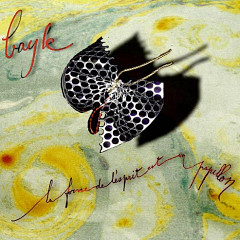
We have the thoughts of trees and the souls of butterflies… François Bayle’s new CD is called La forme de l’esprit est un papillon. The artwork on the cover is sublime, but I can’t find any information about the artist.
As always in this series — concerning covers as well as musical content — there is an elegance and delicate diligence to the artistic expression that is typical of Bayle. You can’t mistake his sonic art for somebody else’s. It has this flexing, bouncing beauty, this mastery of details inside the greater form that many have tried to copy, but none with any real success. That is one reason why I truly welcome this new Bayle release; number 18 in the Bayle series on Magison.
Bayle shows an almost Stockhausenesque orderliness in his account for the sections of the two parts of La forme de l’esprit est un papillon; Ombrages et trouées and Couleurs inventées. Ombrages et trouées has a duration of 22 and a half minutes, and has 33 divisions — not in index points, but in defined parts with different names, like Diagramme 1, 2 and so on, and Klang 1, 2 and so forth, interspersed with other titles, like Trouée 1, Ritournelle etcetera, with consecutive numberings! The same goes for the second part of La forme de l’esprit est un papillon; Couleurs inventées, which is 13 minutes long, with 20 divisions. This, of course, makes listening all the more interesting, since you might get the notion to listen for the changes in the sound, stop-watch in hand — or just following the time on the CD player display!
With a rustling as from leaves or bits of paper blown through the gutter, Ombrages et trouées commences, until softly percussive spheres roll out like marbles on a wooden floor, glistening with colors in erotic nuances. The soundscape gets denser, inhabited by flocks of sounds flying about like tense toy pianos in black and white, the teeth of the keyboards clattering like poltergeists…
So, in this tonal beauty there is an air of the forbidden and the out-of-whack; the danger of demonic tendencies and pleasurable pain; the contradictions of inclinations that are neither healthy nor moral… as dark wings cast long shadows over this Pinocchio ecstasy…
Bayle achieves a mysterious marriage of beat and pitch, of stuttering rhythms and glaring timbres, in a way that pries open your imagination and lets all the hidden paraphernalia out, like a legion of demons that have ravaged your subconscious in all those dreams that should prepare you for inter-lives bardos that you must hike on your way towards enlightenment…
In this music you travel up the stem of a spruce tree, the moonlight glittering in myriads of needles as golden crested wrens emit their high-pitch Morse messages from species to species — and in this music you travel the angulations of space, the geometry of awareness, the hypothetical long hauls of liberated minds; barefooted, with open faces towards Time…
The metal is gluey in Bayle’s world; the thoughts have powdered wings! This is — in part — a Salvador Dali world, time smoothed in melting clocks — and it’s an MC Escher world, impossible constructions appearing in winded perspectives that have been known to make children faint… Yes, there is an abundance of dizzying interlocks of logic in here.
Couleurs inventées starts with flute-like signals, which sets a flock of sounds in motion, as if you flew yourself right in the midst of a giant flock of birds, fluttering around, rising and sinking in a common motion across the topographies. The sense of floating and flying with numerous winged companions is very abstract, though, as if the music was a drug that set inner visions in stir, yes, as if someone stirred coffee with milk with a spoon, having the milk and coffee blend in an upwards, spiral motion.
A little later into Couleurs inventées it is apparent that Bayle accommodates a piano, but merely as a sound-producing device; not as a piano per se. This brings an unusual roughness or… directness, to his music. The flowing, floating sense is disturbed by rocky reefs and guttural statements, maybe even rude questions from someone in a felt hat and a trench coat on a street corner…
In the middle of the booklet here is a ProTools chart of Couleurs inventées, amply testifying to the complexity of musical thought here.
As the piano sounds pass through the Bayle presence, they take on their submerged, submarine characteristics; wavy seaweeds and fish with open, round mouths… and a suspended existential question that we all have in common travels the seven seas as well as Dante’s hell and all of Swedenborg’s heavens…
Trois réves d’oiseau (1963 — 1971) is divided into three sections: Moqueur, Triste and Zen.
Bayle lets on that the first part of this work indeed is a rendition of his first piece, albeit a remix of that work; Trois portraits de l’Oiseau-qui-n’existe-pas (no 15) from 1963, originally composed for the animated images of painter Robert Lapoujade.
Moqueur opens almost imperceptibly, as a chamber piece of sorts; a feeling that immediately is crushed by the violent insertions of brass instruments, human giggles transforming into a ghastly chuckle, real birds and electronic mimicries of birds — in a peculiar mixture of chamber music, electronic music and musique concrète. I wouldn’t have guessed Bayle if I heard this without information. I’d rather guess François-Bernard Mâche or Ivo Malec, maybe — or Graucho Marx teaming up with Spike Jones!
The second part of Trois réves d’oiseau — Triste — rolls down into our vicinity in a slowly breaking cloud of dark threats, filled with alien thought-forms and adverse forces from unknown realms, shimmering horizons on unfathomable celestial bodies… As the ominous forces in this music halts and soars, a more thoughtful, observing atmosphere gives time for all to collect their anticipations a bit.
The last part of Trois réves d’oiseau — Zen — emerges in a spellbinding electronic khoomei figure that repeats itself in a slowly increasing volume, carrying with it innumerable timbres of overtones, as if straight out of the steppes of Mongolia — reminding me a little of Stockhausen’s Sternklang. There are several layers of differentiated rhythmic patterns at play simultaneously, and the shrill high pitches cut through your skull like a surgeon’s bone saw!
Darker hues emerge, mixing with the higher pitches, even introducing a kind of shortwave static — and then this fascinating birdsong figure from the Brazilian uirapuru bird that is supposed to announce a peaceful death. The reason I recognize this part is that it’s taken from Bayle’s work L’expérience acoustique.
The last contribution on this CD is Mimaméta (1989, revision 2004). With bells and wind chimes and Aeolian harps — or the sonic representations of those in a dreamscape — this sonic magic wells forth out of Silence in shining, rippling colors of tone, easing on out into the open, taking shape in front of our imagery of imagination in fluently sweeping and pouring timbres and transparent Klangkörper out of someone’s most delicate upsurge of fantasies.
The stillness of motion — not a contradiction in acousmatique — vibrates with the utmost tension, balancing on a hypothetical point the collected and focused forces of this universe and this life, imaginative or proper, weighed in on itself in the gravitation of matter or soaring in the stillness of the flight of Time at 300 000 kilometers an hour… It’s all a matter of perspective and viewpoint, isn’t it — but Beauty is priceless and unattainable; just possible at the giving up of Will, and here it is, relentlessly and without effort, in François Bayle’s music…

![François Bayle [Photo: Bea Borgers, Bruxelles (Belgique), 27 octobre 2018]](https://res.electrocd.com/image.php/image/b/bayle_fr.9196.jpg?width=n2&cropratio=1:1)
![Nicolas Bernier [Faculté de musique – Université de Montréal, Montréal (Québec), 25 avril 2024]](https://res.electrocd.com/image.php/image/b/bernier_ni_13780.jpg?width=n2&cropratio=1:1)