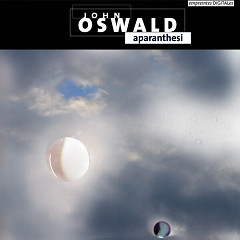
Chris Cutler wrote that John Oswald’s Aparanthesi is a meditation on listening — and it couldn’t be better said. That is the true nature of this piece, which, to begin with, may startle the average listener to the point of giving up… because what is it that you hear? Oswald supplies the longest liner notes I’ve ever seen, in an interview by Norman Igma — and I must say I found reading them quite useful, because the text sharpened and tuned my listening to certain properties and qualities that I otherwise may have missed, while all the while listening for something that isn’t there, instead of hearing what’s up front!
Still, this work — in it’s two versions — demands something of the listener. I wouldn’t call it easy listening… and perhaps you have to be in the business to really enjoy this more than a scientific experiment, a laboratory show-off. Knowing John Oswald’s approach to sound, though, I know his intentions are pure and honest — and we may extend our gratitude to empreintes DIGITALes who doesn’t shy away from issuing marginal releases from time to time, i.e. highly specialized ventures that probably won’t bring in a lot of funds, but which cast new light on the art of listening, the nature of sound.
One composer who unfolded the nature of sound already in the early 1950s — and who has never stopped — is Karlheinz Stockhausen, whose courses in Kuerten — and his seminars at those courses (usually amounting to about 18 CDs worth of talks each year!) — I’ve attended for a number of years as the official photographer, has made a distinction between seeing a number of objects in a constant lighting versus observing the same object under changing lightings… and he would be the right person to make the comparison, too, the way I’ve seen him work with both sound and light during endless rehearsals…
The key point is that we have to listen in a new way — a different way — to a work like Aparanthesi. The old, homey standards do not fit; they’re useless here, in which everything that happens at first does not appear to happen — since we’re naturally attuned to listen in a way that signifies an anticipation for what is not there; an elusive Godot that never shows up. We have to wish ourselves, with John Cage, Happy New Ears — and once we’ve got them, once we’ve ridded ourselves of forced concepts, we can truly enjoy Aparanthesi — and consequently other audibilities that we perhaps were not aware of before. I can compare it to my way of hearing birds before and after I turned an ornithologist. Before I just heard a maze of chirps, and after I could distinguish, I knew who was saying what, and I could, with my inner sight, envision beautiful plumages and migration paths and so forth; a new dimension of bird chirps! Anyway, the Stockhausen distinction above works fine concerning Oswald’s Aparanthesi, in which he works with a single pitch, the A, in version one at 440 kHz, in version B 480 kHz, i.e. the pitch of the electric current in the United States, from wirings, household appliances and so forth.
In Aparanthesi Oswald runs a number of sonic events or objects through the A mill, tuning a variety of sound sources — piano, cello, birds, cows, thunderstorms, wind and whatnot — to an A, tinkering with the overtone spectra, morphing the sounds in a way so that you really can’t say for sure exactly when a cow becomes wind or the piano a cello…
Oswald has calculated that it would be decent to assume that there are ten audible octaves, which is why he works with ten degrees of the A; dire dynamics! The composer investigates the possible varieties possible deduced from the single pitch A. Perhaps you could call it fundamental research!
He utilizes tow real world musicians for the piano and the cello, while all other sounds are derived from recordings of a variety of sounds; really any sound at all you can imagine, like birds and storms and voices — all naturally or synthetically tuned to an A.
When listening, be aware of the serious dynamics, because you may want to increase the volume dangerously when the level slips to the lower limit of hearing, volumewise or pitchwise, but then the sound may be so incredibly forceful and low-pitched that it will threaten your speakers. There are instances of cone flapping, so take it cautiously!
This is truly unfamiliar music to most of us, but why not compare it to the experience or theoretical experience of Rigpa, the state before all states in Tibetan Buddhism, that clear state of mind that can be likened to the sight of a starry sky as the clouds move away, that original state of consciousness out of which all thought-forms and consequent objects arise, and into which they sink back — like all sounds rise out of their original state of silence, into which they’re bound to sink; ashes to ashes, dust to dust — and silence to silence…
This is a magnificent piece of fundamental research. I think we will give John Oswald a strong A for it!

![Adrian Moore / autoportrait [Photo: Adrian Moore, Sheffield (Angleterre, Royaume-Uni), 1 mai 2020]](https://res.electrocd.com/image.php/image/m/moore_ad.9855.jpg?width=n2&cropratio=1:1)

![Jean-François Denis [Photo: Brad Ardley (SOCAN), Toronto (Ontario, Canada), 17 septembre 2025]](https://res.electrocd.com/image.php/image/d/denis_je_15346.jpg?width=n2&cropratio=1:1)
![François Bayle [Photo: Bea Borgers, Bruxelles (Belgique), 27 octobre 2018]](https://res.electrocd.com/image.php/image/b/bayle_fr.9196.jpg?width=n2&cropratio=1:1)