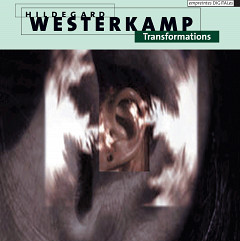
Canadian composer Hildegard Westerkamp’s works have centered around environmental sounds, acoustic ecology, and the creation of soundscapes since the mid-1970s. Her latest release, Transformations, is no exception. This disc contains a collection of works that transform ordinary sound events into unique creations. Westerkamp provides a new way of listening to organized sounds, at times processed, by highlighting the minute details of individual sonic events. This technique attracts attention by making one aware of specific sounds and the environments in which they naturally occur. A Walk Through The City (1981) focuses on the people forgotten and unnoticed in today’s urban society. This work was commissioned by the Canadian Broadcasting Corporation (CBC) radio program Two New Hours, and was first broadcast in April 1981. The opening three minutes of A Walk Through The City sounds more like a walk through the airport due to the nature of the material presented. The aircraft sounds suggest the listener is about to depart on a journey; more particularly, a listening adventure. A Walk Through The City is a depiction of an urban soundscape based on a poem of the same title by author Norbert Ruebsaat, who is heard reading his poem throughout. The sounds featured in this work come from the skid row area in Vancouver, British Columbia. Everyday occurrences like low car sounds pulsating, squealing brakes, sirens, pinball machines, and street music are transformed into rhythmic gestures and lyrical passages. Homeless, drunken men, singing children, whispers, and distant shouts are present while the inanimate sounds of the city fade in and out. This composition effectively creates a vibrant aural canvas that immerses the listener in the real surroundings from which these sounds originated. A Walk Through The City forces one to face sometimes disturbing material, people on the streets, without the chance to quickly dismiss or ignore their sad experiences.
Less heart-wrenching subject matter is found in the composition Fantasie for Horns II (1979). This work presents a variety of horn sounds, beautifully woven together, featuring Brian G’Froerer on the French horn. The tape part, Fantasie For Horns I (1978), received an honourable mention at the 1979 International Competition of Electroacoustic Music in Bourges, France. Both pieces feature a collection of various horn sounds and their echoes. Each horn is distinctly recognisable: the Doppler effect of a train horn, the distant call of a fog-horn, a boat-horn along with the gentle lapping of water, an alphorn with its grand echoes. The echo dialogue between the tape material and the French horn draws the listener into the sound experience through Westerkamp’s use of repetitive material. Fantasie for Horns II wonderfully blends the richness of the French horn, both muted and unmuted, with the recorded horns each from their separate environments. Kits Beach Soundwalk (1989) is a work for spoken voice and tape featuring Westerkamp as narrator. In this composition, the voice acts as a commentary to the sound material presented. While this soundwalk includes the sounds of birds, ducks, cars, planes and splashing water, its primary focus is the intimate sounds of barnacles. According to the narrator, the high frequencies of the barnacles increase brain activity, thus stimulating our dream experiences. When the voice is present in this composition, it adds to the peaceful soundscape with its soothing tones. Kits Beach Soundwalk contains varying ostinato patterns of faint birdsong and sparkling barnacles producing a calming and meditative composition.
The electroacoustic work Cricket Voice (1987) is a sound exploration of a desert region in Mexico called the ‘Zone of Silence.’ In this composition, the cricket’s song is transposed, created into short themes, and looped at varying speeds. Elaborate rhythms result from the cricket’s song being played in and out of phase. The sustained high frequencies in Cricket Voice create a rich sonic canvas in which the listener’s sense of time can become blurred. There is never a dull moment, as subtle variants are always present during repetitive passages. Wonderfully playful panning tickles the ears and stimulates the mind to anticipate the unexpected.
The final track of this CD is entitled Beneath the Forest Floor (1992). This electroacoustic composition was also commissioned by CBC Radio’s Two New Hours. It was recommended for broadcast by the International Music Council’s Rostrum of Electroacoustic Music in 1992, and received a special mention at the Prix Italia in 1994. The sounds were recorded from various forests on British Columbia’s westcoast, particularly in Carmanah Valley. This region is known for containing some of the tallest and oldest trees in the world. Clearly audible in Beneath the Forest Floor is the enormous vastness of the forest soundscapes, (punctuated only occasionally by the sounds of small songbirds, ravens, jays, squirrels, flies and mosquitoes). It is not the preservation of sounds alone which captures and transmits the desired soundscape but the imaginative placement of these sound events. It is this creativity that allows the formation of new, attractive, and stimulating acoustic environments. In Beneath the Forest Floor, there are three present. The first adds little or no processing to the recorded samples while the third adds the most processing to the sounds. The second environment fluctuates between the first and the third, representing the shadow world of the forest. Processing effects in this section act as the sun and shadows would, playing with the sound objects in the forest, hiding some in darkness while exposing others to light.
Hildegard Westerkamp’s concern for acoustic is evident in all of her works on this disc through her selection, preservation, and imaginative placement of the sound events. This allows the sounds she records to be transformed into a new listening journey of discovery while retaining the level of magic first experienced in each particular soundscape. Transformations is an enjoyable disc and a wonderful creative accomplishment.