Sauter au contenu principal
electrocd

Blogue

4252 résultats
  • 684
  • 685
  • 686
  • 687
  • 688
  • 689
  • 690
  • 691
  • 692
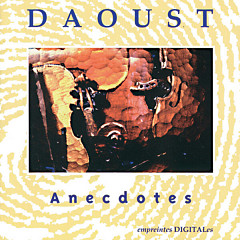
  • Anecdotes dans Vital

    «Review», IS, Vital, no 23, 1 mars 1992
    dimanche 1 mars 1992 Presse

    Daoust is an electroacoustic composer whose work, in contrast to that of Dhomont is (relatively) more easily grasped. This has two causes: one is that he often includes an acoustical counterpoint (accordeon, flute, plano, voice) to the electroaoustical sounds. This enables the listener to choose a side. Secondly, his musical movements have much stronger ‘gestalt’. The movements are more defined. In form (envelope, granularity, etc.) as well as in relation to their environment.

    A thought that jumped up, when I listened to this CD, was that the music is so sympathetic. It shows a sympathetic personal feeling. Daoust is much concerned with two themes: the musical past, and the performer (a remnant of the musical past). He is unable to explain in words why this is so, and why bother? He expresses himself clearly enough through his works.

    … the music is so sympathetic.

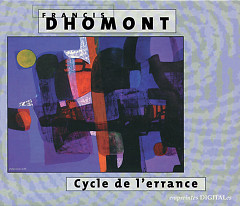
    Cycle de l’errance, Les dérives du signe, Mouvances~Métaphores dans Vital

    «Review», Ios Smolders, Vital, no 23, 1 mars 1992
    dimanche 1 mars 1992 Presse

    This coproduction is a tribute to the great pioneer of acousmatic music, Francis Dhomont, at the occasion of his 65th birthday. In order to explain what his music is all about I will quote from a text in the accompanying 210 page booklet: “In 1955, the writer and poet Jerome Peignot, at the beginning of musique concrète used the adjective acousmatic meaning ‘a sound that we can hear without knowing its cause’ to designate ‘the distance that separates a sound from its origin by obscuring behind the impassivity of the loudspeaker any visual element that may be connected to it. Finally, around 1974 Francois Bayle introduced the term acousmatic music as a specilic kind of music. as the art of projected sounds which is ‘shot and developed in the studio. projected in halls, like cinema’.”

    Francis Dhomont’s career has been a curious one. He grew up. and initially built a living in the south of France. At fifteen he composed music for piano. Much interested in both sounds and technology in 1947 he bought a wirerecorder and started experimenting. When Schaeffer raised a lot of dust in Paris he travelled to the capital and followed courses. Late 70’s he moved to live in Canada. The booklet features an extensive biography.

    The music on these two CD’s spans some ten years of work. It shows music, makes music visible. Dhomont’s works exactly follow the above-mentioned definition. I have my questions about parts of the acousmatic philosophy, but listening to this muslc is quite an experience. DIFFUSION i MéDIA initlated this project and have. again, done a wonderful job.

    … listening to this muslc is quite an experience.

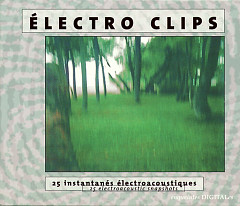
    Électro clips dans Sound Choice

    «Review», Bill Tilland, Sound Choice, no 17, 1 mars 1992
    dimanche 1 mars 1992 Presse

    These 25 «electroacoustic snapshots» purport to extract a three minute essence from each of the 25 North American experimental sound artists represented. If Électro clips itself is considered as an extended composition — which in a sense it is — then the alternations between space and density allow the piece to breathe, and provide necessary transitions between radically different textures and treatments. Most of the clips are worthy of attention, and the overall sequensing seems carefully organised. On either count — as a collection or an aggregate — this is a very successful effort.

    On either count — as a collection or an aggregate — this is a very successful effort.

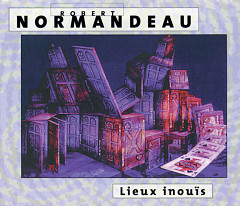
    Lieux inouïs dans Sound Choice

    «Review», Bill Tilland, Sound Choice, no 17, 1 mars 1992
    dimanche 1 mars 1992 Presse

    Normandeau’s work, represented on this CD by five substantial pieces, has a strong affinity with the work of the French electronic music group GRM, wich includes major experimental sound artists such as Parmegiani, Reibel and Bayle. Normandeau’s general æsthetic falls into the category of musique concrète; all sounds — human, natural and electronic — are potential compositional material. Normandeau’s music makes no concessions to popular tastes. It has no regular rythm or melody as such, only textures and more or less recognizable patterns. Mémoires vives, wich samples and maniupulates fragments of traditional Christian requiems, is the most “musical” of the group, and Rumeurs (Place de Ransbeck), wich utilizes the natural sounds of closing doors and dogs barking, is perhaps the least. All the selections require close attention and a reflective listening atmoisphere. Normandeau’s compositions are fascinating and resonate with an internal emotional force, tapping into the mysterious mental territory where sounds hover on the edge of meaning.

    … fascinating and resonate with an internal emotional force, tapping into the mysterious mental territory…

    Cycle de l’errance, Les dérives du signe, Mouvances~Métaphores dans À l’affiche

    «Les traces de l’inouï», Bernard Gilbert, À l’affiche, 1 mars 1992
    dimanche 1 mars 1992 Presse

    Francis Dhomont, un phare

    Depuis janvier 1990, les électroacousticiens du Québec ont leur propre étiquette de compacts: empreintes DIGITALes. Sept albums sont parus, dont un consacré à Robert Normandeau, excellent compositeur originaire de Québec.

    La jeune école électroacoustique québécoise doit beaucoup à certains plonniers plus âgés. Francis Dhomont est l’un de ceux-là; né en France en 1926, il vit au Québec plusieurs mois par année depuis 1979, En publian tun album double de sa musique, empreintes DIGITALes lui rend un important hommage.

    La musique de Dhomont est d’une richesse étonnante; pétrie de science, de recherche (il expérimentait le travail sur magnétophone au moment même où Pierre Schaeffer «inventait» la musique concrète, à la fin des années 1940), mais aussi traversée par un authentique souffle de vie. On trouve aussi, dans Cycle de l’errance ou Les dérives du signe, plusieurs éléments constitutifs de la musique électroacoustique québécoise d’aujourd’hui, sa tendance réflexive, européenne; Dhomont a aussi enseigné à plusieurs de nos créateurs. Regroupées en deux périodes, les œuvres endisquées ici parcourent son travail, de 1982 à 1991.

    Accompagné d’un livre de plus de 200 pages, l’album permet de cerner à la fois les œuvres, la personnalité et l’implication de Dhomont dont les activités d’animateur et de pédagogue s’ajoutent au travail d’écriture musicale. De nombreux témoignages complètent l’ouvrage.

    Produits ici, ces disques sont diffusés en France et en Hollande par le blais de deux firmes reconnues: Ina-GRM et BVHAAST. Assurément, un coffret qui devrait faire date.

    Francis Dhomont, un phare

    Cycle de l’errance, Les dérives du signe, Mouvances~Métaphores dans Le Musicien québécois

    «Les Mouvances et Métaphores de Francis Dhomont», Le Musicien québécois, no 3:6, 1 mars 1992
    dimanche 1 mars 1992 Presse

    Septième titre de l’étiquette montréalaise empreintes DIGITALes, le coffret de deux disques intitulé Mouvances~Métaphores de Francis Dhomont rassemble l’essentiel de sa production depuis les dix dernières années, soit sept de ses œuvres électroacoustiques les plus récentes. Celles-ci traitent de deux thèmes distincts, l’un étant le Cycle de l’errance l’autre Les dérives du signe. À 65 ans, le compositeur francais Francis Dhomont fait figure de pionnier dans l’univers musical électroacoustique du Québec.
    … figure de pionnier dans l’univers musical électroacoustique du Québec.
  • 684
  • 685
  • 686
  • 687
  • 688
  • 689
  • 690
  • 691
  • 692