The first time I heard the music of Magali Babin was in an evening that included, among other rather distinctive ploys for my attention, two men shoving a few dozen sticks of butter into their mouths and letting it dribble down their chins and onto an amplified table, beneath which John Berndt was crouched on four limbs stark naked uttering animal sounds. It was the touring Québécois performance trio of Babin, Éric Létourneau, and Alexandre St-Onge. In total contrast to the perplexing conceptual extremes of their two pieces and the utterly disgusting, abominable, shameful attempt at music-making by the trio of Donald Miller, Jack Rose, and Ian Nagoski that began the non-festivities that evening, Babin performed a solo set that gave me an unequivocally sublime experience I still fondly recall some five years later. Instead of indulging a sado-masochistic obsession with loud volume like Miller, et al, she presented an impeccably focused improvisation on a sound vocabulary of her own creation at a medium volume that was ideal to draw the listener into careful and comfortable attention to the nuances of each passing moment without the slightest hint of pretension or bombast.
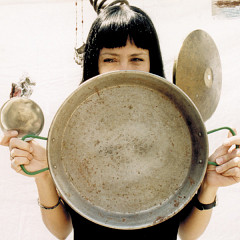
Babin used a modest array of small metallic objects with pickups and guitar pedals, gently amplifying the hidden world of complex sound as metallic objects touch each other in sundry ways. Her methods are simple, but her music is exquisitely rich in detail and variation. A year or two after that memorable performance I saw in Philadelphia, her solo masterpiece Chemin de fer was released by the Canadian label No Type, and if you listen to the very first track, Triturations, you’ll have a pretty good idea of the delicate electroacoustic sound sculpture I heard that evening. As the album artwork suggests, however, Babin’s array of equipment is quite a bit more extensive than what she’d brought on that tour. In her native recording environment she explores the microscopic idiosyncracies of a much wider array of metallic objects, especially pots, pans, and kitchen utensils. The notes accompanying the disc report that Babin created this music by improvising, a simple fact that becomes meaningful when I recall the live performances I’ve enjoyed from her.
Triturations is nine minutes of electroacoustic micro-timbral heaven. Some layers of the piece sound like heavy breathing muted and compressed into a detached, nonreferential, yet still vaguely biological texture. With its evenness of texture and density amidst the cornucopia of crackling, rustling, and rubbing details, it feels like a warm cloud of gentle, unpatronising sound that envelops and comforts me.
When Steve Roden coined the phrase “lowercase sound” in the mid-90s he was expressing an incredibly elegant and timeless concept that both echos and splits away from the Cage/Oliveros paradigm. The sounds sought were simply the ones usually hidden or masked, the details that don’t call attention to themselves. The phrase went on to be widely misunderstood as having specific implications about volume, velocity, and density, but all of this is extrinsic to that jewel of aesthetic crystillization Roden proffered. Triturations and so much other work by Magali Babin stands as an eminent prototype for lowercase music in my mind. It’s worth noting that there’s nothing especially quiet, nor loud, about it. In fact, it’s rather medium-volume, medium-velocity, and medium-density music as a whole. It’s at just the right volume so you can hear everything clearly, which seems like the point to me. It’s simply the sonic microscopy of moving metal, sounds heretofore unknown and otherwise inaudible. I happen to find most of them sublime and intoxicating.
The second track, Petit jardin, is methodologically continuous with Triturations but the soundworld is fresh. Two sounds complement each other: a beautiful, softly resonant gong-like sound (probably obtained via a pot or pan) and the tinkling of small metal objects (perhaps something like paperclips?) being dropped against a metallic surface. It’s the hidden world of an ad hoc metallic idiophone. Monsieur et madame Watt is another track based on lucid juxtaposition, this time between some faint Erstwhilian amplifier hum and some indistinct rubbing (suggesting to me the sound of a microphone’s metal grating moving against another metallic object). I found something ecstatic in these humble sounds, though my feeling dissipated later in the piece as the hum began modulating and assuming greater prominence in the mix; it became mundane.
For more years than I can recall I’ve had this perversely cherished Kevin Drumm CD listing neither a title nor release date, but it has a solid green cover and says it was recorded to tape in 1996; the label is Perdition Plastics and it’s catalog number per007. I don’t know much about Drumm’s discography and have only lightly sampled his other work because I really hated this CD. In fact, I probably never made it all the way through. But it’s always persisted in my thoughts because it’s so rare I have a such a strongly negative reaction to any music. It symbolizes something for me, the very extremes of harsh and difficult music. I have no problem with conventional harsh noise; heck, it’s just a twist on new-age music in a way, but this Drumm disc is mostly silence sporadically and irregularly interrupted by loud, screeching, painful sounds made by fucking with an electric guitar and amplifier. It was just too much for me and the thought of playing it still scares me. The reason I mention it is that some of Babin’s music sounds like the precise opposite—gentle and smooth—yet draws from the same dangerous sound vocabulary of conductive surfaces and amplifiers operating at the threshhold of functionality. It’s a fascinating contrast.
This disc is studded with jewels, but it’s time to report on the rarest, Jogging dans la maison hantée, which was “crafted in joyous collaboration with Alain Chénier and Mario Gauthier”. Its seven minutes are filled with some fairly generic electronic interjections, but they comprise fairly neutral background to one of life’s greatest pleasures: extremely clipped squeaks. A major piece of background information is required here. If there’s one piece of music I’ve played most often in my life, probably upwards of 2000 times by a rough estimate, including a six-month stretch where I played it at least once per day and typically a good handful of times, it’s Bluebird by Judy Dunaway and Yasunao Tone, from Dunaway’s seminal Balloon Music. A piece that should stand in the public consciousness of the current era as an analog to Duke’s Take the A train or the like, it is in fact unknown to virtually every person I’ve broached it to among the relevant demographic. Without attempting to account for its unyielding grip on my aesthetic relationship to sound, I’ll describe it here for you. It’s a seven-minute excerpt of a recording made by Tone applying his standard technique to a CD of solo tenor balloon improvisations by Dunaway. In other words, it’s glitching balloon sounds. So to account for my experience of Babin’s Jogging dans la maison hantée I need to make it clear that there is a thrilling resemblance in these clipped and irregular squeaky sounds that flit across the piece’s uncluttered canvas (mingling marveously with the many birds outside my open windows this lovely hot summer afternoon I might add). Further, I don’t want to mince any words here: Bluebird is by far my single favorite musical composition among all I’ve heard in my 28 years so far. It’s the pinnacle.
A non-squeaky moment in this piece demands special mention. Among self-contained musical events I’ve heard of roughly one to two moments in duration, [6:22-6:27] is exceptionally exciting, a kind of split-second burst of somewhat ordinary electronic sound that merges with a sine-wavish tone that evenly decays across four seconds. It’s not that there’s anything special about these two sounds, just like the greatest moments of violin music are made with essentially the same notes that appear in countless other contexts, but the timing and the dynamic contours combine these two gestures into a single unified event that functions as a higher order version of the note, where I’m referring to the familiar category of sound events prototypically represented by a short episode of relatively constant pitch and timbre. It’s as if an impossible decay pattern suddenly occurred for an unruly burst of noise. This is a kind of sound event I often fantasize about, but rarely encounter in the external world. It is part of my objection (with respect to individual aesthetic desiderata, aka taste) to the typical high levels of density found in so-called noise music that these kinds of momentary shapes are masked. In the brave new sound world of the technologically-facilitated explosion in timbral possibilities for music in recent decades, I perceive a bifurcation in the way new aesthetics are derived from the new sounds. In one direction, exemplified by the sound event being discussed presently, the new shapes and internal structures of the sounds justify a topology of gesture. In the other direction, the sounds are maximally and continuously generated to create texture and immersion in their brute timbres. I’d argue that because the latter aesthetic can often be achieved with such a lack of technical refinement or effort that it has become undeservedly ubiquitous, regrettably displacing the former aesthetic.
Three of the pieces on the disc — La corde, L’entonnoir, and Pluie de homards — don’t go much beyond pleasant for me. L’entonnoir is instructive in its contrast with the main thrust of Babin’s work. It feels a bit ugly and overbearing, with a sound palette and approach close to conventional textural electronic noise music. The key word here is “electronic”. The distinction between electroacoustic sounds and electronic sounds is fascinating and truly central to contemporary music, a topic I find myself returning to again and again, always winding up in a theoretical quandary. Concretely experienced distinctions like that provided by L’entonnoir are surely the key to sorting this out. In the pieces I’ve praised from Chemin de fer there is a resonance and spatiality I associate with acoustically derived sounds. There’s also a wealth of odd non-repeating details. These are qualities that I’d cite to account for enjoying Mikrophonie vastly more than any other work by Karlheinz Stockhausen, most of which suits me well. Thinking about the metal objects Babin patiently manipulates, I’m driven to speculate that perhaps the true musicological antonym of “electronic” is not “acoustic”, but rather “mechanical”. In fact, it’s the similarities I feel between Babin’s work and Howard Stelzer’s (arguably prototypically electroacoustic) abstract hissing and crackling cassette vocabulary that inspired me to revisit this disc recently after being immersed in Stelzer’s art. Surely it’s not trivial that the monumental Stelzer-curated Intransitive Twenty-three features Thermidor, a work by Babin that I would cite among her best.
The placement of Pluie de homards as the final track here was wise. An album of moderation concludes with some annihilatory extremes. Babin created the piece with Mario Gauthier’s assistance by mixing some of her characteristic sounds with Rain by Ian Nagoski, a track from Ian’s drone classic Warm Coursing Blood, a 1998 recording released by Colorful Clouds for Acoustics. As Ian recounted to me recently in a chance encounter that allowed me to broach my recent revisitation of Chemin de fer (recorded in 2000 and released in 2001), he created the piece by recording the water from a shower striking a huge metal pot designed for cooking lobsters and subsequently layering the recording on top of itself more than a few times. When Babin learned of this kindred metallophonic endeavor, she enthusiastically sought to adapt it to her world. Rain was already an extremely thick and static slab of sound; with Babin’s additions it’s that and a lot more sound. I took this review as an opportunity to revisit Warm Coursing Blood, a truly brilliant album in a style of music I have only a nominal attraction towards. One of my listening sessions was a breakthrough for me. One day I somehow found myself in the mood to lay down for a bit and see if I could enjoy being enveloped by Ian’s music played at room-filling (but not biologically irresponsible) volume, something I’d not actually tried before. Ian’s textures opened up for me and I was mesmerized for two long pieces, Feather and Rain. It was a smashing success. Comparing this to my experiences of Pluie de homards, I’ve concluded that Babin’s augmented version of Rain is a pleasant and novel whole, but her distinct vocabulary actually subtracts from the eminently cohesive power of the original, which relies on the shading revealed by an extremely narrow and focused range of sound.


![Annette Vande Gorne [Photo: Chantale Laplante, Ohain (Belgium), May 2009]](https://res.electrocd.com/image.php/image/v/vandegorne_an.9883.jpg?width=n2&cropratio=1:1)
![Robert Normandeau [Photo: Caroline Campeau, Montréal (Québec), September 3, 2021]](https://res.electrocd.com/image.php/image/n/normandeau_ro.12007.jpg?width=n2&cropratio=1:1)