electrocd

Blog

212 results
  • 3
  • 4
  • 5
  • 6
  • 7
  • 8
  • 9
  • 10
  • 11
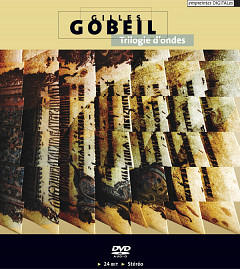
  • Trilogie d’ondes in Sonoloco Record Reviews

    “Review”, Ingvar Loco Nordin, Sonoloco Record Reviews, November 1, 2005
    Tuesday, November 1, 2005 Press

    This is one of two first DVD-Audio discs from empreintes DIGITALes, the other one being Robert Normandeau’s Puzzles.

    Gilles Gobeil is a well-known composer of the more refined, aristocratic type of electroacoustics that we have become accustomed to through the French and the Canadians in particular: intellectual, philosophical high-brow sound art that is truly enjoyable on many levels, of which one do not tire. Receiving these high class CDs from time to time is like enjoying a membership in an exclusive men’s club of 19th century London. It’s exciting but comfortable, daring but rather safe. I like it very much, the same way I like to go hiking in Lapland, staying nights in the huts, enjoying the company of fellow nature lovers and hardship flirters from all over Europe who don’t want to risk their lives unnecessarily, but enjoy an occasional glacier, despite the hidden cracks and crevasses…

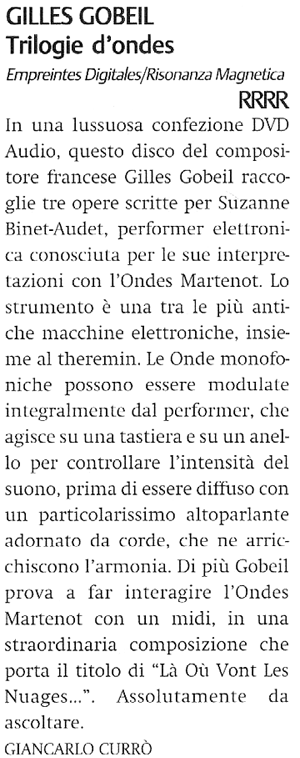
    On this DVD-Audio Gilles Gobeil excels in his interest in the ondes Martenot; the old electronic instrument. The Ondes Martenot is briefly described thus at the Electronic Music Foundation site: “Designed and built in 1928 in France by Maurice Martenot, the ondes Martenot (Martenot Waves) was used by Olivier Messiaen, Darius Milhaud, Edgar Varèse, Pierre Boulez, and other well-known composers. In its most recognizable form, it was a keyboard instrument with some unusual performance features, among them a finger-ring attached to a ribbon that could be pulled to achieve portamento and other pitch-bending effects, a lever located under the keyboard to control timbral change, and a loudness controller to the left of the keyboard.”

    Jeff Snyder, Assistant Director of the Music Technology Program at Lebanon Valley College of Pennsylvania, has written the following narrative about the development and functionality of this early electronic instrument: “At the end of World War I, Maurice Martenot (1898-1980), a sergeant in charge of a wireless station, noticed the purity of vibrations produced by radio tubes (a recent invention). This led to a series of investigations in sound and electronics. He presented his new musical instrument to the public in May of 1928 at the Paris Opera. This was the first concert with an electronic instrument. He called his invention the Ondes Martenot. It was monophonic with low note priority. The early Martenot was played two ways: 1. At the keyboard (7 octaves). The speaker was separate. The player’s right hand played the keyboard while the left hand controlled dynamics and timbre by manipulating switches that controlled filters. The keyboard allowed lateral movement of the keys allowing the player to have vibrato by wiggling his finger. 2. The ‘speaking’ play. A ribbon (also 7 octaves) allowed inflections like a voice or stringed instrument. It allowed for a wide glissando where the player moved a finger ring attached to the metal ribbon, which controlled the frequency. The left hand functioned the same as the keyboard mode. The left hand controlled a key, which served the same as the bow of a violinist or the breath of a wind player. With a touch of the finger, the player controlled the intensity ranging from PPP to FFF. It also controlled the attack. The left hand also controlled the loudspeaker buttons, timbre, harmonics, etc. There was also a knee lever, which could be used instead, freeing the left hand to join the right. The Martenot was intended to become a member of the orchestral family, not to be used to create a new type of music. The tone was glass like. In 1938, Martenot, then a professor at the Paris Conservatory, built a special Martenot to be used for microtonal Hindustani music. Hundreds of symphonic works, operas, ballets, film scores, and other works were composed for the Martenot by composers such as Messiaen, Milhaud, Varèse, Boulez, Honegger and others. The Theremin is similar in the way it produced tone. It is amazing how present day synthesizers have many of the controller functions of the Martenot: ribbons, switches, knee levers — and supposedly Kurzweil is coming out with a keyboard that has a ring.”

    Gilles Gobeil has collaborated with famous Ondes Martenot player Suzanne Binet-Audet in all the works presented on this DVD-Audio. Suzanne Binet-Audet has in fact studied the instrument and its musical implications with the inventor of the instrument, Maurice Martenot.

    The first piece is Voix blanche from 1988-89, with the subtitle “À la mémoire de Serge Garant.” As is also stated in the booklet — i.e., the foldout hard-paper Jean-François Denis cover! —, this work has been heard before, premiered in 1988 at the Salle Claude-Champagne in Montréal, and on presented on CD back in 1989, on Cultures électroniques 4 as 2e Prix de la Musique électroacoustique mixte, but this particular version was realized by the composer as late as 2004 and mixed in its final form in January of 2005. Besides, it has never been heard in such a good-sounding shape before!

    The beginning is pastoral, fresh with green plants and densely wooded forests, hiding many a secret existence: those specks of light dancing over the rocks in the meadow! The music wakes up in this natural bliss, its heart thumping, the score suddenly fresh with oxygen and dew! The very first bar of the music makes a wide gesture, opening our eyes to the scenery, which is half real, half myth: enchanted! The electronic music bends slightly downwards from its upward beginning, leveling out, short and well-marked bird chirps measuring time, while the Ondes Martenot — thin and elastic — rises slowly in a glissando, upwards, slowly upwards, as the electronic motion down under begins to circle like the current of water that disappears down the drain. Gobeil’s music grows granular, like the surface of the sun throw sooty glasses; that boiling motion of prickly elements — but in Gobeil’s world this property is cold, icy — more like myriads of distant stars… and in the following development I can no longer distinguish Martenot from Gobeil, so to say. It all comes together in a vibrant, soaring elasticity of audio, venomously beautiful, dangerously pleasant! I hear surfaces tilting, I see the dust sounds of gold, I piggyback off on the circumstances! I feel ballets in here, see motions around the premises, hands making signs, feet circling over a wooden floor; I hear the intermittent friction of ballet shoes and planks; a wheezing grayness, gravity focused through an act of utter equilibrium, all the way into the central star, gathering momentum way out from the most distant planets: the gyro of the solar system; the ultimate prayer wheel!

    Gobeil and Suzanne Binet-Audet shape the moment wonderfully, at times merging so crazily that they become one and indistinguishable from each other, only to pry lapsing durations open in disparate tendencies, torque and pull straining space and perception ominously, only a distant murmur rising under the horizon like the wasted songs of renounced gods as time runs towards the vanishing point… The White Voice!

    The second work is Là où vont les nuages… from 1990-91, dedicated to Suzanne Binet-Audet. This time the Ondes Martenot is linked to a MIDI converter, opening the utilization of synthesizer, sampler and a sound processing unit to Binet-Audet. This work has been released on an earlier empreintes DIGITALes CD, but as was the case with Voix blanche is the case with Là où vont les nuages…; a contemporary makeover by the composer, who had it overhauled in 2004 and re-recorded in early 2005, collaboratively mixed by Gilles Gobeil and Suzanne Binet-Audet. Here is the result, for our ears only.

    It staggers and winds through its beginnings, through a sonic deliverance that could have been filtered out of a steel factory havoc, reduced and radicalized into a swelling motion that reminds me some of the shaman realms of Rolf Enström’s Tjidtjag & Tjidtjaggaise; a mysterious widening of space and time — and I can’t refrain, either, from making an analogy to Stockhausen’s Sirius space ships gearing up! The sound is rich an sort of waiting — but there are audible footsteps in there, and a panting breath, for a while — so the human touch is there! There is lots of motion about this music; nothing stands still or stops, or if it does, something else moves on; you’re not completely left motionless at any time — but the sounds thin out drastically here and there; breaks that are slapped in the face by singular gold-crusted percussion beats. Several percussive layers are strewn about, achieving tearing, bent-away sensations — until water factory echoes put you right back into Tarkovsky’s Stalker, entering the Zone… Lone and distantly howling sounds are broken up by close and loud alarm clocks. A blind motion forces itself through the vicinity like a train without an engineer. These violent sounds are relieved by distant, meditative foghorns, and then you’re back with Stalker again… with Eduard Artemiev.

    Là où vont les nuages… consists of a complex mix of impressions, but it never gets out of hand. It’s a merger of musique concrète and electronic music, perhaps a little too much on the wild side for my taste, but damn interesting and often surprising.

    The last work is La perle et l’oubli, the one new work on this CD, achieved in 1999 — 2002. Still, this is a later mix, made by Gobeil in 2005. Gobeil says that this is “a personal interpretation of a Gnostic text from the 2nd century, entitled Hymn of the Pearl, attributed to Bardesanes”, who lived 152-222 Anno Domini.

    A high-pitch swirl, a motion deep inside a blue sky — and a shower of gravel passing a barrel of steel, barely touching it, but making enough of a contact to raise a whisper out of gravel and steel, a passing shadow out of matter… The flapping of dark wings or the tails of a coat flying in the wind; an anatomy flexing by, a densification of matter on the move: a person out of the 18th century gliding by in a flash, gone like the improbability of its manifestation… Sudden showers of meteorites pass in silence; not a ripple… A murmur in the night; an ocean turning over in a dream, grunting. The idea of something lighting up inside a brain and dying away… and then: a stirring motion, a vibrating trill, a sound too organized not to be a sign of intelligent life: a message passing from brain to brain, from world to world… as the subway train blows by in a gush of warm air, screeching for help! A choir of wide open mouths behind the barricades are sensed more than heard; a tolling of silent bells, teeth slowly closing the only escape, swallowing the words which were so cleverly lined-up, drowning the messages in saliva and crushing them in intestinal crunches…

    Gobeil and Binet-Audet play hide-and-seek amongst colored silences, soft walls of under-the-breath timbres that are scratched by all but imperceptible razor sharp Martenot incisions… blood gushing out of inaudible openings in the night…

    An explosion! … and crowds stirring inside an oil painting: maroon melodies tenderly brought about: Binet-Audet’s Masses and Motets out of the 15th century moving like black balcony curtains with figures sewn in silver threads… infants dying in the cold Medieval winters of Europe, while the living have to go on breathing, prisoners harnessed by this relentless in- and exhaling; this curse of life in the flesh.

    This musical collaboration between Gilles Gobeil and Suzanne Binet-Audet is extraordinarily successful, visionary, imaginative, enchanting… yes, artistically liberating and both refined and defined in a solid surge of senseless serenity of flesh and spirit; a dance macabre of matter and an interstellar ballet of the soul, winding down into the slow and receding dark thoughts of a decaying mankind at the end of the universe…

    … a dance macabre of matter and an interstellar ballet of the soul…

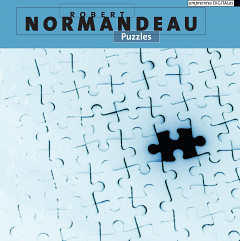
    Puzzles in Sonoloco Record Reviews

    “Review”, Ingvar Loco Nordin, Sonoloco Record Reviews, November 1, 2005
    Tuesday, November 1, 2005 Press

    empreintes DIGITALes has issued its first two DVD-Audio discs. This is one of them. I don’t know if most people that are likely to buy these forefront, top-of-the-line sound art works already have compatible DVD players, but most likely they do. Even I got myself one not long ago, and I’m usually very slow in catching on to new technology. Well, maybe that isn’t completely true. Thing is, I don’t even own a video player, and the reason is that I’ve been so very occupied and intensely passionate about sound as sound that I didn’t need or want an visual information from the outside interfering. There are always plenty of visual things happening on the inside of my eyelids when I listen to any kind of music – but especially when I hear electroacoustic music.

    However, I wanted to watch some Tarkovsky movies, and when I saw that DVD player prices plummeted, I got a machine – and right after that these two DVD-Audio were released by empreintes DIGITALes, and I’m suddenly finding good listening use too for the player! Besides, you can play these discs on your computer too.

    The sound of this Normandeau DVD is amazing! It blows me away!

    Puzzle – track 1 – kicks in with a panting, breathing commotion, crunchy and munching, slithering between lips and out of the corner of mouths; saliva ejected in rhythmic frenzy, in a kind of torrential beat of good humor and wry smiles, sideways motions, sudden attacks out of nowhere and a stubborn nose-and-ear-tip tickling that all but drives you nuts! A male sigh-machine is followed by a female lust-borne sigh that comes and goes, repeats itself in soaring eroticisms, slanting and gliding, erupting and stumbling, rushing and breaking, rolling and rocking, yes! The woman even sounds like a horny cat at times, but one that does get her fishy reward, right on! Fritz the Cat, go into hiding: this kitty rules now: cat woman bouncing and jabbing; get lost or get with it!

    Slender, chocolate sauce extensions fly cross the listener’s head in glissanding trajectories, above the steady pulse of sexy pistons of steam engines and Ondes Martenots! Terrific! Fast! Strong! Glary and Shiny!

    Some sped-up conversations – or rather monologs – inside this frantic musical gesture remind me seriously of Paul Lansky’s More Than Idle Chatter: these stalemates of phonemes and morphemes in a juggling act of insanity… while other puzzling Puzzle traits offer analogies to Pierre Henry’s early Variations for a Door and a Sigh! Clever and FUN!

    Piece number two is Éden, a longer work of more serious properties. When I get to this work I feel the need to study the liner notes, which on the tediously composed covers of empreintes DIGITALes’ CDs are found in different font sizes all over the place, geometrically up or down or sideways, so you have to turn the cover this way and that to find out what you need, and if you’re nearsighted, your have some advantage. This is no trouble though, just a specific style of empreintes DIGITALes, and there is a lot of information in place, which I certainly appreciate.

    So, when I look and read I find out that the whole Normandeau CD in fact delivers music in the form of adapted compositions made from music for various plays directed by Brigitte Haentjens in Montréal and Quebec City. Puzzle (track 1) is based on the music for Farces conjugales by Georges Feydeau – and this work on track two – Éden – comes out of L’Éden cinéma by Vietnam-born Marguerite Duras.

    I became curious as to the origin of thought and intentions as I spun Éden into the laser box, because it begins with an Eastern style female song, close and natural, straight out of the village or the fields, more like a good old Ocora or Folkways field recording than a Canadian electroacoustic work. Normandeau explains this elsewhere on the CD cover: “The music quoted at the beginning is a Laotian song that appears on the album India Song et autres musiques de films that composer Carlos D’Alessio wrote for Marguerite Duras, released by Chant du Monde (LDX 274818).

    Normandeau further talks about his composition (elsewhere on the cover): “I imagined music made of very long sound loops over which very little happens, some sound events disseminated here and there over time and space.”

    The song is Easterly beautiful, like a lullaby in the rice fields – but soon it is abruptly cut short – or simply ended! – relieved by a dense fabric of glaring, tingling and soaring audio that is layered in several – innumerable – strata of events, long, out-drawn events that seems to encircle the planet like the gas clouds of Jupiter as seen on Voyager imagery plastered om office walls throughout the industrial world.

    The soaring, deep and wide sonorities carry all kinds of analogies, in a wicked messenger kind of way, emitting Morse codes and shortwave static, as well as angelic, Stockhausenesque modalities that rise and sink like sea gulls on the wind, like hope that rises in your heart only to descend into despair – and I also hear otherworldly voices from spiritual beings that sing a Mene Mene Tekel Upharsin high up the pitches, in stratospheric vacuum states! They remind me of an old Japanese movie about divine justice that I watched on television in the late 1950s in Sweden, when I was a young Elvis Presley boy of the countryside.

    Inside this massive transparency of forth-welling audio you are stung by the viciousness of sharp, granular elements that afflict your face in the below-zero manner of sharp nails of snow in a serious Lapland winter storm, which you’re headed into in the vicinity of Saami village Nikkaluokta.

    A deep, rumbling grand piano sails by like the contents of a surrealist painting, relieved of all its traditional ties to a concerto reality, on the loose in a shaman world of sonic gestures and symbolic dream debris, as if in a fever dream on the verge of unconsciousness in which the spirit shakes its shackles and longs to cast off its forced anatomy!

    This music is so forcefully compelling and lustful that I get the urge to turn up the volume and really loose myself in it. Other composers, whom I’ve began to feel hostile to, review-vise, can’t handle such a density of sound – but Normandeau succeeds fluently, light-handedly, without any obvious effort. I am impressed! Very beautiful, but also exciting!

    The third work on Robert Normandeau’s DVD-Audio disc Puzzles is Chorus, on tracks 3 – 9. This is a genuinely serious matter. The piece has a subtitle: “To the victims of September 11, 2001.” I choose to hear that subtitle as a sorrowful bow also to the current, present-day victims in the aftermath of the New York attacks; those ill-treated and tormented people harnessed in Guantanamo Bay without the benefit of fair trials by the illegitimate war crimes regime in Washington, and the families slaughtered in Afghanistan and Iraq and Palestine by the same illegitimate American war criminals, whom I’d like to see side by side with Milosevic at the War Crimes Tribune in Den Haag. Be sure, though, Mr. Bush: YOU CAN NEVER ESCAPE YOUR NEXT LIFE!

    Normandeau also divides this work into the following parts: “Overture”; “Judaism”; “Christianity”; “Islamism”; “War”; “Pain”; “Peace”. Then Normandeau shows that he’s able to broaden his view and see things in a wider and deeper perspective, because he says: “The music is inspired by the subject of the play Nathan the Wise by Gotthold Ephraim Lessing, which demonstrates the tolerance ideal of the Age of the Enlightenment.” In the play, it is said: “If it is not given to mankind to theoretically know which religion is the true one, everyone has the practical possibility, by his self-less actions, to prove the value of his faith and his aptitude to contribute to the happiness of humanity.”

    Normandeau further explains that the sound material he used is typical of the three monotheist religions: the shofar of Judaism, the church bells of Christianity and the prayer calls of Islam. The beginning is mighty, with an electronic mimicry of Tibetan monks chanting high up among the mountains of the Himalayas. The soaring, thumping progression of sounds is a dense and still transparent as the sonorities of the piece Éden, only more ominous, fateful – and perhaps… hopeful!

    It feels like Robert Normandeau brings something from deep within into the sonic open in this work, that he taps into a common resource of mankind, a common inheritance, far beyond the evil differences of day-to-day life on the surface of the plane; from within a reality that is far more real than this blinding show-off of material objects that occupy our bodily existences and cause us to take up arms against each other. I seldom feel this kind of significance in a piece of music, but here I really do. Normandeau’s skillful merger of the sounds of three monotheistic religions of a common inheritance with a nontheistic religion of the Himalayas is wondrous, immensely beautiful, with an awesome message attached, leading way beyond what seems to be, deep into what IS! Fantastic! Staggering implications!

    Normandeau’s next work is StrinGDberg; a title that makes a Swede like myself extra alert, since August Strindberg (1849 – 1912), of course, is one of the giants of Swedish literature and theatre; a stubborn, weak and strong and completely unlikely Renaissance character, whose enfant terrible-role in society is especially apparent in view of that he never received the Nobel Prize of Literature; a startling exposure of the double-standards of the Swedish society and a fact that seriously degrades the significance and importance of the prize.

    The music is based on Strindberg’s play Miss Julie. The title is a play on words, of course: the name StrinDberg and strinG. The instruments used for the source sounds are the cello and the hurdy-gurdy! From this material Normandeau builds a flickering, swaggering wall of Northern Lights; Aurora Borealis shining its wondrous veils over snowy expanses of a midwinter Lapland with no sun but lots of other stars that shine through the blistering cold. This Normandeau work is a beautiful as ever, and illusory in the sense that you may get an impression of fast motion one second and the impression of a completely static state the next, reminiscent of a car rides across a desert (which I once experienced, from Damascus to Baghdad), when you may feel that you’re not moving at all even though you travel at 75 miles per hour. Normandeau says: “It is a deep listening work that penetrates into the sound.” So it is! And there are wolves in this music, a circle of wolves around the listener, at the periphery of light around his campfire: glowing eyes…

    The last piece, on track 11, is Hamlet-Machine with Actors. What a title! Normandeau says: “The music, like the play, tries to express the oppression society exerts on Man, the representation of taboos […]” The sounds are more rough here than in the preceding works, more industrial, coming on in slabs of steel and machinery and enormous forces, while human sounds are clear and loud too, inside this Hamlet-Machine, laughter and moans, shouting crowds, pain and pleasure and dust and smoke: relentless events, unstoppable cruelties – but also the open-space dijeridoos of Australia, implying a spiritual context as well in all this violently physical stasis of flesh and metal.

    The sound of this Normandeau DVD is amazing! It blows me away!

    Trilogie d’ondes in Touching Extremes

    “Review”, Massimo Ricci, Touching Extremes, November 1, 2005
    Tuesday, November 1, 2005 Press

    The sound world of Gilles Gobeil mostly revolves around the philosophy of “break” or “rupture”, where “large-scale musical gestures are developed and brought to their acme before being immediately crushed to silence.” This DVD-Audio contains three impressive tracks scored for taped/computerized sounds and Ondes Martenot, the latter fabulously handled by Suzanne Binet-Audet, who studied the instrument with the inventor himself; the resulting soundscapes affect our sense of doubt deeply, carrying an unforeseeable, almost fearful aura which puts them on the same level of excellence of the best electroacoustic mavericks we highly revere. Voix blanche is a highly creative mixture of slowly unfolding irregular drones and digital descriptions of an outside world we are not allowed to judge, where the violence of facts is just a pretext to transform our susceptibility through the congruous reward of a rehabilitated brain, able to classify any new colour just to achieve the pleasure of scare. Là ou vont les nuages… sees more dramatically intriguing junctions among the railways of hope and despair; slow glissando vapors meet pre-recorded voices, strings, car horns and percussive outbursts in a monstrous acousmatic pandemonium which has one reeling punchdrunk at times, oneirically displaced moments later. La perle et l’oubli is based on Hymn of the Pearl, a gnostic text by Bardesanes, and in its 21+ minutes length is maybe the narrative high of the whole set, alternating the feeling of total loneliness with outgrowths of sapient, relentless sonic activity in which samples of eternal void and heartbreaking choirs by invisible creatures are underlined by a masterful use of the “event-silence-event” consecutio; the striking puissance of these explorations of the listener’s psyche closes Trilogie d’ondes with an exclamation mark, immediately awarding it a “classic” stamp.

    … the striking puissance of these explorations of the listener’s psyche closes Trilogie d’ondes with an exclamation mark, immediately awarding it a “classic” stamp.
  • 3
  • 4
  • 5
  • 6
  • 7
  • 8
  • 9
  • 10
  • 11