electrocd

Blog

113 results
  • 3
  • 4
  • 5
  • 6
  • 7
  • 8
  • 9
  • 10
  • 11
  • À la plage in Circuit

    “Critique”, Chantale Laplante, Circuit, no. 25:2, August 24, 2015
    Monday, August 24, 2015 Press

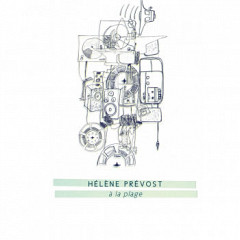
    Hélène Prévost, artiste sonore et musicienne, est engagée dans la musique de recherche à travers ses contributions en tant que réalisatrice radio1 et plus récemment ses performances explorant les techniques du (re)mixage et l’approche semi-installative2. En 2014, elle a produit sur l’étiquette de disque indépendante Tour de Bras3 un premier disque solo intitulé à la plage. L’artiste introduit sa démarche avec un texte elliptique qui énonce en quelques mots les lignes de force sur lesquelles elle aura forgé cette œuvre de dix «plages» totalisant plus de 56 minutes de musique:

    un jeu de mots. rien d’autre. le reste tient au temps.
    mouvement découpé qui tombe de la nuit. et le jour.
    une cosmogonie. objet perçu. objet perdu.
    matériaux des sens. poussière de roche. jeu de pied.
    dedans.

    Cet incipit particulièrement fertile pour mettre en appétit les oreilles, nous indique des pistes à suivre comme pour une intrigue policière, conviant l’auditeur à «jouer le jeu» et à prendre en filature les objets indices et leur empreinte sonore.

    La dramaturgie musicale de à la plage s’élabore dans le contexte d’une esthétique qui met à profit une expérience fondatrice, celle de l’audition en boucle. Ainsi, dès la «plage 01», peut-on reconnaître un attachement à l’approche schaefferienne où des bruits anecdotiques, ici ceux d’un liquide et d’un ululement, sont dès leur énonciation repris en boucle, les faisant basculer illico dans une réalité nouvelle, surnaturelle4. Cette mise sous tension du jumelage sons concrets/sons abstraits par l’usage systématique de l’itération tout au long de la proposition musicale en dix temps, met au jour une parenté «forme et matière» et, du coup, la notion d’homogénéité sonore.

    La sensation d’une profonde cohérence musicale lors de l’écoute repose à mon avis autant sur un usage extensif de la boucle que sur une matériologie caractéristique qui se décline à travers un univers de sonorités bruitistes. Qu’il s’agisse de machines, de balayages d’ondes radio, de grondements ou de crépitements, une tension est créée dans la rencontre de grands espaces telluriques ou a contrario cosmiques, entre des envolées sonores profondément abstraites et l’apparition soudaine d’une présence humaine, inscrite dans le verbe ou des mouvements furtifs dans un espace difficilement identifiable.

    Une engageante ambiguïté colore la construction sonore, nous menant ainsi au cœur du phénomène sonore et du «où sommes-nous?», lorsque nous portons attention à ce qui s’entend, à ce qui arrive. Prévost propose un travail rigoureux qui pointe vers l’exigence d’une écoute à la fois curieuse et abandonnée. Nous ne sommes point dans la berceuse, nous sommes dans une force vitale et sensuelle, dans un souffle, un halètement d’où émerge un geste affirmé, assumé.

    La «plage 01» est aussi celle qui nous présente, à travers les fritures d’une incertaine syntonisation et les bribes d’une conversation lointaine, une préoccupation centrale à toute démarche artistique, celle du «problème». Bien que non défini, l’artiste nous donne soudain accès à la démarche en amont, à l’anima duquel rayonne tout le reste; les parasites en ébullition circonscrivant alors les incertitudes sous-jacentes à l’impulsion artistique.

    Et pourtant, à cette grande trame que constitue à la plage s’insèrent (et peut-être s’insurgent?) des fins abruptes. Cela étonne et cela fait sens. En effet, on aurait pu écouter sans interruption cette musique-bruit (urbaine/interstellaire), le procédé itératif agissant comme un liant. L’expérience de la fin abrupte nous met justement en contact avec la nature même de la démarche, essentiellement ouverte, inscrite dans la circularité, la rondeur: «À qui s’ouvre à la cosmicité des images […]. [le] cri rond de l’être rond arrondit le ciel en coupole5.» Les travaux d’Hélène Prévost semblent tout à la fois prendre racine et leur envol dans une «imagination matérielle6» qui s’opère à même l’intention imageante, cette image fugitive incarnée dans le faire, le sonore d’un «paysage arrondi7», fluide et expansif.

    Notes

    1. De 1978 à 2007, Hélène Prévost œuvre à Radio-Canada où elle se consacre, entre autres, à l’enregistrement et à la diffusion de musiques expérimentales et exploratoires (Musique Actuelle, Le Navire «Night», Bande à part). Information tirée de sa biographie mise en ligne sur le site de Sporobole, Centre en art actuel: www.sporobole.org/programmation/vitrine-sonore (consulté le 24 mai 2015).
    2. Depuis quelques années, Prévost poursuit ses recherches dans le contexte de la diffusion sur multiples haut-parleurs de diverses qualités et sur écouteurs domestiques.
    3. Tour de Bras est un organisme de création, de production et de diffusion qui œuvre à Rimouski dans le domaine des musiques improvisées. Pour plus d’informations: tourdebras.com (consulté le 24 mai 2015).
    4. À ce propos, l’ Étude aux chemins de fer (1948) de Pierre Schaeffer demeure une œuvre modèle où l’artiste apprivoise la nature ambivalente des bruits d’un chemin de fer qui peuvent évoquer des objets sonores aux caractères «bruitistes» ou, en détachant ceux-ci de leur contexte et par artifice, les mener dans le champ de la musique.
    5. Gaston Bachelard ([1957]1992), «La phénoménologie du rond», La poétique de l’espace, Paris, PUF, p. 213.
    6. Concept développé par Gaston Bachelard, entre autres dans le texte L’eau et les rêves: Essai sur l’imagination de la matière (Paris, José Cortie, 1941).
    7. Bachelard, [1957]1992, p. 213.

    Les travaux d’Hélène Prévost semblent tout à la fois prendre racine et leur envol dans une «imagination matérielle» qui s’opère à même l’intention imageante, cette image fugitive incarnée dans le faire, le sonore d’un «paysage arrondi», fluide et expansif.

    And the Winners of the 8th Destellos Competition Are…

    Monday, August 17, 2015 General

    The Foundation Destellos announced today the results of the 8th edition of its electroacoustic composition competition. The first prize of both categories were not awarded. Thus, in the acousmatic category, two ex æquo second prizes were awarded to works by Gilles Gobeil and Andrew Babcock, and, in the mixed category, the second prize was awarded to Demian Rudel Rey. Mentions were also attributed to David Hindmarch, Daniel Blinkhorn, Louise Rossiter, Nikos Stavropoulos, and Keita Matsumiya.

    L’envol in Chain DLK

    “Review”, Vito Camarretta, Chain DLK, July 27, 2015
    Monday, July 27, 2015 Press

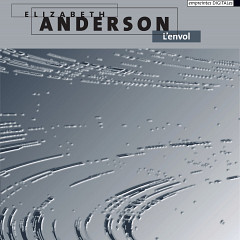
    The renewed interest on electroacoustic and acousmatic sonic material, that labels like empreintes DIGITALes are fostering by means of their publishing efforts, is allowing many hungry listeners to discover quite unknown composers or musicians in this interesting field. In spite of an excellent academic track and a plenty of prizes in international competition — including ASCAP-SEAMUS (USA, 2001), Bourges (France, 1994), CIMESP (Brazil, 1995, 2001, 2003, and 2007), Città di Udine (Italy, 2004), Métamorphoses (Belgium, 2004), Musica Nova (Czech Republic, 2008), Noroit-Léonce Petitot (France, 1998), Stockholm Electronic Arts Award (Sweden, 1994), TIME (2002), and Pierre Schaeffer Competition of Electronic Music (Italy, 2007) —, American-born Brussels-based composer Elizabeth Anderson could be an unknown name for many followers of the scene. Even if listeners who are not so familiar with sound processing couldn’t catch the beauty of this release, L’Envol (French for “the flight”) collects many works by Elizabeth, whose aesthetic research often features metacultural interconnection. Two of the above-listed prizes was given to the opening Les forges de l’invisible, an electroacoustic suite that Elizabeth made by manipulations of some sonic input that she previously created during a residency at the Centre de creation musicale Iannis Xenakis in Paris, between the multichannel electroacoustic studio of City University London and the Studio of Akousma of the Academy of Soignes in Belgium. The main source of inspiration of the two movements — the first one seems to trace different lovels of sonic decay, while the second movement could be the reverse process as the initial particles seems to get gradually amalgamated — was Blake’s poetry and particularly his visionary outlook of progress: she specifically mentions the notorious poem The Tyger, whose “fearful symmetry” has already inspired many musicians and got mirrored by the contrast between creative and distructive forces that animate guts, hearts and behavious of every sonic particles of this suite. Named after the underground fortress that Nazi forces built in northern France, Mimoyecques — the oldest recording of this collection — is a sort of sonic tribute to the forced laborers (more than one thousand prisoners) who died when the fortress was heavily bombed by the Allied air forces in 1944: for this genuine act of remembrance, she combined two sets of sound, being the first one mainly made from sounds that she recorded in the fortress and the second one from the overlapping of different readings in different languages from writings of Hans Christian Andersen, Danilo Dolci, Annette von Droste-Huelshoff, Alexander Pushkin, David Baltuch, Vaino Linna, Bjornstjerne Bjornson, Amir Gilboa and Czeslaw Milosz, intended to mirror the multilingual origin of the died workers. The tracks in the middle — the most recent erecordings — are mainly connected to Anderson’s fascination for space and ancient cultures: Solar Winds, which was dedicated to ancient Mayan astronomers, was based on James Dungey’s open magnetosphere model and interplanetary field lines that got carried by solar winds and interfere with Earth’s magnetosphere, which become a sort of score to give sound to non-sounding astronomical event, while the following … and Beyond proposes an imaginary aural journey beyond heliosphere. The vaguely diquieting Ether and the two movements of Protopia / Tesseract, inspired by Madeleine L’Engle’s novel A Wrinkle in Time, where space / time compression makes intergalactic travels possible, complete this release.

    Even if listeners who are not so familiar with sound processing couldn’t catch the beauty of this release, L’Envol collects many works by Elizabeth, whose aesthetic research often features metacultural interconnection.

    Les lointains in A Closer Listen

    “Review”, Richard Allen, A Closer Listen, July 23, 2015
    Thursday, July 23, 2015 Press

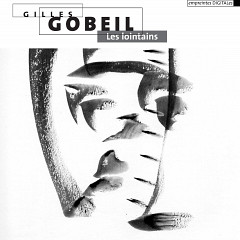
    The final piece of our empreintes DIGITALes triptych demonstrates the diversity of the label, as well as the intelligence of its artists. Québec’s Gilles Gobeil has over 25 years of recordings under his belt, but has not released a solo album since 2008. On Les lointains, he returns with a vengeance, with tracks inspired by Virgil, Hesse and Liszt, and subject matter ranging from the golem to the hydra. Lest we take it all too seriously, he also includes a piece that incorporates the sounds of dishes, a refrigerator and a coffee maker.

    The title track is a joy to decipher, as every sound is sourced from the home of sponsor Folkmar Hein. Inside the apartment, a grandfather clock ticks; outside, the bells of the Rathaus Schöneberg ring. Imagine testing the sonic properties of one’s home: tapping on every surface, sliding every door, testing every appliance. Most people have their favorite sounds (the hum of a refrigerator), as well as some they are less fond of hearing (the rattle of the air conditioner as it shifts from cool to fan). Subconsciously, we suspect that a home is a sort of system, a micro-version of a jungle, filled with mysterious mechanical beasts that creak or whirr without warning. And yet, a strange comfort can be derived by their confluence of sounds. While Gobeil’s treatment emphasizes the crashes and crunches, over time it becomes a tribute to a home and the man who lives within.

    Inspired by Hermann Hesse’s The Glass Bead Game, Castalie starts with the sound of an alarm, then an electronic gate opening, freeing all manner of sounds from their containers. At points harsh and in between gentle (faint birdsong occupying the open spaces), the piece toys with expectations, hiding its moments of transition. Even on repeated listens, one is not exactly sure where the pathway will bend. Composed in 2008 to mark the 60th anniversary of musique concrète, Castalie is a blend of sounds that exist in conjunction nowhere else: take for example the appearance of a crop-duster just prior to the reappearance of the alarm. In the final minute, a melody tip-toes through the background, hoping not to be noticed, outdone by the more abstract foreground.

    Bol-Hydre utilizes the sounds of the bol while adopting the hydra’s menacing mythology: cut off its head and another (or two, for those who read Kirby) will take its place. The percussion continues while the bol [“bowl”] howls and moans its low-toned warning. And yet, there are also bells, along with the sound of passing traffic, as if to suggest danger hidden in plain sight. One would be intimidated even without the prose. At this point, the album seems destined for darkness.

    Gobeil gives into the impulse, introducing Sibylle with a brass blast, followed by a whisper: the gaping maw of the underworld. If Aeneas hopes to descend, he will also need to resist: the hydra was nothing compared to what awaits. Again a bell tolls, like a final plea. Do not do this. Gravel loosens from the path. A voice squeaks like a rusty swing. Clouds of soot obscure the steps. Waves lap at an unseen shore. The sibyl alternates between prophecy and onomatopoeia. The bells return in echoes, until all is devoured in smoke. Golem follows, footfalls colored by construction and percussion, enhanced by film strip and bicycle bell. In the distance, a minyan chants. The שם remains intact.

    As Gobeil closes his collection with a tribute to Liszt, one imagines him opening the curtain a bit. Indeed, a choir seeps in, as do soft horns; the piano enters in the fourth minute. Yet the composition is less a reflection of tempestuous ivory as it is of a tumultuous life: I carry a deep sadness of the heart which must now and then break out in sound. One hopes for Gobeil a happier ending; if at times Les lointains sounds like notes stolen from the underworld, on Des temps oubliés he seems to have borrowed from heaven as well.

    … [Gobeil] returns with a vengeance…

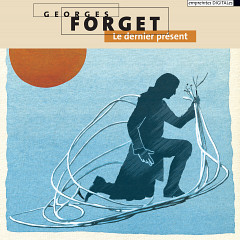
    Le dernier présent in A Closer Listen

    “Review”, Richard Allen, A Closer Listen, July 22, 2015
    Wednesday, July 22, 2015 Press

    With tracks inspired by a Terence Malick film, a Melville novel, and poems by Baudelaire and the French sailing champion Olivier de Kersauson, Le dernier présent wears its literary heart on its sleeve. Yet it is an album of few words, the most obvious being a portion of song from the French Foreign Legion. This segment, midway through the album, reminds the listener of the yearning soul behind the mechanical facade. Even when the words, first sung, are echoed in a guttural whisper, the listener can feel the tension between courageous ideal and smudged execution.

    Montréal’s Georges Forget has lofty ambitions, which include the pulling back of bandages to check the condition of wounds. He is not afraid to expose the “melancholy and fatalism” of a war song, or the underbelly of a breathing city. But at times he turns romantic, underlining the brevity of a fleeting romance or the lure of the ocean; toward the end, he even allows a child’s ebullient voice. No single mood unites Le dernier présent, but the sounds – composed and recorded over the past decade – are intriguing in themselves, and hide their surprises between folds of sonic cloth.

    One of the most effective pieces, Urban Adagio, treats the sounds of transit as both texture and percussion, augmenting the chug of trains and passing of cars with footsteps, squeaks and drones. The effect is both soothing and energizing; the more familiar the sounds become, the more comforting, stripping the terrors of night and replacing them with a siren call. Related sounds will appear later on the album, reflecting the artist’s urban background. The more rhythm one hears, the more rhythm one truly hears or ceases to hear, depending on one’s attitude toward the alluring/offensive sound.

    The two “war” pieces are rougher around the edges, as befits their subject. The prize-winning Métal en bouche is filled with hammers and engines, but is offset by smaller noises: a laugh, a coin, a bell. “We move forward, metal in mouth,” writes Wahed Gotref. The slow march pace indicates a battalion, or at the very least, a metaphorical determination. Orages d’acier is less linear: a counterbalance of lulls and explosions, a nod to The Thin Red Line. Before the soldiers sing, there is again the sound of the rails, connecting this piece to Urban Adagio, albeit with a different connotation.

    A secondary theme is that of water, lapping at the hulls in Une île and anchoring the quotes of Seul et septembre and L’appel. In the first composition, the water looms dark, a murky, many-fathomed ocean. But in the second, the waves and the electronic wings are more benign; and by the Moby Dick-referencing closer, the tone shifts to a summer vacation, replete with playground and child. Whenever it is a damp, drizzly November in my soul… I account it high time to get to sea as soon as I can. If the tamer 21st century invites us to get to the sea instead of to sea, it’s still a pleasant reminder that the world is not all metal, transit and war.

    … the sounds […] are intriguing in themselves, and hide their surprises between folds of sonic cloth.
  • 3
  • 4
  • 5
  • 6
  • 7
  • 8
  • 9
  • 10
  • 11