Sauter au contenu principal
electrocd

Blogue

4252 résultats
  • 697
  • 698
  • 699
  • 700
  • 701
  • 702
  • 703
  • 704
  • 705
  • Électro clips dans The Globe and Mail

    «Snapshots That Stimulate», Robert Everett-Green, The Globe and Mail, 26 novembre 1990
    lundi 26 novembre 1990 Presse

    Twenty-five composers, three minutes each: that’s the rate determined in advance for this attractive compilation from Montréal of “electroacoustic snapshots.” The shutter speed may be a bit fast for the average serious composer, but the snaps featured on this disc capture a fairly wide segment of the scene. Included are works commissioned from composers across Canada, a few Americans, and one senior trans-Atlantic figure (Francis Dhomont).

    The methods and materials used in these sound-bites could hardly be more diverse. Some fabricate a world from a few sounds and timbres, a practice pioneered in Canada by the late Hugh Le Caine. Craig Harris’s Somewhere between teases a symphonic essay from piano tidbits, while John Oswald’s Bell Speeds conjures a hefty carillon from a single pea-sized bell.

    Others play with language and its voices, carrying on the two-fronted assault that busies musicians and “sound artists” alike. Zack Settel’s jivey Skweeit-Chupp, for instance, is synthetic skat; as is Robert Normandeau’s dreamier, grander Bédé, in which a child’s voice is split right across the audible spectrum. Dan Lander’s rougher I’m looking at my hand is an audio equivalent of the language-laden “personal films” that turn up at alternative film screenings.

    Others pick up a thread of musical journalism that has been pretty much invisible since Paul Hindemith wrote Neues yom Tage (The Daily News). Yves Daoust lards his intriguing Mi bémol collage with politically-charged clips from last summer’s Oka broadcasts, Christian Calon patches indpendentiste speeches and open-line exchanges into his Temps incertains.

    Still other entries defy classification. Dhomont commits self-cannibalism in Qui est la?, plundering a decade’s work in a fiercely protean essay that whips past like a high wind. Gilles Gobeil teams up with guitarist René Lussier for the partly improvised Associations libres, by far the most aggressive item on the disc. Hildegard Westerkamp, one of only two women on the album, shapes her Breathing Room with exhalations and heartbeats, a strategy that seems more interesting in theory than in her practice. And Bruno Degazio transforms a formula of fractal geometry into the amusing Humoresque 901534, the closest Electro clips comes to danceable, pop music.

    All in all, it’s a stimulating collection, with half a dozen snaps suitable for framing. The disc booklet includes a set of 25 commissioned black-and-white photographs by Quebec City photographer Joanne Tremblay.

    … snaps suitable for framing.

    Électro clips dans Voir

    «Critique», Félix Légaré, Voir, 22 novembre 1990
    jeudi 22 novembre 1990 Presse

    Si vous vous intéressez à la musique électroacoustique et que vous ne savez où commencer, voici une visie en 25 courts montages de compositeurs d’Amérique du Nord, d’ici et d’ailleurs. Chaque création se présente comme une porte ouverte sur l’imaginaire de chaque musicien, où abondent des extraits sonores de la vie courante. En prime: pour chaque auteur, une biographie et un résumé de leur démarche. Intéressant et accessible. Sur CD seulement.

    petits Big Bangs dans Voir

    «[À propos de Lux]», Dominique Olivier, Voir, 1 novembre 1990
    jeudi 1 novembre 1990 Presse

    […] Troublant, émouvant, fascinant, Lux nous avait révélé, en 1985, le potentiel immense du travail multimédiatique. […]

    Électro clips dans Montreal Mirror

    «Found Sound», Andrew Jones, Montreal Mirror, no 6:20, 1 novembre 1990
    jeudi 1 novembre 1990 Presse

    It’s tough to get modern composers to think small. Encapsulating a grand artistic statement in the space of two minutes and 45 seconds is usually Phil Spector’s bag. Yet a new CD from the Montréal-based DIFFUSION i MéDIA label does precisely that Électro clips invites 25 North American electroacoustic composers to contribute a miniature electroacoustic work, three minutes or less.

    “We simply asked composers to make a three-minute tape work, not 3:45, not 3:20, but three minutes exactly,” says Jean-François Denis, who, along with fellow composer Claude Schryer, is DIFFUSION i MéDIA. “The main idea was to set a challenge to composers. Electroacoustic works are usually 10 to 20 minutes long. Forcing them to do it in three minutes, and make sense, was a challenge. And they all told us so.”

    The sounds that become music range from the simple to the complex. John Oswald’s gentle Bell Speeds is a straight recording of a bell in eight octaves, while Daniel Scheidt’s anarchic What If has an interactive software program that listens to itself, rather than a live performer. The source material can be environmental or empirical. Claude Schryer’s Les oiseaux de Bullion is built up from unaltered and unprocessed nature sounds, and Christian Calon & Schryer’s Prochaine station is a ride through the Montréal Metro, while Bruno Degazio Nino Rota-like Humoresque 901534 is composed with the aid of fractal geometry.

    This is not to say these electroacoustic miniatures sound like a bunch of professors sitting around in skinny ties firing funny sounds at each other. Zack Settel’s dada Skweeit-Chupp is a side-splitting processed voice-percussion duet. Mexican Javier Álvarez deconstructs the mambo musique actuelle style in Mambo à la Braque. And Stéphane Roy’s sensual Résonances d’arabesques, while created entirely on digital interactive hardware and software, shifts and shimmers with an unusually sensitive touch. Two of the most powerful works, John Oliver’s striking dirge for Guatemala, Marimba Dismembered, and the closing, sombre Bajanoom, by respected composer Charles Amirkhanian, evoke moods that stay with the listener long after the song has evaporated.

    “We were borrowing from the pop music format, trying to make the music very condensed,” says Denis. “We were trying to democratize electroacoustic music so that more radio stations will play it, more people will hear it. You don’t even hear it on Brave New Waves.”

    Listening to Électro clips’s big chunk of electroacoustic miniatures may seem a daunting task to some. Denis and Schryer recommend the listener choose the track sequence at home. “For Claude and I, putting together an compilation of 25 artists was a big enough problem,“ he says. “Finding a running order was worse. We listened to the pieces, came up with one sequence, which is the one you hear on the CD. But it is only one way of hearing it. With programmable CD players, you can create your own sequences at home. The booklet that comes with the CD is 25 separate pages. A booklet that is stapled would freeze an order of listening.”

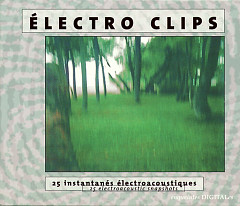
    Électro clips is illustrated by Quebec photographer Joanne Tremblay in much the same way the music was composed — in the dark. “It was the same idea — try to stimulate an artist to do something unusual,” Denis says. “We asked her to shoot 25 polaroids, no subject matter, no constraints.”

    Électro clips was an expensive project. DIFFUSION i MéDIA’s first four releases were funded by the Canada Council for the Arts, but this one wasn’t. Schryer and Denis invested money they didn’t have, and the 24 artists waived an up-front payment. DIFFUSION i MéDIA will launch Électro clips with a free live performance of the composers manipulating their taped works on a new, 40-speaker sound system installed at Bar-Théâtre Les Loges.

    According to Denis, sales are going well for the company’s small catalogue, yet it’s difficult to gauge as theirs is the first to specialize in electroacoustic music in Canada. “We’re like missionaries in a way.”

    Électro clips dans MTL

    «Critique», Philippe Tétreau, MTL, no 80, 1 novembre 1990
    jeudi 1 novembre 1990 Presse

    Puis une idée neuve, le collage de clips sonores que l’étiquette empreintes DlGITALes lance le 2 novembre dans le cadre du festival. Il y en a 25, de 25 compositeurs des quatres coins de l’Amérique du Nord: un feu d’artifice, une excellente introduction à la musique actuelle.

    Électro clips dans Le Devoir

    «Prendre le train des «musiques actuelles»», Carol Bergeron, Le Devoir, 27 octobre 1990
    samedi 27 octobre 1990 Presse

    […] Bien qu’il ne s’agisse pas d’une commande, l’idée de cet enregistrement n’en fut pas moins inspirée par la tenue du MMA/NMA. Jean-François Denis et Claude Schryer ont ainsi commandé 25 miniatures électroacoustiques, d’une durée de trois minutes chacune, à des compositeurs du Québec, du Canada, des États-Unis et du Mexique. Si la liste ne contient que 24 noms, c’est que le 25e électroclip a été réalisé conjointement par Christian Calon et Claude Schryer qui ont aussi travaillé seul.

    Le tout forme une mosaïque captivante où se mélent le spectaculaire et le poétique. Ces courtes confidences révèlent des personnalités, des sensibilités, des esthétiques trés différentes. On ne se lasse pas de parcourir ce disque dont l’une des qualités majeures est de ne laisser à aucun musicien le temps de se fourvoyer en longueur.

    Trois minutes, c’est la durée d’une chanson populaire ou d’un vldéo-clip. Mais là s’arrête le rapprochement car il ne s’agissait pas de fabriquer une pièce aux dimensions étroites d’une chansonnette. Il fallait au contraire obliger son écriture à cerner rapidement un propos qui aurait facilement pu s’étaler dans le temps.

    Les Yves Daoust, Francis Dhomont, John Oliver, Stéphane Roy, Gilles Gobeil, Charles Amirkhanian, Jean-François Denis, Christian Calon, Robert Normandeau, Claude Schryer, Hildegard Westerkamp y sont parvenus avec un bonheut particulier. Les origines différentes des auteurs ne semblent pas jouer un rôle particulier. Comme si le langage électroacoustiaue devenait de plus en plus intenational.

    Pour augmenter le plaisir de l’écoute, on gagnera à jouer ces miniatures les unes contres les autres. Car bien entendu, l’ordre une nous propose le disque n’a rien de définitif. Il peut aisément étre modifié en programmant son lecteur laser.

    Ajoutons encore que la réalisation technique et la présentation du disque ont fait l’objet d’une attention toute particulière. On y retrouve la même qualité, le même souci du détail que dans les CD précédents du même éditeur.

    On y retrouve la même qualité, le même souci du détail que dans les CD précèdents du même éditeur.
  • 697
  • 698
  • 699
  • 700
  • 701
  • 702
  • 703
  • 704
  • 705