electrocd

Blog

56 results
  • 2
  • 3
  • 4
  • 5
  • 6
  • 7
  • 8
  • 9
  • 10
  • Lointain intérieur in Blow Up

    “Recensioni”, Massimiliano Busti, Blow Up, no. 7, July 1, 2024
    Wednesday, July 17, 2024 Press

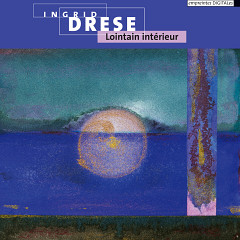
    Con una preparazione da pianista classica alle spalle, Ingrid Drese ha sviluppato un interesse crescente per la musica elettroacustica sul finire degli anni novanta, quando ha iniziato a frequentare i corsi di composizione al conservatorio di Bruxelles. Questo suo lavoro Lointain intérieur si basa su un intreccio di visioni poetiche e ricerche scientifiche, spaziando dalle allucinazioni dello scrittore, poeta e pittore belga Henri Michaux in Pérégrinations d’une petite sphère happée par le temps all’affresco uditivo suddiviso in cinque sezioni Treize virgule huit, concepito per otto altoparlanti e basato sulla trasposizione delle onde elettromagnetiche in onde acustiche; dalla poesia di Rainer Maria Rilke che in Au-delà des Mille Rayons diviene sinonimo di rotazione e circolarità, al finale di Cri de Merlin ispirato all’opera di Carl Gustav Jung. Un’esperienza percettiva complessa, sviluppata attraverso un articolata fusione di suoni e significati.

    A complex perceptual experience, developed through an articulated fusion of sounds and meanings.

    Alex Groves, Zoë Martlew, Thea Musgrave, Mark Simpson, Hildegard Westerkamp in The Guardian

    “The horn is plenty”, Andrew Clements, The Guardian, June 28, 2024
    Friday, June 28, 2024 Press

    Ben Goldscheider’s solo horn took centre stage in a rewarding and fascinating concert featuring new and older compositions that combined his instrument with live electronics

    We’ve come a long way from the early days of electroacoustic music, when a ring-modulated piano or a flute or a violin dialoguing with electronic echoes of itself was often the height of technological sophistication. Even so, it still seems strange to find a solo horn as the focus of a concert featuring real-time electronics. But Ben Goldscheider spent his time during lockdown in 2020 looking into the possibilities of combining his instrument with live electronics, and he presented the results of his research in a recital with the “media artist” Philip Dawson, which featured the premieres of three specially commissioned works.

    Goldscheider also included the work that had started him on his explorations, the 1979 Fantasie for Horns II by the German-born Canadian Hildegard Westerkamp, in which the solo horn has a taped accompaniment assembled from the sounds of many different horns, including fog, car and alp. The writing for the live instrument is entirely conventional, the tape background mostly continuum-like, until shortly before the end the horn embarks on a solo that seems to come straight out of a 19th-century German opera. Thea Musgrave’s Golden Echo III was Goldscheider’s multi-channel recreation of a piece originally composed in the 1980s for solo horn and 16 other horns on tape, which places the audience at the centre of a surround-sound celebration of brass sonorities.

    None of the new works could match that kind of sonic luxury, although Alex Groves’s Single Form (Dawn), which he describes as a “slow-motion, sonic sunrise,”,built up an impressively dense texture from the instrument’s harmonics. Zoë Martlew’s Nibiru places the soloist at the centre of a global apocalypse – the title comes from Babylonian mythology – with the horn pleading for humanity’s salvation, amid sounds drawn from a variety of cultures, and ending with the song of an extinct Hawaiian bird. And in Mark Simpson’s Darkness Moves II, inspired by the work of the artist-poet Henri Michaux and his experiments with mescaline, Goldscheider’s extraordinary virtuosity and the potential of the real-time electronics were fully exploited, and there was a true dialogue between the two. Simpson’s vivid, surreal musical gestures and their interactions with their digital transformations were spectacularly vivid, so that the piece acquired a theatrical dimension that was totally compelling.

    … a rewarding and fascinating concert featuring new and older compositions…

    June 14, 2024: Hildegard Westerkamp Now Doctor of Fine Arts, honoris causa

    Friday, June 21, 2024 General

    On June 14, 2024, the degree of Doctor of Fine Arts, honoris causa, was conferred on Hildegard Westerkamp from Simon Fraser University (SFU) in British Columbia (Canada).

    Hildegard Westerkamp’s compositions have been performed and broadcast in many parts of the world. The majority of her compositional output deals with aspects of the acoustic environment: with urban, rural or wilderness soundscapes, with the voices of children, men and women, with noise or silence, music and media sounds, or with the sounds of different cultures, and so on.”

    Radiolaria in Music Map

    “Recensione”, Samuele Conficoni, Music Map, June 1, 2024
    Wednesday, June 19, 2024 Press

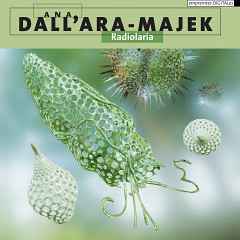
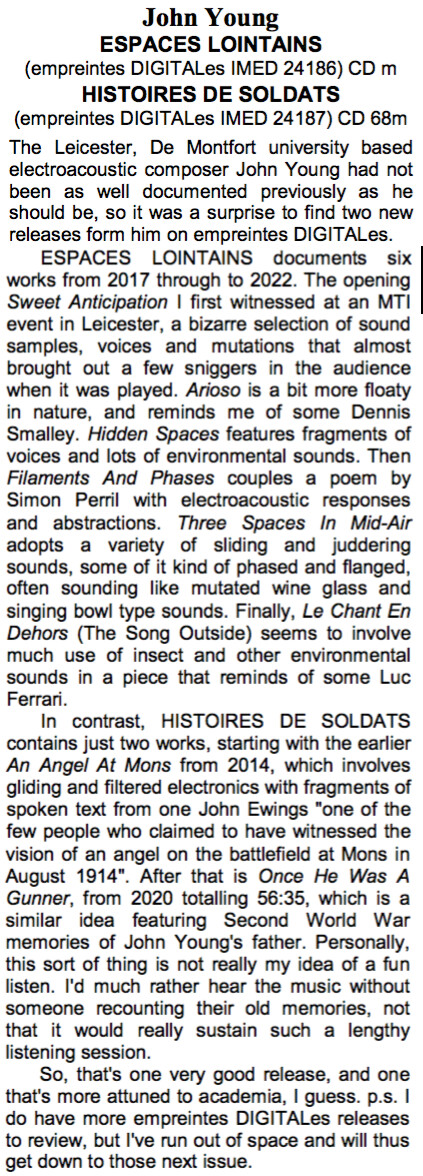
    Radiolaria, uscito per empreintes DIGITALes, è un ciclo di lavori elettroacustici creati utilizzando il celebre Buchla 200, iconico sintetizzatore modulare diffuso soprattutto negli Anni Settanta. Tutti improvvisati e caratterizzati da una partecipazione particolarmente viva ed energica da parte della sua autrice Ana Dall’Ara-Majek, questi autorevoli bozzetti sono acquarelli graziosi e variegati ispirati alla vita acquatica, in particolare al plancton.

    In Radiolaria la visione del mondo di Ana Dall’Ara-Majek emerge in tutta la sua vivacità, tra meraviglia e sogno, tra speranze e concretezza. Lo scopo di Dall’Ara-Majek in questo suo nuovo progetto era quello di creare dei “sound colours”, dei colori sonori, che rappresentassero le varie specie di plancton esistenti sul nostro pianeta. Questo tentativo di dare ordine e diversità a un universo larghissimo e molto diversificato al suo interno è gestito e costruito in maniera ingegnosa e magistrale grazie all’utilizzo del Buchla 200 e al modo in cui la compositrice lo usa, piegandolo alla sua poetica sonora e lasciandolo occupare gli spazi intorno a sé finché non li ha resi una creazione tanto propria quanto dell’artista. Lo strumento, insomma, diventa una proiezione della compositrice e della sua visione del mondo.

    Le otto tessere del puzzle che è Radiolaria sono affascinanti e ipnotiche, levigate al punto giusto da risultare improvvisazioni meditate e al tempo stesso spontanee e tentacolari, in grado di muoversi liberamente e di esistere sia come frammenti sia come indizi di un quadro più ampio e concettuale che è l’intero disco. Dalle magmatiche pulsazioni di Parasiti fluxique ai tre episodi, vivaci e misteriosi, di Improvisus B200, dalle vibrazioni preistoriche del pezzo che apre il disco, Mare Buchlae, alla conclusione espressiva e pregevolmente precaria di Ostinato micromacro, peraltro tutti titoli che rimandano al latino e che si inseriscono in una visione che sa unire tradizione e avanguardia, Radiolaria centra in pieno gli obiettivi della sua creatrice.

    Nella sua audace e intrigante impalcatura, Radiolaria è un ciclo di composizioni che pretende dall’ascoltatore concentrazione e impegno ma che, una volta che questi le vengono concessi, ripaga pienamente le aspettative e le richieste. È un progetto ambizioso, stratificato e totalizzante, che ti catapulta in uno spazio di intenzioni e di passioni che sin da subito ti conquista e ti avvince, coerente e geometrico quasi come una sinfonia.
    It is an ambitious, layered and all-encompassing project that catapults you into a space of intentions and passions that from the outset captivates and captivates you, coherent and geometric almost like a symphony.

    Radiolaria in Gonzo Circus

    “Kritiek”, Gonzo Circus, no. 181, May 1, 2024
    Thursday, May 30, 2024 Press

    Ana Dall’Ara-Majek studeerde zowel in Parijs als in Montréal, waar ze in 2016 met een doctoraat compositie op zak haar parcours als artiest en componist vervolgde. In 2022 voltooide ze een residentie in de Elektronmusikstudion (EMS) in Stockholm met onder meer een tot de verbeelding sprekende Buchla 200 tot haar beschikking. Daar creëerde Dall’Ara-Majek een diverse collectie klanken waarvoor ze zich liet inspireren door het maritieme leven. Terug in Montréal, synthetiseerde ze alle ideeën tot de prachtige elektroakoestische luisterplaat Radiolaria — de zee en haar organismes in klank vervat. Parasiti fluxique is een duet tussen microscopisch klein plankton en menselijke activiteiten.

    There, Dall’Ara-Majek created a diverse collection of sounds for which she drew inspiration from maritime life.
  • 2
  • 3
  • 4
  • 5
  • 6
  • 7
  • 8
  • 9
  • 10