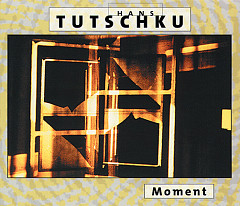
Hans Tutschku is a German composer born in Weimar in 1966. He has been involved in electronic music and the creation thereof from an early age. At 16, he joined the Ensemble für Intuitive Musik Weimar and later accompanied Karlheinz Stockhausen for three years to study sound diffusion. Moment is a collection of electroacoustic compositions by Mr. Tutschku. This compact disc features the subtle blending of vocal, instrumental, and environmental sounds to create rich sonic textures. Although all of the works on Moment were created to some extent through computer programming, manipulation of recorded material, and digital signal processing, it is Mr. Tutschku’s precise craftsmanship in compositional techniques that allows the listener to hear only the voice of the music he has created and not the technology. It is both his ease of knowledge and skill that allows his passion and personality to be present in his compositions. His accomplishments have been acknowledged worldwide with numerous awards and honors for his works. Since 1997, Mr. Tutschku has held a teaching position at Ircam (Institut de Recherche et Coordination Acoustique/Musique). In the composition extrémités lointaines (1998), the composer takes the listener on a sonic journey through Asia, Singapore, Indonesia, the Philippines, and Thailand. Recordings of various cities, churches, temples, and children singing can be heard in this soundscape. In the creation of this composition, Mr. Tutschku used real-time granular synthesis to divide and reorganize the sounds to create new sonic relationships among the sources. Throughout extrémités lointaines the composer is vigilant in maintaining connections to the specific cultures from which the sound sources originated. It is this passion and dense compositional structure that creates the intensity of this fascinating work. extrémités lointaines was originally composed for eight channel dispersion and was commissioned by the French Ministry of Culture in collaboration with Ina-GRM (Institut National de l’Audiovisuel — Groupe de Recherches Musicales) in Paris. This work was a finalist in the 1998 Bourges International Electroacoustic Music Competition in France and was given the award of Distinction at the 1998 Prix Ars Electronica competition in Austria. Most of the compositions on Moment feature the human voice in one form or another. Mr. Tutschku’s … erinnerung… (1996) is no exception, as unique gestures of the human voice are used to create richly colorful and sometimes quite dense textures. The piece is based on the poem … erinnerung… by Antonio Bueno Tubia. This collection of words provides the starting point for the transformation of the human voice later interspersed with bells and tamtams. The intensity created by the juxtaposition of these sound worlds is then interrupted by the clearly spoken text: “Yo/ os lo aseguro, / la cárcel existe, / la recuerdo como untrallazo en la sien” (”I/ assure you/ the prison is there/ I recall it like a lash to the face”). In this recording the poet is also the male voice featured reading the text of the poem. … erinnerung… is a highly dramatic composition full of truly evocative sounds which are well suited to the intentions of the poem. Les invisibles (1996) is a composition for tape without live performers derived from an earlier work, Freibrief für einen Traum (1995) for soprano, flute, cello, percussion, and computer-generated sound files. The work featured on Moment uses 25 short melodies and five longer sequences for instruments, as well as a four-voice counterpoint for soprano. The text for the soprano comes from the poem “Es wird später” (“It’s getting later”) by Austrian poet Karl Lubomirski. The musicians who made the recordings for Les invisibles include Donatienne Michel-Dansac, soprano; Catherine Bowie, flute; Antoine Larette, cello; and Jean Geoffroy, percussion. All the recorded sound material was later reorganized and given different spatial placements within the new composition. The sound world and melodies created are very well suited to the text of the poem throughout the work. Les invisibles focuses on the understandability of words as a part of the compositional process. The poem’s description of travel and its allusions to time are very clearly illustrated in the design of the melodic lines and long sustaining tones created from the elongation of the original instrumental material. Sieben Stufen (“Seven Steps”) (1995) is based on the poem Verfall (decline, decay) by the Austrian poet Georg Trakl (1887–1914). Mr. Tutschku uses the text of the poem primarily as a sound source and is not necessarily trying to “set” the text or illustrate the intentions of the poem itself. This is obvious in the treatment of the words which is, at times, very disjointed, and thus the resemblance to the spoken text is null. At the same time, the sounds that the words create through various processes is very musical, often with long, sustained, subtle, changing timbres which are pleasing to the ear. The piece is divided into several sections, emphasizing various processing techniques. These range from glissandi through movement, clear spoken text, male and female voices, harmonic and melodic elements of the voice, granular synthesis where a single vocal sound is elongated over time in minute splices played together, to superimposed text creating varying delays and echoes. The poem is presented in two languages, German and French, and is spoken by a total of four voices, two male and two female. Mr. Tutschku selected four main words in each language to corresponded to seven different pitches for a total of fourteen pitches for the entire composition. This piece uses the difference in languages to act as a counterpoint throughout the composition. This work received Second Prize in the CIMESP International Electroacoustic Music Competition of Saö Paulo in Brazil in 1995. It is a powerful composition which alters the listener’s perception of strict time through the haunting ebb and flow of the voices. Die zerschlagene Stimme (1991) features sound material derived from only the human voice and percussion sounds. In this composition, Mr. Tutschku imposes vocal articulations on the sounds of the percussion material while those of the voice are transformed into percussive ones. This is similar to Jonathan Harvey’s Mortuos Plango, Vivos Voco (1980), where the envelopes of two sound sources, a boy’s voice and a bell, are switched. Thus, in Die zerschlagene Stimme, the percussion imitates the vocal envelope of a gradual attack, no immediate decay, long sustain, and gradual release, while the voice at times has a percussive envelope, with a short attack and sudden decay followed by a relatively short sustain and decay. The basis of the composition is the exploration and play of the various stages of transformation for both sound sources. The juxtaposition, integration, and relationship between the new and original materials produce an enticing listening experience. The transformation of the human voice into a percussive element surfaces strong emotions such as fear, anger, and distress, feelings commonly associatedwith quick abrupt vocal sounds. On the other hand, the lengthening of the percussion sounds creates a dreamlike setting which is at times quite calming. When transformations occur at the same time there is a great range of intensity as familiar sounds of human emotion meet the aural sound play of the unfamiliar. While Die zerschlagene Stimme was originally written for four-channel diffusion, the sense of sound transformation through movement in a compositional space is still present in this two-channel version. Ideally, this work should be listened to in a concert hall setting to experience the full changing and processing of the sounds as they travel throughout the space. Overall, the compositions featured on Moment are well crafted in the expression of common sounds and poetry transformed into elegant tapestries of music. Mr. Tutschku’s use of the voice for presenting discernable words, text in a harmonic sound source, or the combination and juxtaposition of materials creates rich compositions. It is these various techniques that expose the music within the words themselves. The compositions featured on Moment form a well-rounded collection that include city soundscapes, bells, and percussion, to more melodic works such as Les invisibles, featuring acoustic instruments played and recorded. Mr. Tutschku created his compositions through the use of computer programs, his own programming, and various other electroacoustic techniques. It is his vast talent in this area that enables his music to sound natural and free flowing, rich in emotion and intensity. Unlike some early “computer” music, which sounds very programmed, heavily structured, and devoid of any human element, Mr. Tutschku has elegantly bridged the gap between the music and the medium to produce stunning compositions of exceptional caliber.