electrocd

Blog

4252 results
  • 574
  • 575
  • 576
  • 577
  • 578
  • 579
  • 580
  • 581
  • 582
  • Francis Dhomont in AllMusic

    “Portrait: Francis Dhomont”, François Couture, AllMusic, August 1, 2001
    Wednesday, August 1, 2001 Press

    Born in France, electroacoustic composer Francis Dhomont spent the second half of his life between Paris and Montréal. Gifted with a sense of the narrative never matched, he is able to tell captivating tales through acousmatic art. The two parts of his “Cycle of Depths” the albums Sous le regard d’un soleil noir (1981) and Forêt profonde (1996) remain some of the most enduring examples of musique concrète, transcending the genre to touch the core of Mankind.

    Born in 1926 in Paris, Francis Dhomont came to musique concrète through classical music. He studied with Ginette Waldmeier, Charles Koechlin and Nadia Boulanger. Stumbling upon musique concrète at about the same time Pierre Schaeffer did, he abandoned musical composition around 1953 to create only electroacoustic music. Little is known of his works before 1972, as the composer repudiated them. Sous le regard d’un soleil noir introduced him to a relatively larger audience, the album becoming a classic of the genre and a source of inspiration for many sound artists. He created many acousmatic works playing on sound and meaning, but his best results were obtained through the use of dream-like narratives and “cinema for the ear.” His work in the 1990s grew even more evocative, culminating in the 60 minute piece Forêt profonde, a fantasy on fairy tales through the works of Bruno Bettelheim.

    Dhomont was also very active as a theorist. He edited several issues of magazines on electroacoustic music (L’Espace du Son, Circuit), created radio programs for Radio-Canada and Radio-France, taught electroacoustic composition at the Université de Montréal where he maintained a strong influence on younger composers, and co-founded the Canadian Electroacoustic Community. His work has been recognized internationally through numerous awards and prizes, including the Magisterium of the Bourges International Electroacoustic Music Competition in 1988. In February 2001 he received a Career Grant from the Conseil des arts et lettres du Québec, an incredible achievement for an avant-garde artist.

    Paul Dolden in AllMusic

    “Portrait: Paul Dolden”, François Couture, AllMusic, August 1, 2001
    Wednesday, August 1, 2001 Press

    Canadian electroacoustic composer Paul Dolden managed to work from within the musique concrète institutions even though his art should have placed him at its very margin. Known mostly for what has been coined his “esthetics of excess,” he stirred the otherwise very calm waters of the genre with his works for tape in which he piles up hundreds of layers of acoustic instruments. His 2-CD set L’ivresse de la vitesse remains a classic of fin de siècle electroacoustics.

    Born in 1956 in Ottawa (Canada), Dolden studied in Vancouver, where he still resides. At first an electric guitarist, cellist and violinist, he toured across Canada and Europe. This hands-on experience with “real” instruments explains his decision to approach tape music without the use of acousmatics. The composer does not use the standard techniques to mold the sounds. He works instead by accumulation, mixing together up to 500 tracks of individually-recorded instruments, in order to obtain the textures he wants. The 1990 Tronia CD The Threshold of Deafening Silence presented his first results and sent an initial shockwave into the academic musique concrète community. L’ivresse de la vitesse (empreintes DIGITALes, 1994), a longer and more conceptualized album, consecrated him as a leading figure in sound art. He was invited to numerous festivals, had residencies at the Groupe de Musique Expérimentale de Bourges in France and the Electronic Music Studio in Sweden, and won an impressive number of awards since his first steps in 1981, including three first prizes at the Bourges International Electroacoustic Music Competition (in 1986, 1988 and 1990).

    Dolden collaborates regularly with artists of the Vancouver new music scene. He wrote for John Korsrud’s Hard Rubber Orchestra and helped François Houle for the tape part of his conceptual album Au cœur du litige.

    L’ivresse de la vitesse […] consecrated him as a leading figure in sound art.

    Robert Normandeau in AllMusic

    “Portrait: Robert Normandeau”, François Couture, AllMusic, August 1, 2001
    Wednesday, August 1, 2001 Press

    Robert Normandeau is Québec’s leading electroacoustic composer after Francis Dhomont. One generation younger than his teacher, he took his best techniques and pushed them further into the “cinema for the ear.” All about climates, drama and narrative, his works capture the listener’s attention, either in concert settings or through his steady output of albums.

    Born March 11, 1955 in Quebec City, Normandeau followed the academic route to musique concrète: he obtained his bachelor degree from the Université Laval (Québec) in 1984, his master degree at the Université de Montréal in 1988, and the first Ph.D. degree given by this institution four years later. He studied with Marcelle Deschênes and Francis Dhomont.

    Normandeau played a key role in the development of Canadian electroacoustic music. In 1987 he co-founded the Canadian Electroacoustic Community; he was an active member of the ACREQ, and co-founded the non-profit organization Réseaux through which he produced numerous concert events. He teaches acoustics and electroacoustics at the Université de Montréal since 1988.

    Although he occasionally writes pieces for instrument(s) and tape, most of Normandeau’s output falls into the “acousmatic” category. His first CD, Lieux inouïs, came out in 1990. It revealed strong stylistic similarities with his mentor Dhomont, especially his sense of the narrative. Tangram, in 1994, gave first examples of his fascination with speech. International consecration came in 1996 when he was awarded the prestigious Golden Nica at that year’s edition of the Ars Electronica competition for the work Le renard et la rose, loosely based on Antoine de Saint-Exupéry’s tale Le petit prince. The piece was included on three compilation CDs before finding its way on his third solo album Figures.

    All about climates, drama and narrative, his works capture the listener’s attention…

    Sources / scènes in Prospective Music Magazine

    “Review”, Jukka Mattila, Prospective Music Magazine, July 1, 2001
    Sunday, July 1, 2001 Press

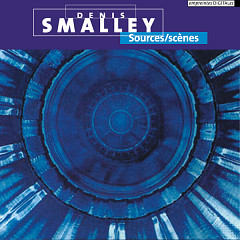
    Denis Smalley is an electroacoustic composer from New-Zealand, on this album concentrating on sound source material, featuring recordings based on metal and water sounds as well as sounds recorded in empty vessels. Smalley succeds in transforming the raw sound source material into very intriguing textures which often leave their abstract guise and take upon a calm, even a soudscape and ambiant form. The works here originate from 1984, 1997 and 2000, yet coming together as an accomplished, whole creation. One for large spaces and loud volumes. (9/10)

    One for large spaces and loud volumes. 9/10

    Sonars, Robert Normandeau in Absorb

    “Review”, Philip Raffaele, Absorb, July 1, 2001
    Sunday, July 1, 2001 Press

    Highly acclaimed Canadian electronic composer Robert Normandeau makes his rephlex debut with Sonars, keeping in line of general weirdness from the label, but not truly fitting into the braindance category. Instead, it is a highly experimental composition that relies on the concept of “sound” and every possible distortion available, all orchestrated into a bizarre soundscape of random click-click-clicks to sweeping echoes, and then cluminating in loud waves of sound. Like I said, this is highly experimental, in a way that might not please the ears of Rephlex’s general audience. A lot of the more experimental releases that Rephlex prides itself on all maintain some semblence of actual music, in that there lies some kind of structure, no matter how “out there” it is. But there is no such structure on this release, it is more of a sound photograph, a way of listening to life, in various applications.

    Boasting a huge discography, and an incredible list of awards and commissions, Normandeau is definitely in the canon of musicians that rely on heavy experimentation and abstract musique concrète pieces. After listening for a while, the most bizarre thing about the album, is the fact that it’s on Rephlex at all. So began the deliberations whether or not the man really exists; it could be an experiment in sound perpetrated by one of the Rephlex crew, but after some careful investigations, Normandeau is in fact legitimate.

    It is difficult to judge a disc like this, by what criteria does one compare or contrast it to? It exists on its own plane of weirdness, that calls for a very specific time and place for listening. Perhaps this marks the maturation of Rephlex as a label, and its desire to branch out and showcase other types of electronic talent. So the fine line of electronic composition becomes a little wider here, where Sonars lies at the polar opposite end of the spectrum to what is generic mainstream electronic music, and I suppose that Rephlex lies somewhere in the middle, when compared to Normandeau.

    Sonars lies at the polar opposite end of the spectrum to what is generic mainstream electronic music…

    Sonars, Robert Normandeau in Splendid E-Zine

    “Review”, Eric Cook, Splendid E-Zine, June 25, 2001
    Monday, June 25, 2001 Press

    Canadian composer Robert Normandeau comes from a distinctly academic background, with degrees in Electroacoustic Composition, a fistful of international “contemporary music” prizes and a CV filled with commissions and residencies. But Normandeau is also no stranger to crossing the invisible membrane between the world of university appointments and composer conferences and the more challenging side of pop culture electronic music, getting involved with Asphodel Records’ Recombinant festival some years back and now releasing this collection of “acoustimatic” compositions on the Rephlex label. Perhaps that’s because Normandeau seems to have mastered a challenging feat — combining truly exploratory sound manipulation, creation and compositional structures into works that are still engaging outside of their theoretical frameworks. In other words, they’re actually interesting to listen to.

    Sonars collects six works, spanning fourteen years, from 1985 to 1999. Despite the wide time frame in which Normandeau created these compositions, the CD is surprisingly coherent and unified. Each piece is a seamless continuum between dramatically artificial and dislocated organic sources. You’re continually confronted with roiling cascades of chiming synthetics — sounds that seem entirely unnatural at first listen. With closer attention, the layers of artificiality and resynthesis are peeled away, revealing the source material (in many of these pieces, wordless vocalizations and mouth sounds). Carefully calculated, this play between the natural and the synthetic draws you deeper into each piece, inviting you to listen and analyze each fragment. The earlier works on this collection seem more self-consciously dramatic (Le cap de la tourmente, for example). While this is not necessarily disappointing, they’re not as subtle, layered or perhaps internally referential as some of the more recent pieces. 1999’s Ellipse is especially satisfying, creating a mysterious soundscape of half-defined scraping and scratching, suggesting strings, contact microphones, late night movement in your walls…

    Each piece is nonlinear, self-sustaining and self-propelling — they’re consistent in their sonic language, and attentive listeners will hear and sense the progression and development in the composition without Normandeau ever stooping to draw an explict line from one to the next. These aren’t simple works, however, and they’ll not be for everyone. Normandeau doesn’t entirely shy away from rhythmic construction like some in academic electroacoustic music, but listeners seeking the more explictly beat-oriented material of Rephlex, or more traditional song structures, will be left scratching their heads. Dispense with those expectations and you’ll be richly rewarded by Normandeau’s universe of familiar yet foreign tones — a “cinema for the ear” which will lead you down unexpected paths.

    … a “cinema for the ear” which will lead you down unexpected paths.
  • 574
  • 575
  • 576
  • 577
  • 578
  • 579
  • 580
  • 581
  • 582