electrocd

Blog

4252 results
  • 587
  • 588
  • 589
  • 590
  • 591
  • 592
  • 593
  • 594
  • 595
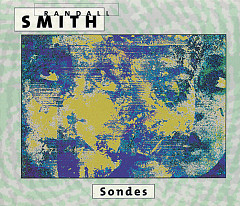
  • Sondes in Fake

    “Kritiek”, Sybilla, Fake, no. 8, March 1, 2001
    Thursday, March 1, 2001 Press

    De Canadese componist Randall Smith maakt een soort moderne kamermuziek. Hij componeert eerst werk voor diverse bekende solisten (vaak in opdracht). neemt de uitvoering op en bewerkt dan delen van deze opnames op elektronische wijze. Het uiteindelijke resultaat komt voort uit een mix van deze bewerkte fragmenten en andere opnames van -meest traditioneleinstrumenten. Toch is wat je hoort niet vervreemdend modern; meestal hoor je pure akoestische instrumenten zoals cello, bas, tluit en accordeon in een warme compositie. Dit moet de ultieme vrijheid voor een componist zijn. Bovendien is in het fraai vormgegeven boekje te lezen dat aan elke compositie een dieper concept ten grondslag ligt op het vlak van natuurgeweld- en schoonheid, ontstaansgeschiedenis van de wereld en primaire lichaamsprocessen zoals bloedsomioop en hartklop. Het lezen van deze boodschappen’ is niet echt nodig om van de muzick te kunnen genieten maar het voegt wel een extra dimensie toe en maakt je alert op dingen die je anders niet zou horen. Veel van Smith’s werk hoett terecht prijzen gewonnen op prestigieuze concoursen voor modern-klassieke muzick. Aanrader!

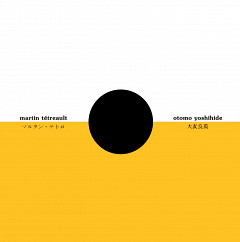
    21 situations in AllMusic

    “Review”, François Couture, AllMusic, March 1, 2001
    Thursday, March 1, 2001 Press

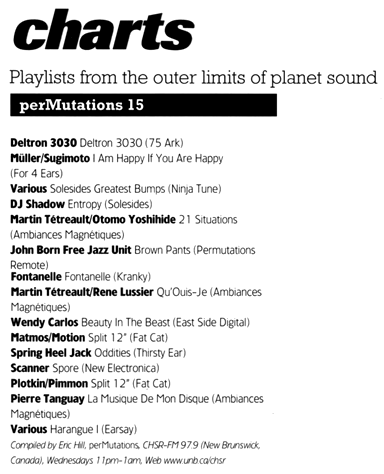
    This encounter between two of the leading turntablists of the avant-garde was meant to be. It happened in Montréal Martin Tétreault’s territory), December 1997. Japanese pioneer Otomo Yoshihide ex Ground Zero performs on turntables, sampler and CDs. Tétreault uses his arsenal of pick-ups, prepared records and prepared needles. They recorded 21 short improvisations (maximum duration: three and a half minutes) on specific themes, ranging from traditional music to cartoon, from science-fiction to education. This working method allowed them to concentrate their efforts on a few selected sound sources for a short period of time. It resulted in sharply focused pieces summarizing the techniques and art of both musicians. Humor is always a key aspect of Tétreault’s work and it is well represented here, especially in Science-fiction where the “spacy” analog synthesizer sounds he dug out are assembled into a melody very close to “Somewhere over the Rainbow”. The listener’s attention has no time to wander off. Recommended.

    Recommended.

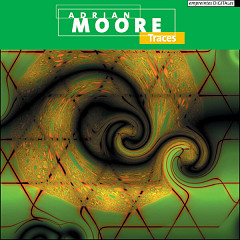
    Traces in Recycle Your Ears

    “Review”, Nicolas Chevreux, Recycle Your Ears, February 22, 2001
    Thursday, February 22, 2001 Press

    One of the latest releases on empreintes DIGITALes comes once again from a professor working in Great Britain. This times, Adrian Moore from Sheffield presents us five electroacoustic pieces, each one lasting between 10 and 14 minutes and recorded between 1994 and 1997.

    Considering the academic nature of this work, Traces is something to be listened to very carefully and also a creation that will be understood more by music students than by anyone else. However, I’d say that these fice tracks are rather easy to enjoy, very melodic and fast evolving. Playing with noises and material from atypical sources (Study in Ink is for example done only with sounds from a pen being used on a plastic board), Adrian Moore has managed to create rhythmic and tonal patterns that can appeal to people into noise or experimental music.

    Junky or Foil-Counterfoil, with their seemingly chaotic structures, evoke a very complex and yet coherent ensemble of short tunes and broken rhythms. The whole thing is very subtle, very calm, but is everything but boring. In a way, you can imagine that this is Merzbow on valium and without distortion: an avalanche of small samples that sound unstructured at first and slowly reveal its entire form.

    I don’t know if I was able to understand fully the ins and outs of this CD, but Traces is to me a pleasant recording, that don’t forget to be nice to the ear even though it stays very abstract and complicated. A nice surprise overall.

    … Merzbow on valium and without distortion…

    Traces in Soundbase Online Musikmagazin

    “Rezensionen”, Dirk Janßen, Soundbase Online Musikmagazin, February 15, 2001
    Thursday, February 15, 2001 Press

    Aus dem Rahmen der üblichen Veröffentlichungen fällt dieses Werk des englischen Elektroakkustikkünstlers Adrian Moore. Weit entfernt von mainstreamigen Klängen bombardiert der mit zahlreichen Trophäen ausgezeichnete Musiklehrer das Gehör mit Samples, elektrischen Schwingungen und verfremdeten Alltagsgeräusche. Was für den einen eine Tortur, kann dennoch für den anderen bei entspannter Atmosphäre eine Reise in neue Klangwelten darstellen. Wenn man erst einmal Zugang zu den anstrengenden Soundspielereien gefunden hat, strotzen die Klangcollagen nur so vor Details und die Erläuterungen im hübschen sowie intelligenten Papschuber lassen verstehen und entdecken. Eine außergewöhnliche Faszination geht hierbei besonders vom dritten Stück aus, wo Moore mit diversen Stiften Klanggemälde auf Papier zeichnet. So vielseitig hatte ich die Buntstifte wirklich nicht in Erinnerung.

    Ansonsten stellt die CD ein unheimliches, aber auch unheimlich anstregendes Hörerlebnis dar, mit dem sich sicherlich nur Personen mit dem gewissen Etwas/Ohr anfreunden können. Diese dürfte dann sowohl Klang als auch Optik des Produktes restlos überzeugen…

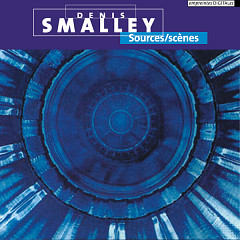
    Sources / scènes in Recycle Your Ears

    “Review”, Nicolas Chevreux, Recycle Your Ears, February 13, 2001
    Tuesday, February 13, 2001 Press

    Denis Smalley is a composer of electroaccoustic music, active since the beginning of the 70’s, and currently head of the music department at the City University of London. The biogaphy that comes in this CD’s long booklet states that he has worked on numerous sonic experiments and has written several books on the aesthetic of electroaccoustic music.

    This CD, released by the Canadian electroaccoustic label empreintes DIGITALes, is full of very abstract sound, of small sounds, of silence and of weird melodies. Clearly, this is music for people into both electroaccoustic and music theory. What can I write, then, that wouldn’t be a blatant insult at the academic work supporting this CD? Each part of this CD is focused on one primal material as source of sounds and as concept for the track. Then, sounds are recorded during processes in which the chosen material (metals, for example, for the first track) have a prominant place. Finally, electroaccoustic takes the relay, and you get, in the end, long track with a lot of silence and outbursts of tones and textures.

    From my point of view, which is the one of somebody who hasn’t taken any class about electroaccoustic music, this CD relates strangely to some works of ambient artists present in the industrial scene. The ample aspect of this sound, the use of silences, the aquatic sound (on the two Tides tracks), a lot of atmospheres to be found here reminded me of some bands playing ambient industrial, like Ultra Milkmaids.

    But then, this is also really music for scholars and I might miss the point totally. I would say that this isn’t an unpleasant record, but it really doesn’t correspond to the things I’m used to. Sources/scènes is probably a mandatory CD for Denis Smalley’s students and for fans of electroaccoustics, but the others should give the disc a try before betting that they will understand this music.
    … full of very abstract sound, of small sounds, of silence and of weird melodies.
  • 587
  • 588
  • 589
  • 590
  • 591
  • 592
  • 593
  • 594
  • 595