electrocd

Blog

4252 results
  • 689
  • 690
  • 691
  • 692
  • 693
  • 694
  • 695
  • 696
  • 697
  • Action / Réaction in Vital

    “Review”, IS, Vital, no. 20, June 1, 1991
    Saturday, June 1, 1991 Press

    The Scheidt CD presents us works composed for instruments and interactive computer. The first composition is percussive. Here the computer produces sounds that are related to the ‘pads’ that the percussionist hits. The work is lively, and brilllantly played. The 2nd and the 5th work feature computer and bass-clarinet. The computer closely follows the pitch-directions that the clarinet points out. Third is a composition for soprano voice and computer. An unintelligible computer-developed language is spoken, the computer here reacts to the way the words are pronounced. There are five sectlons, each with a different sound that is produced by the computer. Number 4 features George Lewis on trombone, and computer. The computer, NORM, follows the fast melodic lines of the trombone, and Scheidt coordinates voice-changes.

    So far the very brief description of what happens on Action/Réaction. It made me thlnk more about interactlve systems. I know people who think that this is the future of computer music. I hear a lot of good things on this cd; the computer generated language of #3 really ‘works’ and the sounds that the computer produces in the first, percussive work are very interesting. But I have not heard many impressive, firm moves coming from the computer itself. For the most part it’s a follower, reacting according to no doubt very intrlcate schemes. Still, the human performer does so this much more subtle and intelligent than this software brain. I don’t hear an equal relationship, but man playing the major role and the computer as a dumb follower.

    Électro clips in Musicworks

    “Review”, Devin Hurd, Musicworks, no. 50, June 1, 1991
    Saturday, June 1, 1991 Press

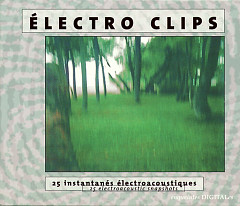
    The new CD Électro clips from the young Montréal label empreintes DIGITALes is a potpourri of twenty-five electroacoustic compositions. This is not a sampler compilation — that is, it does not contain excerpts of works found on other releases. These twenty-five pieces were commissioned specifically for this CD to represent twenty-five different artists working in the electroacoustic medium.

    The careful consideration of the concept and packaging of this CD help it succeed. Each piece is exactly three minutes long and the compact disc comes with a set of numbered, loose pages for each selection: a black and white snapshot is on one side and information about the composer and his or her piece is on the other. The numbers on the pages refer only to the program number on the CD. One may shuffle the pages and the order of pieces on the CD player to eliminate any sense of hierarchical ordering. The equal length of each piece combined with clear documentation gives each artist equal representation.

    Some of the pieces that interest me most are Mambo à la Braque by Javier Álvarez, Somewhere between by Craig Harris and Marimba Dismembered by John Oliver. Javier Álvarez is a Mexican composer whose Mambo à la Braque offers a more whimsical atmosphere that contrasts with the prevailing sombreness of the rest of the CD. Álvarez creates a “sound mosaic” using segments of a recording of Caballo Negro, a well-known mambo by Damaso Perez Prado. Álvarez preserves the recognizable sounds of mambo music while giving the piece a definite electronic slant.

    Craig Harris’s Somewhere between uses piano sounds for its source material. Different timbral variations on piano sounds are used freely to create a remarkable piece. It opens with the scraping of various strings and lowpitched sounds. Later, more melodically oriented material appears that is soon integrated into the initial texture.

    John Oliver’s Marimba Dismembered is described as “a dirge for Guatemala’s national instrument: a cry for an end to the genocide of the Mayan people”. The music alone does not make the same impression as the liner notes. It is not especially dirge-like and the political references are abstract enough that they wouldn’t exist without the liner notes. The music itseif is a fascinating study of marimba timbres. The slowed-down backward marimba sounds are easiest to identify and they run through most of the piece. The other sounds are electronically manipulated to such extremes that one is freed from any sense of their initial source.

    Électro clips represents a wide variety of aesthetic approaches to electroacoustic music. There is a healthy eclecticism of sonic experimentation, political statement, audio cinema, sound journeys and studies of sound sources that are both obvious and abstracted.

    The most successful pieces on this CD are the ones that used the limited time frame to their advantage. Pieces like John Oswald’s Bell Speeds or Daniel Scheidt’s What If made effective use of the time constraint by setting up a process that was followed throughout the course of three minutes. Another way composers made effective use of the time frame was by structuring the dynamic shape so that the dramatic material unfolded in effective proportions. This was achieved in Gilles Gobeil’s Associations libres by building toward a climactic section near the end. Since these pieces were specifically commissioned to be exactly three minutes long there was seldom a sense that these were simply short excerpts of longer pieces.

    The empreintes DIGITALes label is clearly dedicated to the needs of its artists; each composer on the Électro clips CD receives a full representation. I am pleased to note that this label plans to release other works by some of the artists found on this collection, and that a second pressing of this release has been made; the initial pressing sold out in less than six months.

    The empreintes DIGITALes label is clearly dedicated to the needs of its artists…

    Électro clips in Audion

    “Review”, Alan Freeman, Audion, no. 18, June 1, 1991
    Saturday, June 1, 1991 Press

    This CD certainly collates some of the most revolutionary and inventive electronic music composers in Canada today along with a few such explorers of other nationalities.

    Of course, a collectfon of 25 pieces on any other medfum other than CD would be most troublesome, especially, as is often the nature with electroacoustic music, spaces within tracks may be part of the music, and wlthout much melodic structure one track can seem to flow into another, even when subsequent tracks may be very different. The track index on the CD player makes it plain who you are listening to all the time. Thus a-part from being an excellent compilatfon it ls also a good sampler/reference tool for checking out the various artists featured.

    To review the individual tracks would be of course pointless — if you’re at all interested, let the music and informative collection of inserts do their own talking by introducing a world of music that certainly deserves wider recognition.
    empreintes DIGITALes in Son hi-fi vidéo

    “Or séries”, André Major, Son hi-fi vidéo, May 1, 1991
    Wednesday, May 1, 1991 Press

    Pour les compagnies de disques, la période des fêtes est synonyme de grande joie. Malheureusement, cette période de l’année ne fait pas que des heureux; plusieurs séries d’importance sont victimes de négligence «criminelle» et sont oubliées à la faveur d’artistes populaires qui, plus souvent qu’autrement, ne méritent pas autant de considération. Question de se faire bonne conscience, votre humble serviteur vous offre l’occasion de vous repentir et présente sans plus tarder trois séries dignes de mention.

    […]

    empreintes DIGITALes

    J’ai consacré une petite place à l’étiquette québécoise empreintes DIGITALes lors du dernier numéro. En fait ce label mérite beaucoup plus d’attention. Pour faire une longue histoire courte, je me suis familiarisé avec les gens du label empreintes DIGITALes lors du festival Montréal Musiques Actuelles (New Music America) de novembre dernier lors du lancement de l’album Électro clips. S’inspirant de la technique du vidéo-clip, chaque pièce est présentée sous la forme de vignettes de trois minutes; Électro clips est en ce sens l’album rêvé pour celui qui désire s’initier à la musique électroacoustique. Le plus récent album de cette série est Action/Réaction de Daniel Scheidt. La musique de Scheidt est très évoluée, elle donne à la voix humaine une place qui est trop souvent négligée par ce genre musical. J’aime beaucoup. Trois albums complètent cette série innovatrice, soit Ligne de vie: récits électriques de Christian Calon, un album réalisé dans la pure tradition électroacoustique, Lieux inouïs de Robert Normandeau qui est le médium parfait de la musique pour cinéma et enfin Volt d’Alain Thibault qui présente le compositeur le plus «branché» de cette ambitieuse maison. Le prochain album sous étiquette empreintes DIGITALes, Anecdotes, d’Yves Daoust, est prévu pour juin.

    En fait ce label mérite beaucoup plus d’attention.

    Action / Réaction in L’attention

    “Électricité”, Tony Esposito, Ti-Poue, L’attention, no. 4:7, May 1, 1991
    Wednesday, May 1, 1991 Press

    Depuis un an, l’étiquette empreintes DIGITALes a fait son chemin dans le monde de l’électroacoustique. Leur cinquième production vient de paraître, parallèlement à un spectacle intitulé Traces électro. Mais refaisons le chemin de la dernière année.

    - 31 janvier 90, lancement du compact de Christian Calon, doublé d’un spectacle à la Maison de la Culture Frontenac. Une heure et demie avec seulement des hauts-parleurs sur la scène, c’est visuellement… nouveau. C’est la découverte de l’électroacoustique.

    - 28 mars 90, deuxième compact, Robert Normandeau, avec spectacle légèrement plus visuel au Planétarium, mais ses sons nous rappellent trop les matraques des policiers que l’on vient juste de quitter.

    - 25 avril 90, c’est le tour du Montréalais Alain Thibault, bien connu ici pour son travail avec Carbone 14 et L’Écran Humain, au Belmont, malheureusement sans spectacle, mais avec vidéo.

    - 2 novembre 90, en plein festival Montréal Musiques Actuelles, c’est le lancement d’Électro clips, une compilation de 25 compositions de trois minutes chacune. Le tout accompagné d’un spectacle-écoute aux Loges.

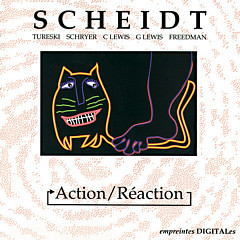
    - 22 février 91, lancement du cinquième disque, Action/Réaction, regroupant les œuvres interactives de Daniel Scheidt, au Western Front, à Vancouver. Début d’une tournée de concerts pancanadienne intitulée Traces électro qui, en deux semaines, se rendra jusqu’à Québec.

    - 6 mars 91, sortie montréalaise d’Action/Réaction et spectacle aux Loges. Deux compositeurs à l’affiche: le petit nouveau Scheidt et notre trésor électroacoustique Alain Thibault accompagnés de la soprano Catherine Lewis, du clarinettiste Claude Schryer, du pianiste Jacques Drouin, du percussionniste Trevor Tureski, de l’inoubliable soprano Pauline Vaillancourt.

    Daniel Scheidt travaille la relation entre sa composition et un élément musical externe, d’où les duos avec voix ou instruments.

    Alain Thibault s’abreuve plus à la source du rock ou du classique et donne ainsi une musique beaucoup plus accessible, à la puissance ravageuse. La pièce Le soleil et l’acier avec Pauline Vaillancourt: est sans doute l’œuvre la plus prodigieuse de notre spécialiste de la forme multi-média. Remercions les organisateurs de la tournée d’avoir pensé ajouter Thibault au programme.

    empreintes DIGITALes continue sur sa lancée. On nous promet une nouvelle parution pour le printemps, un monsieur Yves Daoust. Un certain Francis Dhomont se prépare également. On nous parle aussi d’un concert le 2 novembre à la Chapelle du Bon-Pasteur. Ils voient loin, nos amis. Avec raison.

    Vu l’intérêt grandissant de la clientèle étudiante, un prix de rabais est maintenant offert aux étudiant-e-s pour l’achat de toute la série.

    Soit dit en passant, Alain Thibault fera partie de la prochaine pièce de Carbone 14, Peau, chair et os. Il sera, encore une fois, accompagné de Pauline Vaillancourt qui vient tout juste de sortir un album solo.
    Ils voient loin, nos amis. Avec raison.
  • 689
  • 690
  • 691
  • 692
  • 693
  • 694
  • 695
  • 696
  • 697