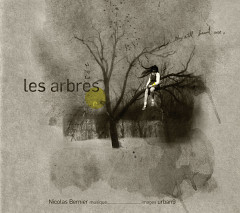
It is easy to see why two dynamic media, like music and film, should be able to complement each other. But what happens when the equation becomes asymmetrical and moving sounds are juxtaposed with static images? On Les arbres, Canadian composer Nicolas Bernier has joined forces with visual artist Urban9 to find out. A collection of six electroacoustic works and six accompanying postcards featuring paintings by his artistic partner, the album is an attempt of researching how different techniques of creative expression can be combined into a coherent new entity. As natural as the result has turned out after a collaborational process of four years, Bernier gladly admits to the challenging nature of the endeavour: “To create music on ‘static’ images was a hell of a deal!”, he says, “I see this music creation for static images as if I were adding a third dimension to the 2D image. Except that this third dimension is not ‘visual’, it is sound. With the music, I’ve tried to go deeper and explore what the images are suggesting. Is there sound in the picture? Is there somebody else near? Or far? Are we moving in front of it or are we still? Is it raining? Is it windy? Are we far or close?”
That, for sure, are a lot of open questions. But they are definitely leading somewhere. The images of Urban9 revolve around themes like childhood and a magical view of the world around us, humanity and nature or, on a more technical level, monochromatics and colour. Bernier’s music mirrors these sentiments without ever simply copying them. On the postcard to // Piano, two little girls are standing on an open field in front of a solitary tree at the edge of the forrest. Even though they are only metres apart, each seems to be caught in thoughts, unaware of the others’ presence, black specks covering up the contours of their faces. And yet, a rope is binding them together, as though to protect them from getting lost and from loosing sight of each other. It is a scene of great discomfort, of an uneasy tension waiting to be released and Bernier’s soundtrack, with its echoes of Jazz, slowly decaying Trumpet tones, glitchy beats and thundering piano clusters, does just that: At one point, he even allows the sky to explode in a burst of thunder, as if trying to wake the children from their horrific nightmare.
“Even tought we are often speaking about ‘static’ music, we could refute the theory that images are static because the mind is extrapolating so much with images. And the way our mind works is not static, it is moving in time”, Bernier elucidates, “The fact that Urban9 and me have been working together for a long time and the fact that we we’re sharing a common love for certain aesthetics and that we we’re attracted by the same kind of subject implied that everything went really smooth in our creative process. I was quite aware about his visual world and Urban9 was aware of my musical world. But the project did evolve a lot since the bigginning. Sometimes I was giving a new track to Urban9 and he was starting new images listening to it and vice-versa. Sometimes, the images he was sending to me were the starting point of a new piece… Or they were giving me some ideas to add or remove some material in an existing piece.”
Physical Qualities
Les arbres is not just yet another collaboration either. It documents an artistic friendship, which budded in one of the most trivial of environments: Their day job. Bernier and Urban9 were sharing an office in an agency for Web programming. Quite unlike any of his other colleagues, Urban9 turned out to foster a deep interest in experimental music and their conversations at work would suddenly be infused with discussions about new releases, sounds and their various projects. Coincidentally, a great record shop was just around the corner and both would happily spend their hard-earned money on the latest CDs and Vinyl — which, of course, would spark new talk and an even stronger bond. “Urban9 and me were sharing a strange fascination for electronic and “organic” visuals and musical landscapes. It’s like if we couldn’t assume the burden to work in a virtual world (the internet) all day”, Bernier remembers.
After contributing a track for the Urban9 homepage, the duo decided it was time for a more extensive collaboration. Because their quotidian routine already involved them surfing immaterial spaces, it was established that this project should have distinct “physical” qualities. In fact, for a long time, Les arbres was to be a combination of a book and DVD, which was only discarded at the last minute after no publisher was ready to take on the financial burdon of investing in it. This physicality was, of course, easy to achieve for the images. Awarding similar characteristics in terms of sound was less straight-forward and involved a deep, sonorous production, which seems to bulge out into the room, and a lot of acoustic instruments such as Vibraphones, Accordions, Cellos ans Trumpets. To match the stylistic integrity of the visuals, Bernier composed each piece using the same basic ingredients, while always avoiding obvious repetition. As a result, the images and sounds of Les arbres work both as works of art in their own right and as a multimedia experience which encapsulates its audience in a nostalgic, discreetly melancholic and romantic emotional bubble.
That, as it turns out, is what Bernier has been meaning to do ever since he got involved in scoring music: “My aim with music at the more basic level is to create a mood. This does not mean that I want to do background music, not at all acutally! To create music for other art forms is also to find the right mood, but instead of only creating a space by filling an architectural form (when the work is only musical), the music is completing the other art form by finding the right sound mood.” Towards the end of Les arbres, which dies down with the beautifully disharmonic digital brass band of // Ouverture, that mood is a silent kind of elation.


![John Young [Photo: Cecilia Young, Leicester (Angleterre, Royaume-Uni), juillet 2023]](https://res.electrocd.com/image.php/image/y/young_jo_13447.jpg?width=n2&cropratio=1:1)
![Annette Vande Gorne [Photo: Chantale Laplante, Ohain (Belgique), mai 2009]](https://res.electrocd.com/image.php/image/v/vandegorne_an.9883.jpg?width=n2&cropratio=1:1)