In his wide-ranging multimedia program at the 92nd Street Y, Seth Parker Woods used different artistic avenues as channels for personal and communal exploration.
The cellist Seth Parker Woods presented an evening-long, multimedia program titled Difficult Grace Saturday evening at the 92nd Street Y’s Kaufmann Concert Hall. It was the full staging’s world premiere, but, as Woods remarked, he had premiered a “nucleus version” in February 2020 in Seattle; the coronavirus lockdown gave him the opportunity to rework his concept into its current form.
Woods was already a cellist of prodigious technical gifts and sharp intellect. This program has stretched him even further into performing as a spoken word artist and singer as well as instrumentalist.
Aided by the choreographer and dancer Roderick George — a childhood friend from Houston — Difficult Grace was a feast for the ears, eyes and mind.
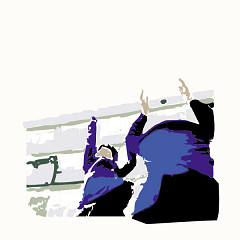
In one portion of Freida Abtan’s My Heart Is a River, the audience sees a prerecorded video projection of two dancers as Woods plays live in front of the screen. The dancing figures straddle a cello that they are reimagining as a boat. The performer in front — actually Woods himself, with dancer Tamzin O’Garro behind — is wielding the cello bow as an oar. It’s a marvelously apt metaphor: Woods is an artist rooted in classical music, but whose cello is a vehicle that takes him, and his concertgoers, on wide-ranging journeys.
The program included works by a large roster of composers, many of whom used electronic sound design as well as live acoustic cello: Fredrick Gifford, Monty Adkins, Nathalie Joachim, Abtan, Ted Hearne, Devonté Hynes and Pierre Alexandre Tremblay. (In addition to Coleridge-Taylor Perkinson, who died in 2004.)
Gifford’s piece Difficult Grace, which lent its name to the entire program, included projected artwork by Barbara Earl Thomas and was inspired by Dudley Randall’s poetry. Regrettably, it was difficult to discern from the auditorium seats much of what Woods was saying during long spoken-word stretches. (Projected supertitles would be a welcome addition.) The same was true during Hearne’s work with an unprintable title, with texts by the poet Kemi Alabi. Within the most riveting section of Hearne’s piece, Woods sang and played R&B-flavored harmonies atop hip hop-inspired electronic beats.
Each composer who used prerecorded cello and electronic sound design, sometimes with on-the-spot manipulations, did so to very different aesthetic ends. Woods performed two movements from Abtan’s piece (Opening Out and Seeping In), in which the electronics and the live cello swirled around each other in haunting, echoing duets. Adkins’s gentle, cinematographic Winter Tendrils, accompanied by an equally warmhearted film by Zoë McLean, used electronics almost like an invisible string orchestra, framing Woods’s cello in lush, glowing harmonies.
The most overtly narrative work was Nathalie Joachim’s The Race: 1915, which used projected images from the artist Jacob Lawrence’s Migration Series” and texts taken from The Chicago Defender, the Black newspaper that was founded in 1905 and urged Black Americans to move northward in what became the Great Migration. Joachim’s music alternated between busy, cyclical motion and periods of meditative, slow arcs.
The most traditionally “classical” piece during the evening was a technically demanding cello sonata written by Devonté Hynes, whom certain music-loving New Yorkers may recall from his recent stint opening for Harry Styles at Madison Square Garden.
The other fully acoustic work was the third movement from Perkinson’s Lamentations: Black / Folk Song Suite for Solo Cello, entitled Calvary Ostinato. Perkinson’s music evoked centuries of Black American music, between lavish pizzicato sections which called to mind the connections between the American banjo and West African plucked string instruments and bluesy slides from note to note.
The evening ended with a powerful duet between Woods and George dancing live onstage in Tremblay’s asinglewordisnotenough3 (invariant). It’s a piece that crackles with nervous, coiled energy. Woods often attacked his strings with furious intensity, while George’s dancing combined solid muscularity and sinuous movements. Somehow, all of these emotional currents found a home inside Tremblay’s score.

![Pierre Alexandre Tremblay [Photo: Alex Bonney, Londres (Angleterre, Royaume-Uni), mai 2021]](https://res.electrocd.com/image.php/image/t/tremblay_pi.11934.jpg?width=n2&cropratio=1:1)