electrocd
  • This website is also available in English.

Blog

4252 results
  • 96
  • 97
  • 98
  • 99
  • 100
  • 101
  • 102
  • 103
  • 104
  • Voyages in The Wire

    “Soundcheck”, Julian Cowley, The Wire, no. 391, September 1, 2016
    Thursday, September 1, 2016 Press

    One of the big beasts roaming the electroacoustic savannah, Jonty Harrison combines technological sophistication and psychological subtlety with insatiable hunger for sound. His hour-long Going / Places ranges far and wide, quite literally, grazing materials from around the globe: railroad horns from Ohio; bubbling geothermal pools in Iceland; calls to prayer in Istanbul; Mexican bagpipers; frogs in Borneo; market callers in Melbourne. A travelogue of bewildering discontinuities, it rushes on with the uplifting fluency of a dream. Voyages also features Espaces cachés, a series of scenes and apparitions also crafted from found sounds. Originally conceived in 30-track expansiveness, the piece is here condensed into unusually vivid stereo. And Harrison never allows studio expertise to sideline potential for enchantment.

    A travelogue of bewildering discontinuities, it rushes on with the uplifting fluency of a dream.

    Les lointains in The Sound Projector

    “Review”, Gunter Heidegger, The Sound Projector, August 3, 2016
    Wednesday, August 3, 2016 Press

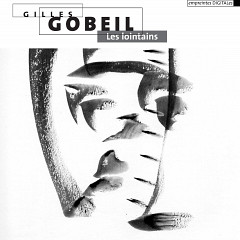
    My latest encounter with the estimable empreintes DIGITALes label following my recent review of Erik Nyström’s brings me in touch with Canadian composer Gilles Gobeil in what has proven to be one of the label’s less immediate releases, yet which becomes more threatening / welcoming with each play. That ‘five of the six works on this disc were realised while in residence in studios abroad’ might lead one to infer a psycho-geographical undercurrent to each, which is true at least in Les lointains noirs et rouges. Opens in a living room animated by its contents: a weaving together of innocuous objects like grandfather clock, and church — and doorbells that by and by reveals its true character: a psychodrama of hypnic jerks and electric shocks.

    Following this hurricane of free association, Castalie initiates shock treatment with incessant alarms, more machines and doors slammed by no visible human agency. Though ‘inspired freely’ by Hesse’s The Glass Bead Game, its moments of stillness have the lurking menace of a Thomas Ligotti factory upon the protagonist’s passive and helpless body. Moving deeper into Bol-Hydre, Gobeil sets a ‘stunning musical instrument… (which) produces weird, menacing sounds’ against the mythical, multi-cephalic monster whose immunity to decapitation was finally thwarted by Hercules. It’s a case of reading the instructions here: Gobeil’s ‘weird and menacing’ is indeed the rickety groan of whatever passes for dentist music in the infernal regions.

    Clearly more important to this collection than the geographical origins is its seat in the imagination, literary conceits being the order of the day, plus the odd whiff of radio drama. Drawn from The Aenid for instance, Sybille mixes moist whispers with yet more alarms and a dread-inducing drone through episodes of blackout, demonic intimacy and death by water, conveying a vapour-heightened state with unwelcome and unshakeable visions. Golem is perhaps the least startling piece here for the very reason that it’s pretty much a gestalt of everything else, though it’s unlikely that Gustav Meyrink would have disapproved of claustrophobic alarms (again), ticking clocks, and sudden swipes as an approximation of his paranoid Prague. In lieu of end credits, Des temps oubliés adds to this malaise a faint congregation of strings, choir, piano and gut-level rumbling, a human presence as distant from the listener as faceless bystanders in a nightmare. One though that the participant might feel reluctant to leave.

    … which becomes more threatening / welcoming with each play.

    Morphogenèse in The Sound Projector

    “Review”, Gunter Heidegger, The Sound Projector, July 29, 2016
    Friday, July 29, 2016 Press

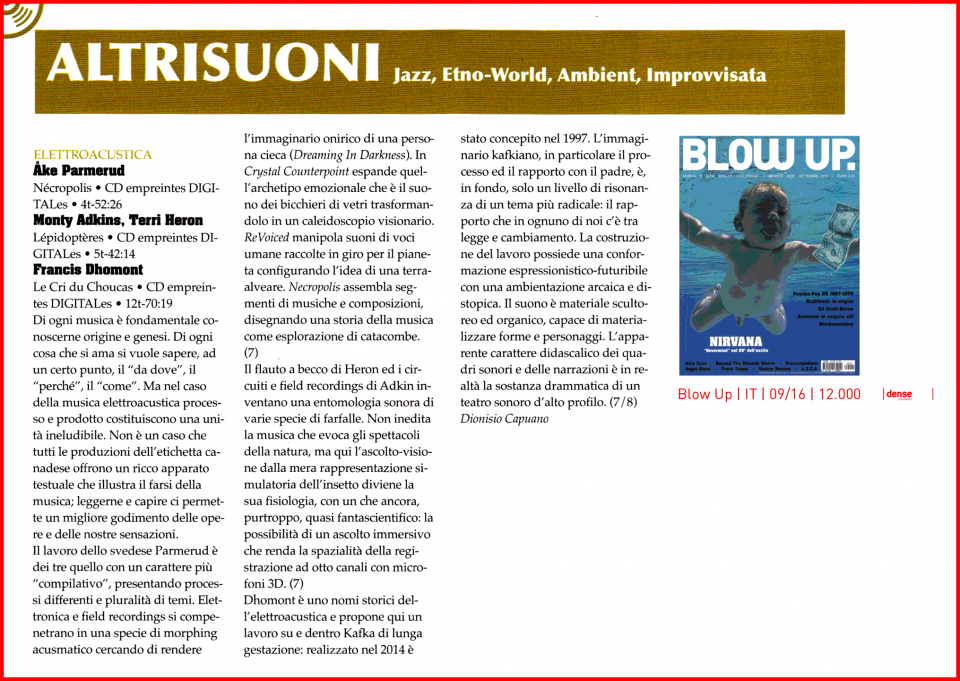
    ‘Music that produces its own forms in the continual weaving of a spatial fabric’ is how Swedish sound engineer and electroacoustician Erik Nyström likens ‘his’ music to seemingly arbitrary cosmogonic forces as they pass almost accidentally through humanly appreciable forms. Something of a Serious Seeker of ‘spatial textures in acousmatic music’, the dazzling descriptions of his four compositions don’t quite deliver the shock of primordial violence I’m somehow expecting, though I do get the feeling that these pieces are quite happy to be left to their own devices.

    Like a vague approximation of the Lorenz Attractor, the resounding void of Latitudes mutates like the weather filmed in time lapse, shifting too rapidly for our deep inner peace yet glazed with smoother surfaces than your usual jump-cut sound-editing shenanigans. This sounds quite typical of the empreintes DIGITALes establishment: sci-fi space-scapes and processed sounds turned inside out; their interior lives bleeding into infinity as our own universe is condensed into one of many microdots that go pinging off your shiny surfaces and windows.

    Lucent Voids adds squelches of mechanised bird twitter and virtual reality sea spray to this vertiginous feat of sonic telescoping, but with a little more rough-housing before the end of the rainbow. Unsurprisingly, Cataract is of the same stratosphere, providing similarly psychotropic scenery and eventual pre-landing disillusion. While far from bucking this trend, Far-from-equilibrium is a sort of hapless A.I. accident that might have bubbled out from a table-top improviser’s set of material-testing stretch and strain. The most dynamically vivid of the four pieces, it seems designed to disorient the listener into seeking respite back at the start of the CD, where things are unlikely to have remained the way they were.

    … their interior lives bleeding into infinity as our own universe is condensed into one of many microdots that go pinging off your shiny surfaces and windows.
  • 96
  • 97
  • 98
  • 99
  • 100
  • 101
  • 102
  • 103
  • 104