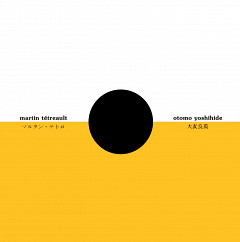
Martin Tétreault is a French Canadian from Montréal who performs with turntables. In London for LMC New Aura concert, he explained to Philip Tagney and Ed Baxter that he doesn’t have a sampler, but he does have a record called How To Train Your Dog.
Resonance: Can you tell us something about your background?
Martin Tétreault: First of all I was in fine art. I was involved in a conceptual approach, and I was cutting up paper. One day, I decided to cut up something else. I took a record, cut it into to slices, fixed side A with side B together with tape, put it onto record pickups and it worked. It all started from that.
R: So you had no formal music training, and you weren’t aware of other people experimenting with records?
MT: No, I did it alone. This was in 1984. Five years later someone asked me to collaborate in the Broken Music exhibition, and make a performance with Christian Marclay. Then I realised that some others had done the same as me, but I hadn’t known about them.
R: What are the aesthetic implications of what you are doing?
MT: I think right now I am changing. The work I did until now was mostly based on quotation, you know, taking a little part and adding it to another. I’m still doing that, but now I’m playing more with the physical, with the record itself, the noise it can produce. All the possibilities of the record itself, not only the music, but the object. You can cut it, splice it, scratch it, erase it, put paper on it, and so on.
R: Tell us something about your New Aura performance tonight.
MT: I’ve brought a lot of old turntables from Montréal. Some of them are called Calliphone, this was the turntable found in every school when I was a kid. Each turntable has its own possibilities and its own sound. I also have a Thecnics turntable—a friend of mine put a switch on it so I can play reverse and forwards at 100 rpm. And I use a balloon which I put around the tone-arm: I call it “frottophone”, and it creates a friction between the balloon and the record—it’s very funny to do it! I have some spoken word records, in Montréal I have a collection of maybe 200: How to Train Your Dog, How To Dance Disco, How To Save Your Life…
R: Do you see a problem maintaining an individual quality in the music you’re making? David Shea remarked that if you have too many elements in the sound, then it becomes a kind of continuum again. Do you think there’s an optimum level between not having enough material and using too much material?
MT: Too much material is dangerous. I realised that some weeks ago, because I buy a lot of records and I don’t have time to listen to them. After a show someone came up to me and said “Hey, you used a Bartok String Quartet”. I said that I didn’t know, because I don’t use the music because of who wrote it, but for the music itself. I have a selection of electronic music, drumming, guitar music, so when I want to make a cut I say OK, I’ll take a bit of electronic… this is a way I can build music.
R: So it’s like orchestration?
MT: Yes. And I can reproduce that many times. It’s not only improvisation. I make a mark on the record—I learned that in Bruire, a band that I play with in Montréal. Every night I had to play the same cut, it’s this record, at this place, at this moment, at this speed. It can be very precise. It’s like sampling, but it’s mechanical sampling. Someone asked me, “Why don’t you use a sampler?” I answered, “It’s not old enough. ” When no one is interested in samplers any more, that’s when I’ll use them!
R: Why? What’s the attraction of old technology?
MT: Mechanics! I’ve found new ways to use turntables, just through mechanics, varispeed and so on. I’m not yet ready to explore samplers. But I did some collaborations with electroacoustic musicians, and there’s a good balance, because their sounds are very real and clutured while with me it’s more Art brut. So if you put those things together… I’mvery interested in the larger scale—every sound has its own quality. There’s no sound better than another—it’s how, where, and why you use it.
R: I’m interested that you reject samplers. Essentially you’re interested in an end result, and its seems to me you could get the same result from samplers or CDs.
MT: For me the samplers is too much “itself”. You know the origin of the sound,and if I play this sound it will be this sound. But when I put on a record and I make a wrong move — whoops! — the needle skips and I have to play with that.
R: So does your music mostly depend on spontaneity?
MT: Yes, a part of it does. I prepare a road, and I have a place where I start, a place where I stop, and a place where I ask myself “Where am I going?” And the result is what we call the show.

![Michèle Bokanowski [Photo: Patrick Bokanowski, Paris (France), December 7, 2008]](https://res.electrocd.com/image.php/image/b/bokanowski_mi.5623.jpg?width=n2&cropratio=1:1)
![Robert Normandeau [Photo: Caroline Campeau, Montréal (Québec), September 3, 2021]](https://res.electrocd.com/image.php/image/n/normandeau_ro.12007.jpg?width=n2&cropratio=1:1)