electrocd
  • This website is also available in English.

Blog

4252 results
  • 662
  • 663
  • 664
  • 665
  • 666
  • 667
  • 668
  • 669
  • 670
  • Amore in Contact!

    “Review”, Ned Bouhalassa, Contact!, no. 8:2, June 1, 1995
    Thursday, June 1, 1995 Press

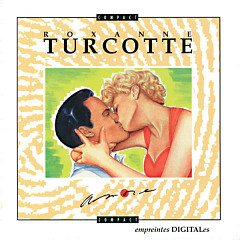
    The second disc, Turcotte’s Amore, contains the six parts of a single piece (with the same title as that of the CD) that necessitated four years of work (1988-92) in various studios. Featuring the spoken and sung voices of Judith Bergeron, Daniel Leduc and the composer herself, Amore is an electroacoustic tale, ‘seasoned with passion, humor and… love’ (CD booklet notes). Though Turcotte’s approach to storytelling brings to mind the work of other francophone composers, like France’s Pierre Henry and Michel Chion, she does not shy away from pop-influenced composition and timbres. While some of her instrumental writing suffers from the limitations of her tools (RAM-limited samplers), the spoken texts are witty and focused on the main theme (love). Relating the telephone dialogues and subsequent preparation rituals of two would-be lovers planning a date at the movies, T’es le fun téléphone is unquestionably the strongest section of Amore.

    Alchimie in Contact!

    “Review”, Ned Bouhalassa, Contact!, no. 8:2, June 1, 1995
    Thursday, June 1, 1995 Press

    Undoubtedly, the period beginning in 1985 and ending around 1991 will certainly go down as the ‘golden age’ of electroacoustic composition at the Université de Montréal. That six-year span would see a cluster of future internationally-renowned composers like Gilles Gobeil, Robert Normandeau, Stéphane Roy and Alain Thibault walk the same corridors and share studio time. Other composers like Michel A Smith, Denis Saindon, and Daniel Leduc would also realize outstanding works in their respective specialization (Multimedia, Live Electroacoustics, and Radio Art). Why, come to think of it, Christian Calon, though not a student, was working in the music library during some of those years!

    The fact that this was indeed a unique period is confirmed with the release of Alchimie (alchemy) and Amore (Love), two short-duration CDs (+/- 40 min). Mario Rodrigue and Roxanne Turcotte were also part of that illustrious group, and though there names may not be familiar to readers of Contact!, their work is as rich and polished as that of their former classmates.

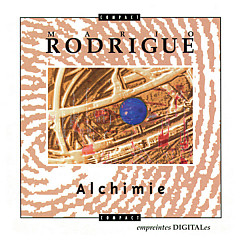
    Rodrigue’s Alchimie contains 5 acousmatic (solo tape) works covering an 8-year period. The first piece, Tilt (1986), is a short, dynamic ride in an imaginary pinball game. Chosen as best overall work in the 1986 CBC National Competition for Young Composers, it contains most of the elements that one finds in Rodrigue’s latter works: rich inharmonic tones (bells); tonal chords (pads) and progressions; short repeated rhythmic patterns; and most of all, lots of movement (dynamic stereo panning, montage). Of the remaining four works, it is Cristaux liquides (1990) that stands out, with its very colourful blend of anecdotal and abstract sound objects. Like Calon, Gobeil and Normandeau, Rodrigue’s work has been influenced by cinema, and virtually all of the works on Alchimie provide the listener with finely-crafted, vivid examples of ‘cinema for the ear.’

    … merveilleux exemples du «cinéma pour l’oreille».

    L’ivresse de la vitesse, L’ivresse de la vitesse 1, L’ivresse de la vitesse 2, Jean-François Denis, Paul Dolden in The Toronto Star

    “Chalmers Award Recipients”, Robert Crew, The Toronto Star, May 16, 1995
    Tuesday, May 16, 1995 Press

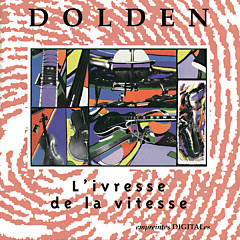
    Paul Dolden, winner of the composers’ award for L’ivresse de la vitesse, his 15-minute piece for [recorded] orchestra, Eastern instruments, choir and found sound objects, was praised by the jury for producing “an image of music for the next millennium.” A leading figure in Canada’s electroacoustic community, Dolden has had the same piece praised in London and Prague, where it won first prize in the Musica Nova ’94 International Competition.

    Jean-François Denis, winner of the presenters’ award, “is central to the growth and success of electroacoustic music in Canada.” He programmed an annual concert series featuring original works and Canadian premieres as a professor of electroacoustic music at Concordia University in Montréal from 1985 to 1989 and is one of the founders of the organization Canadian Electroacoustic Community. Denis’ magazines Contact! and Flash! and recording activities have had a widespread influence.

    A leading figure in Canada’s electroacoustic community… is central to the growth and success of electroacoustic music in Canada.

    L’ivresse de la vitesse, L’ivresse de la vitesse 1, L’ivresse de la vitesse 2, Paul Dolden in The Wire

    “Soundcheck Review”, Phil England, The Wire, no. 135, May 1, 1995
    Monday, May 1, 1995 Press

    Most people use the recording medium for purely documentary purposes; Paul Dolden’s project is to highlight the way the recording studio can create ‘impossible’ effects and musical events. This CD finds him multitracking up to 400 tracks of expanded orchestral instrumentation to create a kaleidoscopic music of dazzling complexity.

    Dolden’s stunning debut CD worked with the transmuting effect of speed — not speed as an end in itself, but as a gateway into another sonic and textural reality. L’ivresse de la vitesse, by contrast, sounds more conventionally orchestral. Wagnerian vocal passages give way to humour, fragmenration and objection. Aaron Copland and morning-in-America passages move into hyperspeed and cascade into huge, finely detailed washes of sound. Like Conlon Nancarrow or the New Complexity school, Dolden sets different tempos and time signatures against each other. Such a vast amount of musical information demands a new way of listening, the imposition of patterns on apparent chaos.

    Spiritually, Dolden seems to have plumped for being a postmodern rootless soul fascinated with surface. “Seduction threatens all orthodoxies with their collapse as it is a blacK magic for the deviation of all truths” he writes in the sleeve notes. He seems able to incite controversy witn ease. Since his appearance at last year’s LMC festival, idle talk has centered on his “objectionable” personality; one composer has even called for Dolden’s music to be banned for its alleged misogyny.

    This double CD (selling for the price of a single) also contains a number of works for instrumentalist and tape. Dolden magnifies tne tiny sounds made by the instruments and then uses them to surround the soloist along with his usual orchestral apocalypse. Francois Houle (soprano saxophone, clarinet) and Peggy Lee (cello) both worked on developing the parts and put in excellent performances here. Veils, the final 30 minute track, takes a different tack completely with dense, lush, sustained chords — possibly the final word on drone music, with a closing passage which will make your windows death-rattle.

    Dolden’s music is like viewing a landscape from a helicopter, or at Koyaanisqatsi hyper-motion: a postmodern lens through which to view complexity. Do not miss the work of this important “fin de siècle” artist.

    Do not miss the work of this important “fin de siècle” artist.

    Ne blâmez jamais les bédouins in The New Mexico Sun News

    “Avants In the Garden”, Dwight Loop, The New Mexico Sun News, April 1, 1995
    Saturday, April 1, 1995 Press

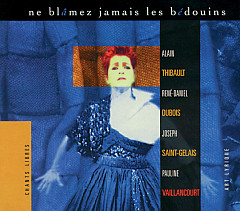
    Another Canadian label, DIFFUSION i MéDIA, is a consistent good bet for the new music seeker looking for an experimental “find.” Their modern opera recording of Ne blâmez jamais les bédouins featuring singer Pauline Vaillancourt, electronic music computer whiz Alain Thibault and a cast of other Phantom of The Opera-types is nothing short of unusually captivating.

    … a consistent good bet for the new music seeker…

    Les méandres du rêve in Contact!

    “Review”, Denis Dion, Contact!, no. 8:2, March 1, 1995
    Wednesday, March 1, 1995 Press

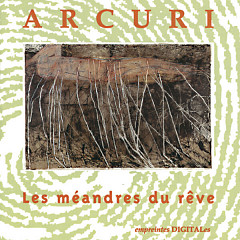
    Serge Arcuri has some new work out on empreintes DIGITALes. In Les méandres du rêve, the Montréal composer selected seven titles from his already very impressive collecion of works. The album’s title, roughly translated as ‘dream meanders,’ is representative of the works within. There is an interesting blend of pieces composed for tape which explore the genre of tape and live electronics. The works on the disc are: Prélude aux méandres (1985); La porte des sables (1989) for oboe or English horn, MIDI percussion and tape; Murmure (1989); Errances (1992) for oboe d’amore, harp and tape; Lueurs (1987) for horn, percussion and tape; Résurgence (1982); and Chronaxie (1984) for multiple percussion and tape.

    There is an inate sense of sonic poetry in Arcuri’s work. The musical journey often begins delicately, and subtly offers the listener a wealth of discoveries. This record is a good example of work by a composer who is in full command of his abilities. Arcuri’s journey is an adventure in technological innovation — in other words, the music comes first!

    I must also mention the other musicians involved: Lawrence Cherney on oboe, oboe d’amore and English horn, Trevor Tureski on percussion and MIDI percussion, Erica Goodman on harp, and the talented Francis Ouellet on [French] horn. The unique combination of instruments and tape testifies to the strong complicity that exists among these four great musicians. This type of writing is a study of the coming together of the instrument and electroacoustics, and these musicians do it beautifully. There is no hint of conflict or struggle between the genres, only a respect for the natural instrument and a desire to realize its full potential. It’s a successful union and leaves the listener with the pure pleasure of listening.

    Like all works from empreintes DIGITALes, this CD conforms to the labels’s policy of quality over quantity. Congratulations to the whole group!

    … un compositeur en pleine possession de ses moyens.
  • 662
  • 663
  • 664
  • 665
  • 666
  • 667
  • 668
  • 669
  • 670