Sauter au contenu principal
electrocd

Blogue

4252 résultats
  • 649
  • 650
  • 651
  • 652
  • 653
  • 654
  • 655
  • 656
  • 657
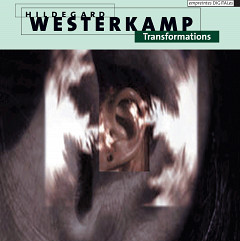
  • Transformations dans SOCAN — Words and Music

    «Review», SOCAN — Words and Music, 1 avril 1997
    mardi 1 avril 1997 Presse

    Vancouver composer Hildegard Westerkamp is treated to a complete CD of her works in a new release on the Montréal label empreintes DIGITALes (DIFFUSION i MéDIA). All four pieces derive their raw material from environmental sounds (car horns, construction noise, bird song, foghorns), which are then mixed and electronically manipulated in various fascinating ways. One work feature readings by poet Norbert Ruebsaat.

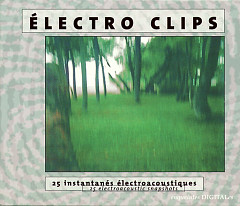
    Électro clips dans Alternate Music Press

    «Review», Ben Kettlewell, Alternate Music Press, 1 avril 1997
    mardi 1 avril 1997 Presse

    The small French-Canadian label known as empreintes DIGITALes has quietly become one of the world’s best sources for some of the most forward-thinking experimental music of recent years.

    This album contains 25 pieces commissioned by the label which all share the same time frame of 3 minutes in length. Composers from Québec, Canada, the United States, and Mexico participated. The music was commissioned to underline the 1990 New Music America festival in Montréal.

    The concept of the album is to merge popular song form (of a three-minute duration) with the concept of the video clip. This reactualizes electroacoustics by taking it out of the traditional concert hall and transporting it to the world of media, of clips, of miniatures, of the immediate… while still preserving the artistic integrity that electroacoustics demands today. The disc is in itself, a microcosm, presenting a synthesis of new electroacoustic creation as it is practiced in all its forms. Thus, presenting an opportunity to visit and revisit some of North America’s most dynamic composers.

    The album is a wonderful compilation of cutting edge new music. Artists include Michel A Smith, Craig Harris, Jean-François Denis, Francis Dhomont, Charles Amirkhanian, as well as others.

    John Oliver’s Marimba Dismembered is a haunting dirge written for Guatemala’s national instrument; a cry for an end to the genocide of the Mayan people. It exudes oblique melodies and harmonies, and goes well beyond your clinical academic style music.

    One of albums highlights is Point-virgule by Jean-François Denis. The timbres you hear were sampled and then edited and manipulated in Denis’ studio. Point-virgule was developed through five approaches, enunciated one after the other, and concludes with an exclamation point. It develops in an irregular meter providing metric vitality and dynamism.

    Another standout in this collection is a piece by Roxanne Turcotte called Minisérie. Its comprised of three short scenarios without words or images. The sound environment of a chase through different aspects of Alfred Hitchcock’s universe; the cinematic flavor of a Werner Herzog soundtrack, it creates a cinematic construction for the ears, and the imagination.

    In summary this is a great introduction to electroacoustic music, and establishes empreintes DIGITALes as one of the most viable and important experimental labels of the nineties.

    empreintes DIGITALes has quietly become one of the world’s best sources for some of the most forward-thinking experimental music of recent years.

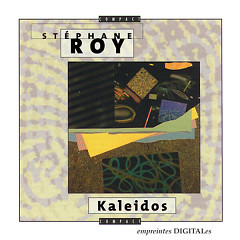
    Kaleidos dans SOCAN — Paroles & Musique

    «Critique», Claude Dornier, SOCAN — Paroles & Musique, 1 avril 1997
    mardi 1 avril 1997 Presse

    Intitulé Kaleidos afin de refléter le «fourmillement, éclatement, contraste et transparence» des quatre œuvres acousmatiques de Stéphane Roy qu’il juxtapose, ce recueil fait miroiter des pièces qui ont souvent valu à leur auteur des récompenses prestigieuses: Mimetismo, premier prix du Concours international Luigi Russolo (1992); Paysages intérieurs, deuxième prix du Concours national des jeunes compositeurs de Radio-Canada (1988); et Crystal Music, premier prix au Prix international de musique acousmatique Noroit-Léonce Petitot (1994).

    … des pièces qui ont souvent valu à leur auteur des récompenses prestigieuses…

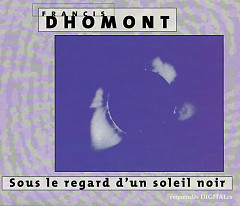
    Sous le regard d’un soleil noir dans Voir

    «Le disque de la semaine», Dominique Olivier, Voir, 27 mars 1997
    jeudi 27 mars 1997 Presse

    Premier volet d’un diptyque intitulé Cycle des profondeurs, Sous le regard d’un soleil noir était déjà paru sur vinyle en 1982. Il s’agit une réédition importante pour l’art acousmatique. Ce «mélodrame» de Francis Dhomont, un des pionniers de l’électroacoustique, s’inspire d’une réflexion sur la schizophrénie. Réflexion au sens premier, donc action de l’esprit qui examine et approfondit ses pensées. Chez Dhomont, cette réflexion est d’abord et avant tout artistique, puisque l’exploration de la citadelle intérieure du schizophrène par le compositeur produit une œuvre qui se justifie principalement par sa grande qualité musicale. Il s’agit bien d’une mise en musique, mais, plutôt que le texte, qui est utilisé ici à bon escient, c’est l’état du schizophrène qui est évoqué par les sons. Ce tour de force incroyable, ce défi artistique que s’est imposé Dhomont, est relevé avec un art d’une finesse et d’une force troublantes. Les sons créés par le compositeur réussissent bel et bien à nous faire approcher de cet univers cauchemardesque qu’en d’autres circonstances nous cherchons à fuir. Comme quoi l’art jette parfois des ponts entre nous et ce que nous n’osons pas voir. Une grande œuvre musicale.

    AVIS: Le texte reproduit ici est extrait du site de Voir et est protégé par la Loi sur le droit d’auteur du Canada. © Communications Voir Inc, 1997

    Ce tour de force incroyable […] est relevé avec un art d’une finesse et d’une force troublantes.

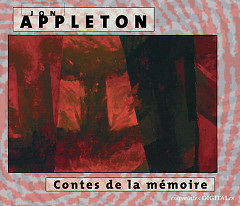
    Contes de la mémoire dans CMJ (College Media Journal)

    «Further Out», Robin Edgerton, Douglas Wolk, CMJ (College Media Journal), no 514, 24 mars 1997
    lundi 24 mars 1997 Presse

    Jon Appleton has been composing and constructing electronic music since the early ’60s, and a professor at Dartmouth for nearly as long. This career retrospective begins in 1966, with a few abstract tape pieces typical of the period (layered machine sounds, Moog cascades punctuated by sharp points). But he quickly turned a humorist’s ear to the world of sound — his Chef d’œuvre mixes amplified and distorted cooking noises with the overlapping, stretched and pinched voices of the Andrews Sisters singing a Chef Boy-Ar-Dee commercial. Times Square Times Ten peruses the elaborate soundscape of the New York landmark, then messes with it: sidewalks seemingly breathe and twist, subway and truck rumbles become overpowering, the whole area becomes taken over by a giant wind chime, then by elfin voices from a wax cylinder. Other highlights include a piece for altered voices that ends up sounding remarkably similar to Native American chanting, but disorientingly not quite, and two pieces made from responses people in airports gave to the question “What do you think of this new electronic music?” — made, respectively, in 1969 and 1996.

    Paul Dolden dans The Georgia Straight

    «Sonic Boom», Robert Jordan, The Georgia Straight, 20 mars 1997
    jeudi 20 mars 1997 Presse

    […] Far more engaging was Paul Dolden’s The Gravity of Silence. Resonance #5, for flute and piccolo (both excellently played by Chenoa Anderson) accompanied by taped sounds. The Gravity of Silence. Resonance #5 turned out to be a volte-face for the typically irascible Dolden — it sounded as though he was having fun sending up classical showpiece clichés. This tonal and melodious music is a long way from the noisy, chaotic territory his music usually explores.

  • 649
  • 650
  • 651
  • 652
  • 653
  • 654
  • 655
  • 656
  • 657